























Eight campers does not mean two RVs: decode campsite occupancy before booking
A four-column method for checking people, sleeping units, vehicles, tents, and visitors before booking one RV campsite for a group.

Eight campers does not mean two RVs: decode campsite occupancy before booking
By Romana | October 15, 2026 | RV Camping
Quick answer: A campsite's maximum head count does not tell you how many RVs, tents, cars, or overnight visitors it can hold. Check four separate limits before paying: people, sleeping units, vehicles, and parking space. If two households plan to bring two RVs, assume they need two sites unless the exact campground or group-site rules clearly allow both units.

A reservation form may accept eight names and still allow only one RV. It may permit a second car but not a second camper van. It may allow one RV and one tent, yet send a boat trailer to overflow parking. Those are different rules, even when the entire party fits below the site's people limit.
This matters most when friends converge from different directions, adult children sleep in a second van, or an RV group tries to save money by sharing one pad. Do the occupancy check before checkout, not while several rigs are blocking the campground road.
Build a four-column occupancy card
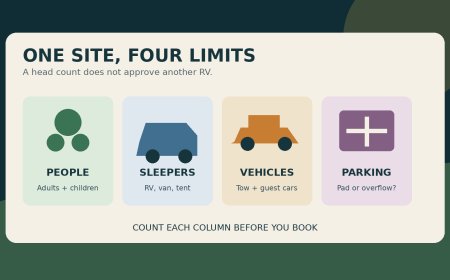
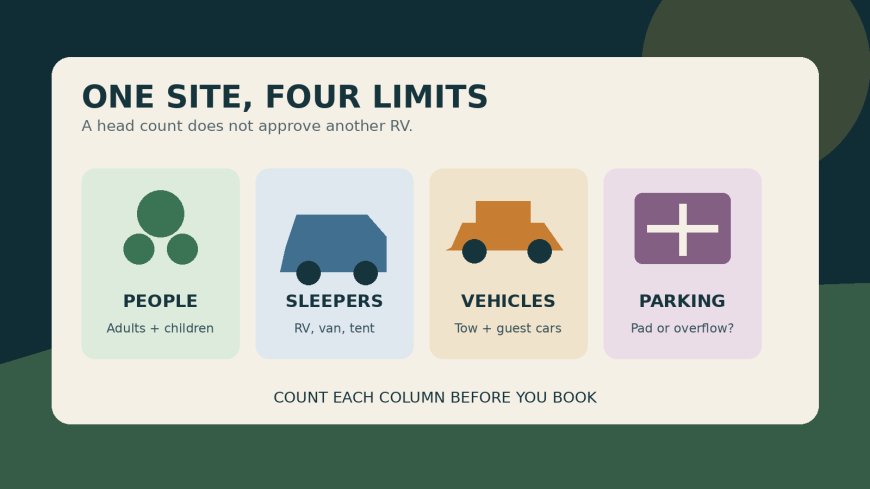
Write the campground, loop, site number, dates, and source page at the top. Then make four columns:
- **People:** adults, children, overnight guests, and any stated maximum.
- **Sleeping units:** motorhome, travel trailer, camper van, truck camper, tent, or hammock.
- **Vehicles and trailers:** tow vehicle, towed car, guest car, boat trailer, utility trailer, and motorcycles.
- **Placement:** what must fit on the paved spur or inside the campsite boundary, and what may use overflow parking.
Do not combine the columns into one vague note such as "site sleeps eight." Eight describes people only when the rule says people. It does not create permission for another RV.
The people limit is only the first gate
California State Parks' Silver Strand campground rules cap a campsite at eight people. The same page separately limits a site to three vehicles, including the RV, requires equipment to remain inside the registered campsite lines, and says an additional RV or trailer cannot be treated as an extra vehicle.[1]
Oregon State Parks makes the same separation in a different way. Its statewide FAQ says most sites allow eight campers, some allow six, and the park manager has the final say. It then states that only one RV is allowed per site; extra cars or trucks may be allowed at the site or in overflow parking, depending on the campground.[2]
Those examples are a warning against reading a maximum head count as a space allowance. A family of six in one trailer may comply. Three couples arriving in three camper vans may not, even though both groups contain six people.
Record the exact number of overnight occupants, including children. If someone plans to visit during the day and then sleep at the site, move that person into the overnight count before checking capacity.
Count anything used for sleeping as a sleeping unit
The most useful question for a second vehicle is not "Can we park it?" Ask, "May anyone sleep in it at this site?"
A regular car can be an extra vehicle. A camper van is both transportation and a sleeping unit. A truck with a slide-in camper is not merely a pickup for occupancy purposes. A rented travel trailer delivered to the pad still occupies the RV-unit allowance even if the renter arrives in a separate car.
Plymouth Park's current Recreation.gov page illustrates why the exact facility language matters. It says RV sites allow one RV and one tent, or two tents, with a maximum of eight people. Elsewhere in the same notice, a site is described as having space for a single sleep-capable unit and one vehicle; additional vehicles and boats use overflow parking.[4] Because those two statements can be read differently for an RV-plus-tent party, a traveler planning to use both should ask the listed park contact to confirm the exact site arrangement and retain the answer.
Do not solve mixed wording by choosing the sentence you prefer. Flag it as an open item. A short call is cheaper than arriving with a tent or second sleeper that staff cannot place.
Separate the tow combination from extra parking
Vehicle language is easy to misread because agencies classify tow combinations differently. Your card should list every item with wheels:
- motorhome;
- truck or SUV;
- travel trailer or fifth wheel;
- towed car;
- guest car;
- boat or utility trailer;
- motorcycles.
Then mark each item as a sleeping unit, tow unit, towed unit, or ordinary passenger vehicle. Ask whether the reservation fee covers it, whether it may remain on the pad, and whether overflow parking is available for the dates.
Washington State Parks tells campers to check the individual site description before bringing an extra car because space or nearby parking must exist. It allows a maximum of eight overnight occupants and says an overnight visitor still counts toward site capacity.[3] That is a useful distinction: paying an extra-vehicle fee may solve parking, but it does not increase the number of people or sleeping units allowed.
Physical fit remains a separate test. Even when a rule permits one RV plus another vehicle, both may need to stay on pavement. Measure the complete parked combination, not just the trailer box. Include the tow vehicle if it must remain at the site and note any rear carrier that extends the rig.
Day visitors can change the plan
A friend who stops for dinner affects parking even if that person leaves before quiet hours. A friend who stays overnight affects both parking and occupancy.
Washington allows day-use visitors, but its guidance connects overnight visitor parking to the site's eight-person capacity and the availability of extra parking.[3] Silver Strand directs campsite visitors to day-use lots rather than treating the campsite as unlimited guest parking.[1]
Add two lines to the reservation card:
- maximum or practical day-visitor parking;
- latest time a day visitor must leave or register for overnight use.
If the official page does not answer those questions, call the park. Do not promise a gathering at the site until you know where guests may park and whether the park limits the camping party.
Know when one site is the wrong product
Book another individual site or a legitimate group site when any of these is true:
- a second RV, camper van, or truck camper will be used for sleeping;
- the tent count exceeds the exact site's allowance;
- the complete combination cannot remain within the parking boundary;
- overflow parking is unavailable or cannot take a trailer;
- the party exceeds the people limit;
- staff cannot confirm how mixed or conflicting wording applies.
A group site is not automatically an RV group site. Confirm the number and type of RVs it accepts, the parking layout, hookups, arrival procedure, and whether individual vehicles owe separate fees.
Use a phone script that names the equipment
Avoid asking, "Can eight of us fit?" It invites an answer about people when your real problem is equipment.
Use this instead:
We are considering site [number] for [dates]. We will have [number] adults and [number] children. Equipment will be one [length] travel trailer towed by a [length] truck, plus one [length] camper van that two people intend to sleep in, and one passenger car. Which units may stay at the campsite, which may use overflow parking, and do we need a second site?
Write the date, time, number called, staff member's name if offered, and the answer. Then save the relevant rules page and your reservation confirmation. A call does not override a written rule, but it can resolve site-specific details the listing omits.
Recheck after any group change
Run the card again if someone adds a car, swaps a sedan for a camper van, brings a boat, or decides to sleep in a vehicle instead of the tent. The reservation may still have enough people capacity while failing the sleeping-unit or parking rule.
At arrival, keep the card simple enough to explain at the kiosk. Every person, sleeping unit, and vehicle should have a legal place. If one does not, the booking was never really for the whole group.
Sources
- Campground Rules and Regulations — California State Parks (accessed October 15, 2026)
- Statewide FAQ — Oregon State Parks (accessed October 15, 2026)
- Camping — Washington State Parks (accessed October 15, 2026)
- Plymouth Park — Recreation.gov (accessed October 15, 2026)
What's Your Reaction?