




















2026 Winnebago Boldt 70BL review: excellent twin-bed idea, legacy-model homework
Research-based 2026-context buyer guide to the Winnebago Boldt 70BL, covering model-year ambiguity, official specifications, owner reports, recall checks and used prices.

2026 Winnebago Boldt 70BL review: excellent twin-bed idea, legacy-model homework
Summary: Winnebago still presents the Boldt 70BL with a $245,587 starting MSRP, twin beds, a front dinette and a 12.8-kWh-class Pure³ power system—but the current page says “dealer stock only” and does not identify a 2026 coach model year. This research-based buyer guide treats it as a current-in-2026 legacy-model purchase, not proof that Winnebago built a 2026 Boldt.
Research disclosure: This is a desk-researched buyer guide, not a road test. RVCamping.info did not drive, inspect, weigh, rent, sleep in, purchase or otherwise test a Boldt.
Review identity
| Item | Reviewed identity |
|---|---|
| Manufacturer | Winnebago Industries |
| Model family | Boldt |
| Review date | October 13, 2026 UTC |
| Model-year basis | Current Winnebago marketing/specification pages retrieved in 2026; not a confirmed 2026 coach model year |
| Floorplan | 70BL, front dinette/flex bed, mid wet bath and galley, rear twin beds with flex-bed conversion |
| RV class | Class B diesel camper van |
| Chassis shown by current page | Mercedes-Benz Sprinter, 170-inch wheelbase; rear-wheel drive or optional legacy on-demand 4WD |
| Availability shown by Winnebago | Dealer stock only |
| Review method | Official page and rolling specifications, independent owner reports, NHTSA data and time-stamped listings |
The Boldt family is absent from RVCamping.info’s prior-365-day review manifest. That clears the duplication gate. The year label needs a separate warning: Winnebago’s current 70BL page contains specifications and a current displayed price, but no visible “2026” model-year claim, and it marks the floorplan dealer stock only.[1] The rolling specifications also describe the earlier 3.0-liter V6/7G-Tronic Sprinter and optional on-demand 4WD configuration rather than establishing a newly built 2026 coach.[2]
This package therefore uses “2026” as the publication and current-marketing context. A seller must prove the actual coach year, chassis year and installed equipment for any specific unit. Do not let the headline become paperwork evidence.
Bottom line
The 70BL remains an appealing couples’ layout. Two permanent-length rear beds avoid nightly sofa conversion, a flex-bed kit can bridge them, and the separate front dinette provides a place to eat or work without dismantling the bedroom. Winnebago says the dinette can become a third sleeping space, making the published capacity three.[1]
The trade-off is complexity and age ambiguity. The official page describes a four-module Pure Advanced Energy System, 3,600-watt inverter, 230 watts of roof solar, induction cooking, propane-backed Truma heat/hot water and multiple pumped drains.[1][2]
Those systems can support quiet camping away from hookups, but they also create more items to test than a simple AGM-and-generator van. Independent accounts include both enthusiastic reports about the lithium system and extended boondocking, and isolated reports of charging, wiring, drain-pump, awning, door and workmanship problems.[3][4][5]
Best fit: a couple that values separate rear twin beds, a real front lounge, all-season features and strong battery capacity—and is willing to audit a complex older coach carefully.
Skip it: buyers who need an unequivocally new 2026 model, simple systems, a large wet bath, a generous single gray tank, nearby one-stop chassis-and-coach service, or a low-cost entry into Class B ownership.
Official specifications: current 70BL page, not a verified 2026 build
The figures below are Winnebago’s current-page data as retrieved 2026-10-13 00:24 UTC. Winnebago itself says equipment, availability and price may change and directs buyers to confirm the exact vehicle with a dealer.[1]
| Specification | Official current-page figure | Buyer check |
|---|---|---|
| Exterior length | 22 ft 11 in | Measure with rear accessories installed [1][2] |
| Exterior height | 9 ft 8 in RWD / 9 ft 10 in 4WD | Measure the exact loaded van; roof gear changes clearance [1][2] |
| Exterior / interior width | 6 ft 4 in / 5 ft 10 in | Mirrors and awning project beyond body [2] |
| Interior height | 6 ft 3 in | Stand in bath, galley and bed aisle [2] |
| Wheelbase | 170 in | Plan for turning radius and rear swing [1][2] |
| GVWR / GCWR | 11,030 / 15,250 lb | Limits, not the completed coach’s actual weight [1][2] |
| Front / rear GAWR | 4,410 / 7,720 lb | Get an axle-by-axle scale ticket [2] |
| Hitch | 5,000-lb drawbar / 500-lb maximum tongue weight | Loaded axle and combined ratings still control [2] |
| Fresh water | 21 gal | Verify tank label and usable fill [1][2] |
| Black tank | 24 gal | Verify drain operation [1][2] |
| Gray tanks | 26/10 gal | Official formatting indicates split capacities; identify which fixtures feed each tank [1][2] |
| Fuel | 24.5 gal | Chassis specification [2] |
| Sleeps | 3 | Rear twins/flex bed plus small dinette flex bed [1][2] |
| Electrical | Four-module Pure³ pack, 3,600W inverter, 2 x 115W solar | Record module health, software and charge-source output [1][2] |
| Cooking / refrigeration | Single induction burner, microwave, 4.3-cu-ft 12V compressor refrigerator | Load-test together, not one appliance at a time [1][2] |
| Climate | Coleman-Mach 10 A/C; Truma Combi Eco Plus with two 850W electric elements | Test from cold on every supported energy source [1][2] |
| Warranty shown | 12 months / 24,000 miles basic | A used or legacy-stock unit may have no remaining coach warranty [1] |
| Current displayed starting MSRP | $245,587 | Dealer-stock-only page; excludes tax, title, license, delivery and options [1] |
A price is not a model-year certificate
Winnebago labels $245,587 as base manufacturer suggested retail price and excludes tax, title, license, delivery and optional features.[1] The page does not say the price belongs to model year 2026. Treat it as a current displayed reference price for the legacy 70BL configuration, not evidence of a factory-orderable 2026 unit.
The same caution applies to drivetrain language. The page describes the 3.0-liter V6 diesel, seven-speed automatic and optional on-demand 4WD.[1][2] A dealer may advertise a later coach year, but the VIN, Mercedes data card and Winnebago serial/build sheet decide what chassis and conversion you are buying.
Floorplan and daily-use analysis
Rear twins are the reason to choose the BL
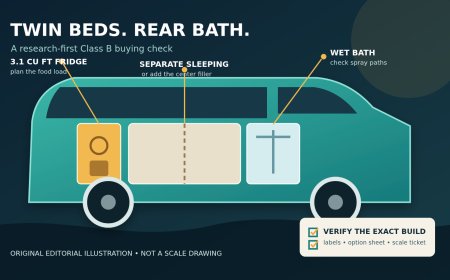
The permanent rear twin-bed arrangement keeps sleep separate from the front lounge. That is useful for different bedtimes and for leaving bedding in place. The official flex-bed kit can join the twins, but buyers should build it themselves, measure the resulting surface and test the center support. Open the refrigerator, bath and rear doors with the bridge in place.
Storage sits around and below those beds. An early BL owner liked the amount of storage but reported a fragile bed-support leg and awkward access.[3] That is one earlier unit, not a defect-rate study. It is still a good reason to lift every platform, inspect fasteners and confirm access to electrical and plumbing service points.
The front lounge works better as a lounge than as an adult bed
The forward-facing dinette provides a belted travel position and converts to a small flex bed. Winnebago counts three sleepers.[1] An owner who lived in an early BL found the dinette useful for meals but considered its fold-out bed suitable mainly for a child or smaller dog.[3] Build it at the dealership. Check cushion retention, length, edge support, seat-belt hardware and whether the bed blocks the aisle or door.
Never infer child-seat compatibility from a belt count. Inspect the specific seat structure and follow both the child-restraint and completed-vehicle instructions.
Wet bath and split gray-water system need a real shower test
The 70BL wet bath combines shower and toilet. Winnebago lists a wall surround, powered vent, Oxygenics showerhead and folding clothes rod.[1] The earlier full-time owner said usable room was tight and reported that the pumped shower drain screen required frequent cleaning. The same owner reported an overloaded fuse affecting the sink-gray macerator/tank-heater circuit on that early coach and later factory work.[3]
Those reports do not prove later units share the fault. They do explain why a pre-purchase inspection should put water through both sinks and the shower, identify the 26-gallon and 10-gallon gray circuits, run every pump and heater, and verify any service campaign or owner modification.
Power is the attraction—and the inspection risk
The Pure³ system is the Boldt’s defining feature. A Class B Forum owner praised quick alternator charging, generator-free use and the ability to run air conditioning from the battery under moderate settings.[5] The RGB Adventures owner described two cool-weather dry-camping nights with cooking and tank heaters before reporting about 10% state of charge remaining.[3] These are useful first-person examples, not controlled endurance tests.
Battery condition, temperature, appliance duty cycle and driving change the result. Ask for a full-capacity test by a qualified technician, not a dashboard percentage at delivery. Start near full charge, apply a documented load, record energy delivered, then demonstrate charging from shore, alternator and solar. Confirm that all safety campaigns and harness work are complete.
Payload, towing and service access
Winnebago publishes ratings but not an exact completed-unit occupant-and-cargo allowance on the current page.[1][2] Options, water, occupants, a bike rack, batteries and tongue weight all consume payload. Read the yellow cargo label and weigh the travel-loaded van by axle.
Service can split between Mercedes, Winnebago and component suppliers. One 2022 owner described long travel to dealers after hot house-battery wiring, an awning problem and a later chassis failure.[4] Whatever the ultimate causes, the account shows the cost of buying a complex coach without a nearby service plan. Before purchase, identify one shop for Sprinter work and another for Winnebago/Volta/Truma systems, and get both to confirm they will accept the VIN.
What independent owners report
The available independent evidence is mostly from 2020–2022 coaches. It is relevant to a used purchase but cannot predict every Boldt.
- Livability positives: owners praised the separate dinette, twin beds, storage, Mercedes driving comfort, Truma heat and the ability to camp without a generator.[3][5]
- Electrical positives and concerns: one owner reported useful battery endurance, while another forum owner celebrated fast alternator replenishment. Separate owners reported hot wiring or charging problems, making campaign completion and a measured load test essential.[3][4][5]
- Water-system concerns: the early BL review described a sink-gray macerator/fuse issue, frequent shower-drain screen cleaning and small fresh/sink-gray capacity as practical constraints.[3]
- Fit-and-finish concerns: that same early owner reported refrigerator hinges, screen installation, counter fit, reversed shower controls and bed-support hardware, followed by factory repairs.[3]
- Service geography: the 2022 owner’s account emphasizes that coach and chassis repairs may send the van to different facilities far from home.[4]
These reports are inspection leads, not proof of a universal defect. There are too few matched-year, matched-floorplan reports to calculate reliability rates.
New purchase path and current price evidence
Winnebago’s page says dealer stock only, links to inventory, and displays a $245,587 starting MSRP with explicit exclusions.[1] At 2026-10-13 00:24 UTC, this research did not verify a live, priced, newly built 2026 Boldt 70BL listing. That absence is consistent with the page’s legacy/dealer-stock presentation, but it does not prove no unsold unit exists.
Purchase paths: search Winnebago’s inventory from the model page, use the official dealer locator, and ask a dealer to identify every Boldt by coach serial and VIN.[1][9] For any unit advertised as new, request the original window sticker, factory build sheet, in-service date, warranty status, battery commissioning record and a written out-the-door quote. Make a deposit refundable pending those documents, recall completion, independent inspection and a loaded scale ticket.
Do not compare an old-stock discount against $245,587 without matching coach year, chassis year, drivetrain, option content, storage history and warranty start date.
Used-market snapshot
The following asking prices were observed at 2026-10-13 00:24 UTC. They are not transaction prices, appraisals or a market value. All three were advertised as 2022 coaches.[6][7][8]
Their published VINs decode through NHTSA vPIC as 2020 Mercedes-Benz Sprinter chassis years—a concrete example of why coach year and chassis year must be recorded separately.[12][13][14]
| Marketplace / seller | Advertised unit | Mileage | Ask at capture |
|---|---|---|---|
| Camping World, Longmont, Colorado | Used 2022 Boldt 70BL, stock 1010514P, VIN ending 8492, 4x2 | 58,488 | $118,898 [7][13] |
| La Mesa RV / RecVan, West Sacramento, California | Used 2022 Boldt 70BL 4x4, stock DT217703, VIN ending 3661 | Not exposed in captured evidence | $129,998 [6][12] |
| Lichtsinn RV, Forest City, Iowa | Used 2022 Boldt 70BL 4x4, stock 902000B, VIN ending 8861 | 52,573 | $124,900 [8][14] |
Camping World states that its sales price excludes tax, title, license and governmental fees, while other fee treatment depends on location.[7] La Mesa’s indexed listing showed a prior $134,998 price and a $129,998 ask.[6] Lichtsinn labeled $124,900 a retail price and invited buyers to request its best price.[8]
The sample covers three dealer marketplaces but only one advertised coach year. Mileage, 2WD/4WD configuration, paint, accessories, service history, recall status and battery health differ. Compare total out-the-door cost after an inspection, not the bold number alone.
Recall and exact-VIN check
NHTSA’s model-level API returned campaign 21V793000 for the 2022 Winnebago Boldt. The filing says certain 2021–2022 Boldt vehicles may have an incorrectly built wire harness that can lose over-current protection, allowing wires to overheat and increasing fire risk; the remedy is harness replacement and connection inspection.[10]
A model-level result does not establish whether a particular van is open, completed or unaffected. Run the full 17-character VIN at NHTSA’s recall lookup on inspection day, save the result, and also ask Winnebago and Mercedes-Benz for open safety recalls, service campaigns and completion records.[11] Repeat the check immediately before closing because recall data and remedy status can change.
Model-specific used-unit inspection checklist
- Match the 17-character VIN, title, registration, Winnebago serial number, completed-vehicle label and seller’s advertised 70BL identity.
- Record coach model year, Sprinter model year, Winnebago completion date and every warranty in-service date separately.
- Obtain the original window sticker and factory build sheet; reconcile drivetrain, paint, windows, racks and every option.
- Decode the VIN and confirm 2WD versus 4WD, engine and chassis year; never rely on a listing badge.
- Run the exact VIN through NHTSA, Winnebago and Mercedes recall/campaign systems on inspection day.
- Require documentation for campaign 21V793000 where applicable; inspect the repaired harness and connections with a qualified technician.
- Read the yellow occupant-and-cargo label, then weigh the loaded van by front and rear axle.
- Measure actual travel height, overall length and width with A/C, antenna, awning, ladder, box and rack.
- Inspect the roof, windows, awning mounts, body seams, running boards and all penetrations with a moisture meter where appropriate.
- Record every Pure³ module’s identifier, age, firmware, fault history, temperature history if available and remaining warranty.
- Perform a documented battery capacity/load test rather than accepting the state-of-charge display alone.
- Demonstrate charging from 30-amp shore power, the under-hood alternator and both roof-solar inputs.
- Run the A/C, induction cooktop, microwave and refrigerator under controlled combinations while logging voltage, current and inverter temperature.
- Inspect high-voltage and low-voltage cabling, disconnects, fuses, grounds, strain relief and service labels; reject undocumented alterations.
- Confirm the battery’s cold-weather protection and the seller’s storage/charging procedure.
- Start the Truma Combi from cold on each supported fuel/energy mode; check heat, hot water, exhaust and fault codes.
- Fill the fresh tank, pressurize the plumbing and inspect pump cycling, filter, fittings and winterization valves.
- Identify which fixtures feed each gray tank; fill and drain both circuits and demonstrate every macerator or transfer pump.
- Clean and inspect the shower-drain screen/pump access; confirm the bath drains at the van’s normal camping attitude.
- Flush the black tank, inspect termination valves and verify the hose and exterior service center do not leak.
- Build both rear twin beds and the flex-bed bridge; inspect slats, supports, hinges and access to under-bed systems.
- Convert the front dinette to its flex bed; measure usable length and test cushion retention and aisle clearance.
- Inspect every belt, seat pedestal, swivel, slide, head restraint and anchor; verify child-restraint suitability from documentation.
- Cycle the powered sliding door repeatedly on level and modestly sloped ground; check manual operation and pinch protection.
- Extend and retract the awning while inspecting fabric, arms, motor housing, mounts, wind sensor and manual override.
- Inspect refrigerator door hinges and latch, cabinet veneer, drawer slides, counter-to-wall fit and screen-door alignment.
- Test bath hot/cold orientation, showerhead height, vent, seals, privacy and nearby cabinetry for moisture damage.
- Check tire DOT dates, matching load ratings, pressure history, brakes, steering, alignment, suspension and chassis scan results.
- Review diesel service, emissions-system history, fan/accessory-drive repairs and all Mercedes maintenance records.
- Confirm hitch label, tongue load and towing plan against the actual axle weights and 15,250-pound GCWR.
- Verify that nearby Mercedes and RV service facilities will accept this VIN and its installed coach components.
- Make the sale contingent on clean title/lien history, independent RV inspection, chassis inspection, records, keys and manuals.
Alternatives worth comparing
- Pleasure-Way Plateau TS: a long Sprinter couples’ van with rear lounge/bed rather than permanent twins; compare dealer support and battery architecture.
- Winnebago Travato 59K: shorter gas-powered twin-bed van with a more current production identity; compare bed width, generator/power package and front lounge.
- Airstream Interstate 24GT: a more passenger-oriented extended Sprinter; compare seating, bed conversion, price and service reach.
- Coachmen Beyond 22C: Ford Transit gas alternative with a rear lounge; compare chassis service availability, wet bath and usable payload.
Compare exact-year paperwork and unit labels. Similar layouts do not make batteries, drains, warranties or weights interchangeable.
Methodology, limitations and disclosures
This review uses Winnebago’s current product page and rolling specification page as the official baseline. Because neither captured page visibly identifies a 2026 coach and the product page says dealer stock only, this article does not claim that a factory-built 2026 Boldt 70BL exists. The headline reflects the 2026 review date/current-page basis; the review identity box controls.
Owner reports come from earlier coaches and are presented as attributed experiences, not a reliability survey. Dealer pages and indexed search evidence support only the identified listings at the stated timestamp. Asking prices can change or disappear. No dealer was contacted, no VIN was physically inspected, and no transaction price was obtained.
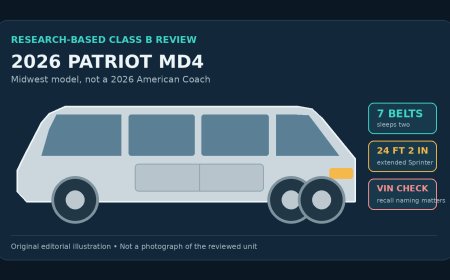
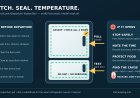
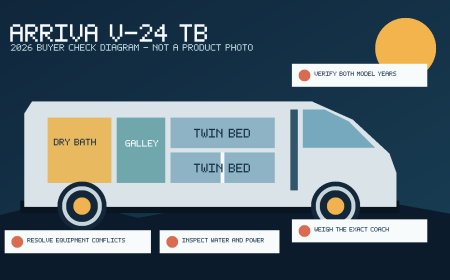
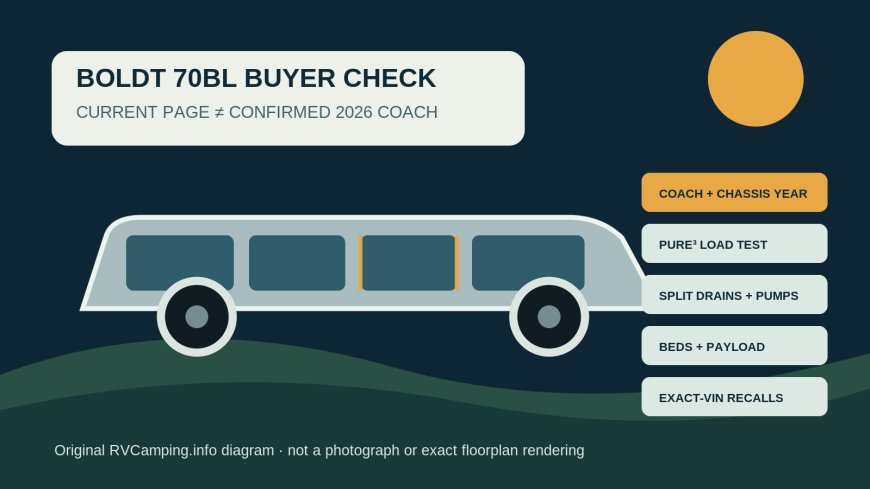
No exact Boldt 70BL photograph with an explicit license permitting commercial editorial reuse was found in the targeted rights search. Manufacturer, dealer, marketplace and forum images were not reused. The lead image is an original 1600-by-900 non-photorealistic buyer-check diagram; it is not a photograph or exact floorplan rendering.
No video is embedded. No thumbnail or frame was downloaded or reused.
Affiliate disclosure: This article contains no affiliate links, paid placement, dealer lead tracking, RVshare tracking or manufacturer sponsorship. All purchase and listing links are ordinary, untracked evidence links.
Sources
- Winnebago Boldt 70BL current product page
- Winnebago Boldt rolling specifications
- RGB Adventures Winnebago Boldt BL owner review
- Winnie Owners: problems with a 2022 Boldt
- Class B Forums: Winnebago Boldt owner discussion
- La Mesa RV used 2022 Boldt 70BL 4x4
- Camping World used 2022 Boldt 70BL
- Lichtsinn RV used 2022 Boldt 70BL 4x4
- Winnebago dealer locator
- NHTSA recalls by vehicle: 2022 Winnebago Boldt
- NHTSA recall lookup
- NHTSA vPIC decode: La Mesa listing VIN
- NHTSA vPIC decode: Camping World listing VIN
- NHTSA vPIC decode: Lichtsinn listing VIN
What's Your Reaction?