




























Dry ice in an RV cooler: solve the cold problem without creating a cabin hazard
Use a vented cooler, an outside-air cargo location and protective gear so dry ice keeps food cold without releasing carbon dioxide into the RV cabin.

Dry ice in an RV cooler: solve the cold problem without creating a cabin hazard
By Romana | October 15, 2026
Dry ice can keep food frozen when shore power fails or a long travel day outruns ordinary ice. Inside an RV, though, it creates a second problem while solving the first. Dry ice turns directly into carbon dioxide gas. A cooler that releases that gas into a cab or living space can make the air unsafe without producing a smell or a visible warning.
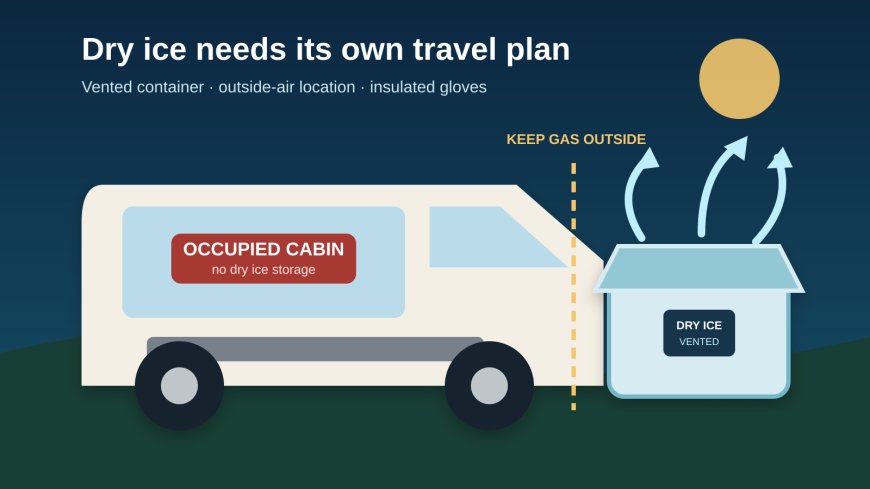
The safest RV plan starts with a blunt question: can the dry ice stay outside every occupied and sleeping space while its container remains able to vent? If the answer is no, use block ice, frozen gel packs or a powered cold-storage option instead.
Treat the transport decision as the first safety check
A CDC investigation documented a driver who put 100 pounds of dry ice in paper bags on the front seat of a pickup, closed the windows and set the air conditioner to recirculate. He developed breathing difficulty after about a quarter mile and later lost consciousness. CDC says poor ventilation during dry-ice transport, storage or use can cause harmful carbon dioxide exposure, including death.[1]
An RV combines the features that make this warning matter: a small interior, connected driver and living areas on many rigs, sealed windows during travel, and people who may sleep near cargo. Do not treat a dinette, shower, under-bed bay, pass-through connected to the cabin, or towed-vehicle passenger area as harmless storage simply because nobody plans to open the cooler there.
Use this go/no-go test before buying dry ice:
- Where will it ride? It needs a location isolated from occupants and pets, with continuous outside-air ventilation appropriate for the quantity and container. A separate pickup bed may meet that separation better than an SUV, van, motorhome cabin or travel-trailer interior.
- Can the cooler release gas? CDC says dry ice belongs in a container that allows gas to escape, such as a vented cooler, and never in a tightly sealed container.[2]
- What does the vehicle or cooler maker allow? Read both manuals. Do not put dry ice in a compartment that contains batteries, fuel, propane equipment, ignition sources or components whose instructions prohibit cargo.
- Who could enter the area? Children, pets and another traveler must not be able to touch the dry ice or climb into its storage space.
- What is the fallback? If any part of the route cannot maintain separation and ventilation, change the cold source before departure.
A cracked window is not a substitute for a designed storage plan. Airflow changes with vehicle speed, fan settings, wind and parked conditions. The CDC case occurred with the climate system recirculating cabin air, but switching a dashboard control is not a general guarantee of safe carbon dioxide levels.[1]
Buy only after the cooler and route are ready
Ask the dry-ice supplier how much is needed for the cooler, food load, trip duration and ambient conditions. Avoid copying a household-freezer quantity into an RV cooler. USDA's emergency guidance says dry ice can help during a prolonged outage, but its example uses an 18-cubic-foot freezer. That is not a dosing formula for a portable cooler or small RV refrigerator.[3]
Bring insulated gloves and eye protection to pickup. CDC describes dry ice as a cryogenic material that can cause severe frostbite after skin contact and recommends gloves intended for very cold temperatures plus safety goggles.[2] Keep it out of reach while loading. Never put a piece in a drink, let children handle it for a fog effect, or hold it with a dish towel that can shift and expose skin.
Label the cooler plainly: "DRY ICE: VENTED CONTAINER. DO NOT TOUCH." Add the purchase time and starting amount if the supplier provides it. Tell every adult in the group where it is and why the lid or vent must not be taped shut.
Pack the food without sealing the gas in
Start with food that is already cold or frozen. Dry ice is a cold source, not a repair for food that spent too long warm. Put food in packaging suitable for freezing and protect it from direct contact with dry ice. USDA specifically cautions against touching dry ice with bare hands or placing it directly against food.[3]
Follow the cooler manufacturer's arrangement and the supplier's instructions. Use a separate appliance thermometer where it can be read without prolonged rummaging. If the goal is to keep refrigerated food rather than frozen food, dry ice may be too cold for some items and packaging; frozen gel packs or block ice can be easier to manage.
Do not improvise a gasket, latch or tape wrap that makes the cooler airtight. Carbon dioxide must escape as the dry ice sublimates. A bulging container, stressed latch or hissing improvised vessel is a stop signal. Move people away rather than leaning over it or forcing it open.
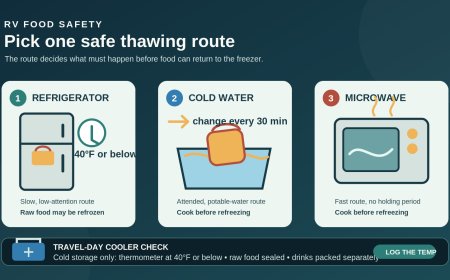
Food status still depends on measured temperature. Dry ice may disappear before the trip ends, and a cold-feeling package is not a temperature record. For refrigerated perishables, USDA uses 40°F or below as the safe cold target in emergency cooler guidance.[3] Keep a written reading at departure and at planned stops. If the cold source is gone or the temperature history is not acceptable, follow the applicable discard guidance rather than tasting the food.
Run pickup, travel and arrival as separate phases
At pickup
Load the prepared vented cooler directly into the approved unoccupied location. Do not set dry ice on a seat or floor "just for the drive back." Secure the cooler against sliding and impact without blocking its gas-release path.
During travel
Keep occupants and pets out of the storage area. Do not move the cooler into the RV because of rain, theft concerns or a rough road unless the new location independently passes the same separation and ventilation test. If you smell nothing, that proves nothing; CDC describes carbon dioxide as colorless and odorless.[1]
Headache, dizziness, confusion, unusual rapid breathing, shortness of breath or loss of coordination near dry ice calls for immediate action. Get everyone to fresh air, call 911 for serious symptoms or loss of consciousness, and tell responders about the dry ice. Do not re-enter a suspect compartment to save the food.
At camp
Do not bring the dry-ice cooler into the RV, tent, screen room or enclosed vehicle overnight. Keep it in the approved outside-air location, protected from tampering and campground traffic. Never store it in a bear box, locker or other sealed container unless the responsible agency explicitly designed and approved that setup for dry ice.
Open and handle it outdoors in a well-ventilated place. Put on the gloves and eye protection before touching any remaining pieces. Keep your face away from the opening and do not invite children over to watch the fog.
Disposal is a ventilation task, not a trash task
CDC says not to put dry ice in a sink, toilet or trash. Let it sublimate from a container that is open to the air, in a place with ample ventilation.[2] At a campground, that also means choosing a secured location where visitors, pets and wildlife cannot contact it. Ask campground staff before leaving any container outside; local rules and wildlife precautions still apply.
Do not abandon dry ice in a fire ring, dumpster, bear-resistant trash can or closed storage locker. Do not pour water over it inside the RV to make it disappear faster. If you cannot provide a secure, ventilated disposal location, ask the supplier to take it back or choose a different cold source from the start.
The practical RV default
Dry ice is useful when the transport and storage system was designed around it. It is a poor improvisation for a refrigerator problem after the campsite power fails.
For most trips, block ice and frozen gel packs are simpler because they do not release carbon dioxide gas. Choose dry ice only after the cooler, cargo location, ventilation, protective gear, food packaging and disposal plan all pass inspection. The food is not worth moving an invisible gas hazard into the room where people drive or sleep.
Source note: This RVCamping.info workflow applies CDC dry-ice exposure and handling guidance plus USDA emergency food-temperature guidance to the small, occupied spaces of an RV. It does not replace the dry-ice supplier's instructions, vehicle manual, cooler manual or emergency advice.
Sources
- Acute Illness from Dry Ice Exposure During Hurricane Ivan — CDC MMWR; vehicle-exposure case, carbon dioxide properties, symptoms and ventilation warning.
- Dry Ice Safety for Healthcare Professionals — CDC; insulated gloves, eye protection, vented-container, ventilation and disposal guidance.
- Keep Your Food Safe During Emergencies — USDA FSIS; 40°F cold target, emergency cooler use and dry-ice contact cautions.
What's Your Reaction?