


























Shurflo 4008-101-E65 review: a good RV pump, if the suffix fits
Research-based Shurflo 4008-101-E65 review covering suffix fit, 12-volt wiring, plumbing, noise, maintenance and limits.

The Shurflo Revolution 4008-101-E65 is a sensible replacement for a common 12-volt RV fresh-water pump when the circuit, connector, plumbing and mounting space all match.[2][3] Pentair rates it for 3.0 gallons per minute at zero pressure, a 55 psi shutoff and intermittent duty.[1][2] Buy it if you need a three-gallon-per-minute demand pump for an ordinary multi-fixture RV system and can install it with the required strainer and flexible hoses.[2][3] Skip it if you need continuous high-pressure service, a 24-volt or 115-volt pump, more flow, or a guaranteed plug-for-plug replacement based only on the "4008" name.[2][3][5]
The tradeoff is not raw performance. It is installation discipline. The E65 can be quiet and smooth when it gets adequate wire, open plumbing, vibration isolation and a clean inlet.[3] Put it against rigid pipe, starve it through a clogged strainer or assume every 4008 suffix uses the same connector, and the simple swap becomes a troubleshooting job.[3][5]
This is a research-based review. RVCamping.info did not purchase, install, use or physically test the Shurflo 4008-101-E65. The verdict comes from Pentair's current product page, technical sheet and installation manual, the exact Amazon listing, replacement guidance and an attributed owner report.
As an Amazon Associate, RVCamping.info earns from qualifying purchases. If you buy through an Amazon link in this article, we may earn a commission at no additional cost to you.
Check the Shurflo 4008-101-E65 listing on Amazon. Confirm the full E65 suffix, 12-volt rating and seller before ordering.
The exact model reviewed
This article covers the Pentair Shurflo Revolution 4008 Series aftermarket pump, model 4008-101-E65.[1][2] The matching Amazon listing is ASIN B002XM5G70 and names the full model in its title.[4] Pentair's data sheet pairs the E65 with OEM model 4008-101-A65 and publishes the same core specification set for both.[2]
That A65/E65 cross-reference does not make every 4008-101 pump interchangeable.[2][5] The full suffix can identify an OEM wiring or connector variation.[5] In one etrailer replacement discussion, a Winnebago 4008-101-F65 owner was told that an E65 could replace it only with wiring changes because the F65 used a different connector.[5] Treat that as a warning to inspect your own pump, not as proof that every F65 installation is identical.
Before buying, photograph the old label and compare:
- the complete model number, including its suffix;[2][5]
- 12 V DC input;[2]
- positive and negative wire or connector arrangement;[3]
- the fuse, switch and any pump controller rating;[3]
- 1/2-inch-14 NPSM male ports and existing swivel fittings;[2]
- mounting footprint, hose direction and service access;[3]
- required flow and pressure for the RV's fixtures.[2][3]
An RV maker's parts list or wiring diagram should outrank a visual resemblance. If the old pump is easy to reach, measure twice. If it sits behind a panel with an OEM harness, identify the connector before the replacement is on the floor beside you.
What its ratings mean in an RV
Pentair lists the 4008-101-E65 as a four-chamber diaphragm demand pump for multi-fixture RV fresh-water systems.[1][2] The technical sheet gives these main limits:
- 12 V DC permanent-magnet motor;
- 3.0 gpm at zero pressure;
- 55 psi shutoff and 40 psi restart, each with a stated tolerance;
- 62 psi maximum bypass setting;
- 7.5 amps maximum on the current product page;
- 10-amp recommended fuse in the technical sheet;
- six-foot dry-prime rating;
- 130°F maximum liquid temperature;
- thermal-overload protection with automatic restart;
- intermittent duty.[1][2]
The 3.0 gpm figure is not what every faucet receives.[2] In Pentair's 12-volt test table, output falls from 1.5 gpm against 30 psi to 0.5 gpm against 50 psi; the listed 40 psi result sits between them at 1.2 gpm.[2] Real output also depends on battery voltage, wire loss, pipe diameter, elbows, valves, aerators and filters.[3]
For one shower or a faucet and toilet in a modest RV, that can be enough. A large coach whose occupants expect several high-flow fixtures at once may need a different pump and plumbing plan. Do not upgrade flow or pressure without checking the RV maker's limits for the water heater, toilet, filters, fittings and tubing.
The internal bypass begins opening near 40 psi so a small draw can continue without rapid on-off cycling.[3] Pentair says an accumulator is not required with this bypass design.[3] That does not mean an accumulator is forbidden, nor does it promise silence in every cabinet. Installation has more influence on perceived noise than the word "quiet" in a listing.[3]
Who should buy it, and who should skip it
The E65 fits the owner replacing a conventional 12-volt, three-gallon-per-minute demand pump in a travel trailer, fifth wheel, truck camper or motorhome. It is especially appealing when the old unit is an A65 or E65 and the existing electrical and plumbing layout already meets Pentair's instructions.[2][3]
It is also a practical spare for an owner who has verified the fit before a long dry-camping trip. A pump failure does not stop city-water use at a serviced site, but it can leave the fresh tank unusable when hookups are unavailable.
Skip this exact pump when:
- the RV uses 24 V DC or 115 V AC;[2]
- the system needs more than the published pressure or flow;[2]
- the application runs continuously at high pressure;[3]
- it feeds a reverse-osmosis system;[3]
- the existing controller is rated only 7.5 amps and no approved relay or controller change is planned;[3]
- the old OEM pump has a connector you cannot safely adapt;
- the pump bay cannot provide service access and ventilation.[3]
Pentair specifically limits the pump to intermittent duty and excludes reverse-osmosis filtration, which can demand sustained operation under pressure.[3] "Can run dry" is another easy phrase to overread. The data sheet says the pump has run-dry capability, but that is protection against an incident, not a reason to leave it running without water or airflow.[2]
Five fit checks before you order
1. Check the electrical path
The pump needs more than a nearby red and black wire. Pentair calls for an individual protected circuit, a 15-amp switch on the positive lead, and wiring sized for the full round-trip distance.[3] Its chart starts at 16 AWG for a run up to 25 feet, then increases conductor size as distance grows.[3]
The manual states a minimum 10-amp circuit and warns that undersized wire can reduce performance and create a fire hazard.[3] It also says an Intellitec pump controller must be rated for 10 or 15 amps; a 7.5-amp controller needs replacement or a high-amperage relay.[3]
Do not copy a fuse value from a forum post. Read the label on the received pump, the current RV diagram and the controller instructions.[3] Disconnect power before working, preserve correct polarity and use RV-appropriate connectors.[3] If the circuit or controller identity is unclear, this is a job for a qualified RV technician.
2. Check the ports and fittings
The E65 has 1/2-inch-14 NPSM male ports designed for compatible swivel fittings that seal against an internal taper when hand-tightened.[2][3] Pentair warns that thread sealer or PTFE tape can lubricate the threads, encourage overtightening and crack the housing.[3] Loose sealing material can also enter the pump and interfere with its valves.[3]
That is a different joint from a typical tapered pipe-thread connection. Reuse fittings only if their sealing faces, swivels and washers are in good condition and correct for the port. A bargain replacement pump becomes expensive if a cracked head floods a hidden compartment.
3. Check the inlet strainer and pipe size
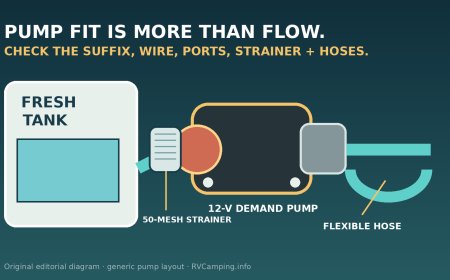
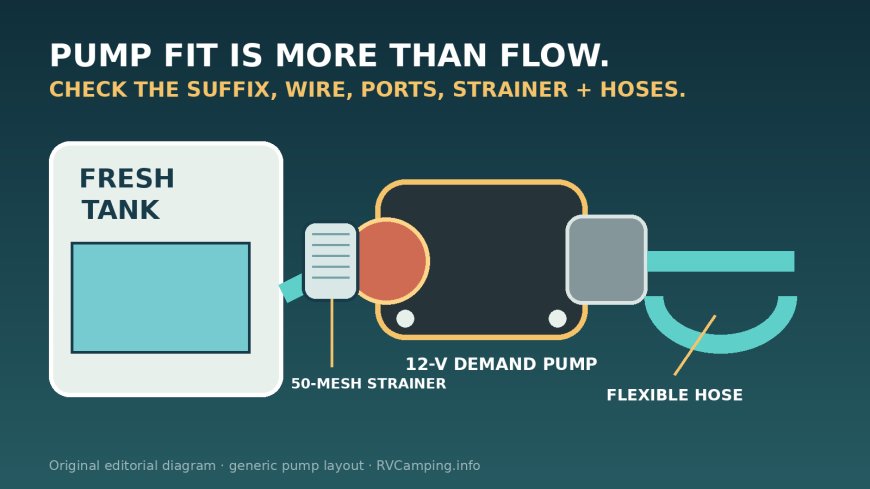
Pentair requires a 50-mesh inlet strainer and at least 1/2-inch inside-diameter plumbing.[3] Smaller or restricted plumbing can cause cavitation, noise, low flow and higher backpressure.[3]
Place the strainer where you can actually open and clean it.[3] An owner report about an exact E65 that overheated after five years prompted forum members to suggest checking the inlet screen and ventilation; the owner ultimately installed another pump.[6] That discussion is troubleshooting experience, not a controlled diagnosis. The manufacturer's manual independently lists a clogged strainer, restricted inlet, poor ventilation and a hot motor among the things to check when performance fails.[3]
4. Check the hose isolation and mounting surface
Pentair recommends at least 18 inches of flexible, high-pressure, 1/2-inch-ID hose at both ports.[3] It says not to connect the ports and strainer directly to rigid plastic pipe because normal pump movement can transmit noise and loosen or crack components.[3]
Mount the pump on a solid surface, but do not crush its rubber feet by overtightening the screws.[3] A thin cabinet wall can work like a drum.[3] Keep hose bends broad, anchor the flexible sections where they meet hard plumbing and leave room to remove the strainer bowl.[3]
The manual allows mounting in any position and recommends staying within six feet of the tank for best output and pump life.[3] A longer suction run asks the pump to work harder and can increase noise.[3] If the existing pump is far from the tank, do not assume a new motor will cure a plumbing-layout problem.
5. Check ventilation and access
Pentair asks for at least one cubic foot of ventilated space to limit overheating.[3] Do not bury the pump behind packed camping gear or insulation.[3] You need access to inspect fittings, clean the strainer, check wiring and catch water during winterizing.[3]
Plan for leaks even when every part is new. Keep electrical splices above the likely water path and protect nearby wood or electronics. After installation, watch the pump and every joint through several faucet cycles before closing the panel.
A careful replacement sequence
Use the RV and pump manuals for the exact installation.[3] This sequence is a planning checklist, not a substitute for either document.
- Turn off the pump, shore-water supply and relevant 12-volt circuit. Open a faucet to release pressure.[3]
- Drain or isolate the fresh tank so removing the inlet does not empty it into the pump bay.
- Photograph the old wiring, connector, flow direction, fittings and mounting orientation.
- Compare the old label with the full 4008-101-E65 model and inspect the received pump for shipping damage.[2][4]
- Check the strainer. Replace a damaged bowl, screen, O-ring or fitting rather than building the new installation around it.[3]
- Install compatible swivel fittings by hand as directed. Do not add tape or sealer where the Shurflo fitting seals internally.[3]
- Provide the specified flexible hose on both sides, with no kink or strain on the pump head.[3]
- Mount the pump on a firm surface without flattening its isolating feet.[3]
- Complete the correctly fused wiring with proper polarity. Secure the conductors away from sharp edges and wet areas.[3]
- Add water, open a faucet and power the pump. Let it purge air, then close fixtures one at a time.
- Inspect the inlet, strainer, pump head and outlet under pressure. Listen for repeated cycling after every faucet is closed.
- Recheck for seepage and loose hardware after the first trip because road vibration can loosen plumbing and mounting parts.[3]
If the pump runs but will not prime, look first for an empty tank, inlet air leak, clogged strainer, kinked hose, restrictive valve or debris in the pump valves.[3] If it cycles with all fixtures closed, inspect the pressure side, toilet valve, water heater and pump check valve for pressure loss.[3] Repeated cycling is a symptom, not a feature to hide with a switch adjustment.[3]
Noise, cycling and the adjustment screws
The 4008 is marketed around smooth bypass flow, but the pump still has a motor and diaphragm assembly bolted to an RV structure.[1][3] Some sound is normal. A sudden change deserves inspection.
Start with the installation before touching an adjustment:
- clean the 50-mesh strainer;[3]
- check tank level and inlet air leaks;[3]
- remove kinks and restrictive valves;[3]
- verify voltage at the running pump;[3]
- bleed air from every fixture;[3]
- check the mounting feet and nearby panel;[3]
- confirm that rigid pipe is not carrying vibration through the coach.[3]
Pentair says bypass adjustment should be performed by a professional technician with the proper gauges.[3] If bypass pressure and shutoff pressure overlap, the pump may never stop.[3] Turning screws to quiet a bad installation can trade an annoying sound for an overheated motor or an overpressurized system.
Maintenance, sanitation and winter storage
Routine care is simple but not optional. Pentair calls for strainer cleaning, fresh-water-system sanitation, winterizing and periodic checks of plumbing hardware and fittings.[3] The manual ties scale and contamination to poor flow, valve leakage and occasional cycling when no faucet is open.[3]
Follow the RV maker's sanitation procedure, especially after storage or any time the potable system is opened or contaminated.[3] Do not improvise chemical concentrations from memory. Filters may need to be bypassed or removed during sanitation, depending on their instructions.[3]
Before freezing weather, drain the tank and plumbing according to the vehicle manual.[3] Pentair's procedure opens the fixtures, runs the pump to purge the tank, disconnects the pump plumbing over a catch pan and briefly operates the pump until remaining water is expelled.[3] It says freeze damage can seriously harm the pump and void the warranty.[3]
Turn pump power off whenever the RV is unattended.[3] That limits water damage if a hose, fitting or toilet valve fails. A demand pump can keep feeding a leak until the tank empties.
Verdict
The Shurflo 4008-101-E65 is a strong default replacement for the right 12-volt RV, not a universal replacement for anything marked 4008.[2][3] Its three-gallon-per-minute rating, 55 psi shutoff, internal bypass and repairable pump-head components suit ordinary fresh-water service.[1][2]
The best reason to buy it is that Pentair documents the installation boundaries clearly. The same documentation also explains most disappointing outcomes: a missing strainer, small plumbing, rigid connections, long undersized wiring, poor ventilation or an unverified OEM connector.[3][5]
Buy it after the five fit checks pass. If one fails, choose the pump, harness or installation plan that matches the RV rather than forcing the E65 into place. The model is good. The suffix and the installation decide whether it is good for your rig.
Sources
What's Your Reaction?