



















Dometic CFX3 45 review: efficient RV cooling, but check the generation
Research-based Dometic CFX3 45 review covering RV power use, battery protection, airflow, single-zone limits and older-generation checks.

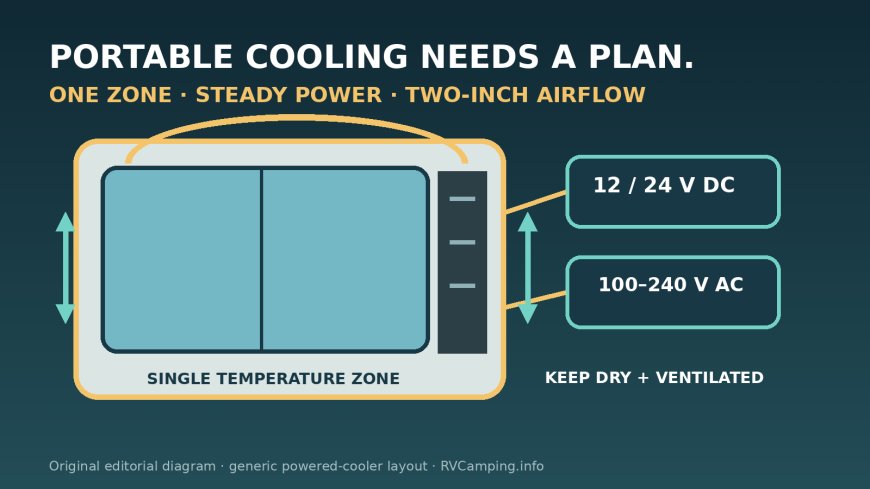
The Dometic CFX3 45 is a good fit for RV campers who want one portable 46-liter compartment that can refrigerate or freeze, have a dependable 12/24-volt power system, and can give the cooler two inches of airflow on every side.[1][2] Buy it for efficient food storage without ice, physical controls and useful remote monitoring. Skip it if you need simultaneous fridge-and-freezer temperatures, a weatherproof exterior cooler, or a light box that one person will enjoy moving when loaded.[1][2][5]
The central tradeoff is easy to miss: this is a single-zone, 42-pound-class compressor cooler from the CFX3 generation.[1] It gives you more usable food space than an ice chest of similar outside size, but it needs continuous power, ventilation and a dry location.[1][2] Dometic now foregrounds CFX5 and CFX2 products on its US cooler page, so CFX3 buyers also need to confirm that the exact unit is new, supported and sold with the expected US warranty.[7][8]
This is a research-based review. RVCamping.info did not purchase, use or physically test the Dometic CFX3 45. The verdict comes from Dometic's product data and operating manual, the exact Amazon listing, two published field reviews and one owner sound measurement.
As an Amazon Associate, RVCamping.info earns from qualifying purchases. If you buy through an Amazon link in this article, we may earn a commission at no additional cost to you.
Check the Dometic CFX3 45 listing on Amazon. Confirm ASIN B083V6M9G8, model CFX3 45 and US manufacturer part 9600024618 before ordering.[3]
The exact model reviewed
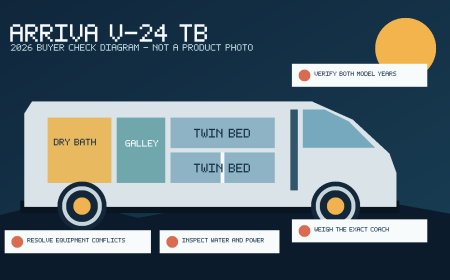
This article covers the single-zone Dometic CFX3 45 sold on Amazon under ASIN B083V6M9G8. That listing identifies model CFX3 45, manufacturer part 9600024618 and UPC 713814310462.[3]
Dometic's global product page uses SKU 9620009573 for a 46-liter CFX3 45. It publishes the same basic CFX345 identity, 694-by-398-by-476-millimeter cabinet, 12/24-volt DC input, 100-to-240-volt AC input, single-zone layout and compressor platform.[1] Regional SKU differences matter because the supplied AC cable, warranty and certification can differ.[1][2] The label on the received cooler should say what you actually bought.[2]
There is a generation issue too. Dometic's current US electric-cooler category features CFX5 and CFX2 families, while the old direct US CFX3 45 product URL now redirects to that category.[8] The CFX3 45 still has a live Amazon listing and a global Dometic product page.[1][3] That makes it a current buying option, but not the newest Dometic generation.[1][3][8] Compare the received manufacture date, seller, return terms and warranty with any CFX5 alternative before deciding that a sale price is a bargain.[7][8]
What the CFX3 45 is, and what it is not
Dometic lists 46 liters of total volume, room for 67 12-ounce cans, a 42.78-pound net weight on the current global page, and a temperature setting range from 68°F down to -7.6°F.[1] The Amazon US listing gives 41.23 pounds and outside dimensions of 27.3 by 15.7 by 18.7 inches.[3] The small weight conflict is another reason to use roughly 42 pounds for planning rather than designing a slide to the last pound.[1][3]
The entire main compartment follows one temperature set point. It can be a refrigerator or a freezer, but it cannot hold lettuce at refrigerator temperature while keeping ice cream frozen.[1] A basket and divider help organize the space; they do not create a second temperature zone.[1]
It is also not an unpowered cooler in the usual sense.[2] Insulation slows warming during an outage, but the compressor needs AC or DC power to maintain temperature.[1][2] OutdoorHub found that a lightly loaded test unit returned close to room temperature within a day when it was switched off.[5] That is one reviewer's observation, not a standardized hold-time test, but it is the right planning lesson: do not treat the cabinet as a substitute for a battery plan.[5]
Power use: plan in amp-hours, not marketing phrases
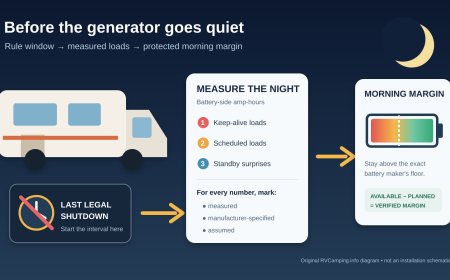
Dometic rates the cooler at 1.03 amp-hours per hour on 12-volt DC with 90°F ambient air and a 39°F interior.[1] That works out to 24.72 Ah over 24 hours, or about 316 Wh if the system averages 12.8 volts. A 100 Ah battery with 80 Ah allocated to the cooler would last about 78 hours at that exact laboratory-style rate.
That is a planning baseline, not a runtime promise. Initial cooldown, hot groceries, direct sun, repeated lid opening, wiring loss, other RV loads, battery temperature and a freezer set point can all change the result.[2] Solar production also varies by weather, season, shade and installation angle.
MotorTrend reported less than 1 Ah per hour during normal use in weather above 90°F when the lid stayed closed. Opening the cooler produced a short reported spike to 1.3 Ah per hour before consumption settled around 0.7 to 0.8 Ah per hour.[4] Those are attributed field observations without a published controlled test protocol, but they are reasonably close to Dometic's 1.03 Ah-per-hour rating.[1][4]
Use this sequence before depending on it away from hookups.[1][2]
- Decide whether the cooler will be a refrigerator or a freezer. Freezing is the harder job.[1]
- Start with Dometic's 24.72 Ah-per-day figure and add a conservative reserve for your climate and access pattern.[1]
- Subtract lights, water pump, furnace blower, fans, inverter standby and every other load from the battery's usable capacity.[1][2]
- Confirm how the battery will recharge on travel days and stationary days.[1][2]
- Run the real packed cooler from the real RV circuit for at least a full day before a remote trip, then compare battery state at the same time on consecutive days.[1][2]
"Solar powered" does not mean a raw solar panel plugs straight into the cooler.[2] The manual identifies AC and fused DC inputs.[2] A solar setup needs a suitable regulated path, usually through an RV battery, charge controller or compatible power station.[2] Do not connect an unregulated panel output to the cooler.[2]
Starter battery versus house battery
The three-stage battery monitor is useful, but it cannot measure how much camping time remains. It watches input voltage and switches the cooler off below a selected threshold, then restarts after voltage recovers.[2]
For a 12-volt system, Dometic publishes these cut-out and restart pairs:
- Low: 10.1 V off and 11.4 V restart;
- Medium: 11.2 V off and 12.2 V restart;
- High: 11.8 V off and 12.6 V restart.[2]
Dometic recommends Medium or High when connected to a vehicle starter battery and Low for a separate supply battery.[2] Low is not automatically right for every house battery.[2] Battery chemistry, the battery-management system, cable loss and the RV builder's limits still apply. A long or undersized cable can make the cooler see a lower voltage than the battery terminals, causing early shutoff.[2]
If the cooler shares a vehicle accessory outlet, find out whether that outlet turns off with the ignition and what current it can supply. The manual specifies a 10-amp DC fuse for the CFX3 45 and warns that the DC plug housing can get hot during extended hot-weather operation.[2] A warm plug, intermittent compressor or low-voltage warning calls for inspection of the socket, fuse, wiring and connections.[2] Do not defeat the fused plug to make a marginal outlet keep working.[2]
Fit it in the RV before you buy it
A 27.3-by-15.7-inch footprint is only the start.[3] The cabinet stands about 18.7 inches tall, and the lid needs room to open. Dometic requires at least 50 millimeters, about two inches, of ventilation on all four sides and warns against closed compartments with little airflow.[2]
A fridge slide therefore needs more than a tray that matches the base.[2] Check:
- slide load capacity for roughly 42 pounds plus food and drinks;[1][3]
- vertical room for the open lid;[3]
- two inches of airflow on every side, including the compressor end;
- cable movement through the full slide travel;
- access to the DC and AC plugs, fuses and drain;
- a restraint method that does not block vents or damage the cabinet;
- clearance from furnace ducts, sunny windows, cooktops and other heat sources.[1][2]
Dometic says the cooler can tolerate a short-term 30-degree inclination.[2] That is useful during travel, not permission to store it permanently tilted or let it slide around.[2] Secure the loaded unit to the RV structure with hardware rated for travel loads. A 42-pound empty cooler becomes a much heavier projectile after it is packed.[1]
The manual also says the unit must not be exposed to rain and should be protected from moisture.[2] OutdoorHub independently listed lack of weatherproofing as a drawback.[5] A pickup bed, open cargo tray or outdoor kitchen needs shelter from rain and road spray, plus enough airflow to shed compressor heat.
The lid deserves a deliberate check
Two independent reviews describe the same small annoyance: the light lid may rest on the gasket without fully latching unless the user presses it down.[5] A poor seal wastes battery and risks unsafe food temperature.
Make the latch part of the routine.[5] Close the lid, press until it catches, then tug once before walking away.[5] Inspect the gasket for crumbs, deformation and frost.[2] Dometic tells owners to check the lid seal regularly, minimize open time and defrost when ice forms.[2]
The app can warn about temperature movement, but it should be backup information rather than the only check.[2][4][5] MotorTrend reported useful pairing, temperature alerts and power graphs.[4] OutdoorHub reported that its app sometimes would not connect.[5] The physical controls remain important when a phone is flat, the app misbehaves or another camper needs access.[1][5]
Noise and sleeping near it
Compressor coolers cycle. One Expedition Portal owner measured a CFX3 45 at 31.4 dB with the compressor off and 38.1 dB running, with the meter 12 inches from the compressor side.[6] That is a single community measurement, not a laboratory comparison, but it gives more context than "silent."
MotorTrend described the compressor as quiet enough to sleep near during nine months of use.[4] Whether that holds in an RV depends on placement. A rigid slide, hollow cabinet or wall can amplify vibration. Test the cooler in the intended location before a long trip, and keep it away from a sleeper's head if small cycling noises are bothersome.[4][6]
Setup and first-trip checklist
Use Dometic's manual for the exact received unit.[2] This checklist adds an RV planning order:
- Read the data label and confirm CFX3 45, regional part number and input requirements.
- Inspect the cabinet, cord, plugs, gasket, latch and vents for shipping damage.
- Clean the interior and exterior with a damp cloth before first use.[2]
- Place the cooler in a dry, ventilated position with two inches of space on every side.[2]
- Secure it against travel movement without covering a vent.
- Choose one power source. Dometic warns not to connect AC and DC at the same time.[2]
- Set the battery-protection level for the actual battery role, not just the chemistry label.[2]
- Pre-cool the cabinet on shore power when practical, and load already cold food.
- Put a separate refrigerator thermometer inside for the first trip. Compare it with the display before trusting the app alone.
- Confirm that the lid latches every time and that cables cannot be pinched by the slide or cabinet.
- Watch voltage and energy use over a complete day with the RV parked.
- Recheck the DC plug for unusual heat after a long compressor cycle.[2]
Do not pack the vents, surround the compressor end with bedding or place a power station directly behind its hot-air outlet.[2] The manual also warns against placing extra socket strips or battery packs behind the cooler.[2]
Food safety, cleaning and storage
A powered cooler is food equipment.[2] Set it for the food you carry, minimize lid-open time and verify temperature with an independent thermometer when the consequences matter.[2] The manual says food should remain in original packaging or suitable containers and warns that long openings raise compartment temperature.[2]
Clean food-contact surfaces and the drain regularly. For extended storage, switch the unit off, defrost it, clean and dry it, then leave the lid open to prevent mold.[2] Never fill the cabinet with loose water or ice, immerse it, or use sharp tools to remove frost.[2]
If power is lost, use time and measured food temperature rather than the app's last reading to decide what is safe.[2] The cooler may reconnect after a battery recovers, but restarting does not undo time spent too warm.[2]
Warranty and older-stock questions
Dometic's CFX3 warranty document covers the CFX3 45 for three years of specified parts, labor and freight, followed by two years of compressor parts only. The electronic module is excluded from those final two years, and the owner pays labor and freight then.[7]
The warranty is written for the original purchaser in the continental United States and Canada and asks for proof of purchase.[7] Before buying older inventory, confirm that the seller is authorized, the unit is new rather than returned or refurbished, and the purchase documentation will support a claim. Do not assume that "five-year warranty" means five years of full coverage.
The product-generation question belongs in the price comparison. A discounted CFX3 45 can be a sensible buy when its capacity, controls and power use fit the RV. If the price is close to a newer CFX5 model, compare current app support, dimensions, accessories, energy data and warranty terms rather than buying by family name alone.[8]
Verdict
The Dometic CFX3 45 remains a capable portable refrigerator or freezer for an RV with a real battery and ventilation plan. Its 46-liter single zone, roughly 42-pound cabinet, physical controls and published 1.03 Ah-per-hour test figure make it easy to plan around.[1]
Its limits are equally clear. It cannot refrigerate and freeze at once. It should not sit in rain. It needs two inches of airflow on every side, and its lid deserves a deliberate press.[1][2][5] The battery monitor can prevent some over-discharge, but it does not create energy or replace correct wiring.
Buy the CFX3 45 when the exact ASIN, seller, warranty and older-generation price all check out. Skip it when you need two temperature zones, outdoor weather exposure, less weight or the newest Dometic platform. The cooler does the cooling job well. The RV owner still has to solve power, airflow and food safety.
Sources
What's Your Reaction?