
























Look up before you level: an RV campsite tree-hazard and wind plan
Screen an RV campsite for overhead tree concerns before leveling, know when to stop and call staff, and separate an early relocation decision from a high-wind shelter plan.

By Romana
A campsite can be level, long enough, and still be the wrong place to park. The missing check is overhead: a dead top, split limb, damaged trunk, or root plate that puts the RV inside a tree's likely fall area. Add wind, wet ground, or snow loading and a quiet wooded site deserves another walk before the jacks come down.
This is a camper's screening routine, not an amateur tree inspection. It helps you notice reasons to stop, move, or call campground staff. It does not certify a tree as safe. National Park Service arborists use a root-to-leaf assessment and consider defects, exposure, lean, disease, and what a failure could strike.[2] A five-minute walk by an RVer cannot replace that work.
Do the overhead walk before setup
Leave the rig in a lawful staging position while the driver and one other adult walk the assigned pad. If the loop is narrow, ask the host where to wait rather than blocking traffic. Start at the parking surface, trace where the RV body, cab, slides, awning, tow vehicle, chairs, and usual walking path would sit, then look up from several angles.
NPS site-selection guidance specifically tells campers to consider wind and dead trees or branches, and not to camp beneath dead overhead limbs.[1] That instruction applies even in a numbered, developed site. Maintenance reduces risk; it does not make every tree incapable of failing. One NPS hazard-tree program says apparently healthy trees can fail and that complete risk elimination is not possible.[2]
Use three viewing positions: both ends of the pad and the planned door side. A branch hidden by foliage from the road may be obvious from the picnic table. Check the space above the roof, not just the trunk nearest the bumper. A long limb can originate outside the site boundary and reach across the pad.
What should stop the setup
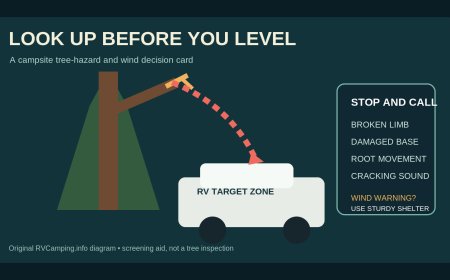
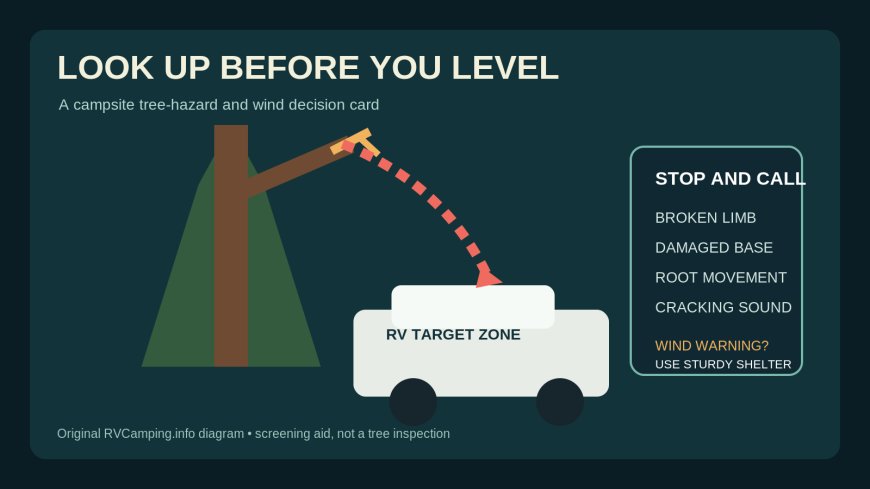
Do not diagnose species, decay severity, or the precise direction a tree will fall. Screen for visible conditions that justify a conversation with staff:
- a dead, cracked, broken, or partly detached limb over the pad or living area;
- a hanging branch caught in another crown;
- a trunk that is broken, split, hollowed, or rotten-looking near its base;
- fresh root lifting, exposed roots with new damage, or soil opening around the root plate;
- a tree or large limb newly leaning toward the occupied part of the site;
- recent limb debris beneath the same crown;
- a burned tree, storm-damaged tree, or tree carrying a heavy snow or ice load;
- cracking, popping, or snapping sounds from above or near a trunk.
These are reasons to create distance, not prompts to walk closer for a photograph. NPS warns that trees and branches can fall whether they are dead or alive and even when the air seems calm. Its immediate advice is to stay alert and run if roots, trunks, or branches begin cracking or snapping.[3]
Do not shake a limb, strike a trunk, climb, cut, throw a line, or move a park barrier. Do not assume paint, tape, or a tag means that you understand the agency's decision. The C&O Canal's NPS guidance notes that tree marks can mean several things and should be reported to staff for interpretation.[2]
Draw a target map, not a tree score
The useful question for an RVer is not "Is that tree hazardous?" It is "What could this tree or limb hit if it failed?" Sketch the site as five target zones:
- the occupied RV body and sleeping positions;
- the entry door, steps, and routine path to the bathhouse;
- deployed slides and awning;
- tow vehicle or towed car;
- picnic table, fire ring, and outdoor seating.
A questionable limb above an unused corner is a different exposure from one above a bed, door, or driver's seat. That does not make the first limb safe. It gives campground staff a precise location: "Site 42, large broken limb over the rear third of the pad, above the RV sleeping area." Clear language beats "the tree looks bad."
Take a wide photo from a safe location, include the site number, and call the host or ranger. Ask whether the site should remain unoccupied while staff checks it. If staff cannot inspect it promptly, request another suitable site or leave. A reservation is not worth sleeping under a condition that remains unresolved.
Wind changes the decision
A calm arrival check is only a snapshot. Recheck the canopy when a front approaches, gusts rise, heavy rain softens the ground, or snow loads branches. The NPS advises campers to ask staff about alerts and conditions, including severe weather and dead trees, and to keep watching the forecast during a stay.[5]
Separate two decisions. The first is whether to occupy the site at all. The second is where people should shelter during a warning. Moving the RV a few feet may reduce one branch exposure but does not turn the RV into a sturdy storm shelter.
During a high-wind or severe-thunderstorm warning, the National Weather Service says to enter a sturdy building and use an interior room or basement. It specifically tells people in mobile homes to move to a sturdy building before winds arrive. If no building is nearby, a car may be used as a fallback, but NWS says to position it away from falling trees and power lines.[4] An RV is a high-profile vehicle, not the preferred shelter for damaging wind.
Ask about shelter before a watch becomes a warning:
- What building is open to campers, including after office hours?
- Is it unlocked, and can everyone in the party reach it quickly?
- Are pets allowed or is there a separate pet plan?
- Which route avoids trees, power lines, and low drainage areas?
- Who announces an all-clear?
- Where is the second option if the first building is closed?
Write the answer down. "The bathhouse, probably" is not a shelter plan unless campground staff confirms that specific building and access procedure.
When moving the RV creates more risk
Relocating early, in calm conditions and with staff direction, can be sensible. Trying to retract slides, hitch a trailer, or drive beneath swaying trees after damaging wind begins can put people outside at the worst time.
Use a cutoff. Before the warning or before winds arrive, decide whether there is time to pack, move, and reach the approved destination without rushing. After the cutoff, follow the campground's emergency direction and shelter plan. Do not improvise a departure through blocked roads or beneath downed power lines.
NWS warns people to stay away from fallen electrical lines and trees during high winds.[4] Treat every wire as energized, keep other campers back, and call emergency services or the utility through campground management. A branch touching the RV, pedestal, or cord is not a do-it-yourself removal job.
Recheck after the weather passes
The all-clear ends the warning, not the site inspection. Before walking back beneath trees, scan from an open area for newly hanging limbs, changed lean, broken tops, exposed roots, downed wires, and debris lodged in the canopy. Use a flashlight from a safe spot if darkness prevents a full view; postpone close inspection until daylight.
If the RV was struck, do not climb onto the roof under an unstable canopy. Photograph from the ground, keep people away from the impact side, and ask staff and the appropriate emergency or service professional what happens next. Roof damage, electrical contact, propane damage, and blocked exits each need their own qualified response.
Report close calls as well as impacts. NPS asks visitors to report falling-tree close calls to a ranger.[3] A limb that missed one camper may remain above the next arrival's table or parking pad.
Copy this arrival card
Use this short record before leveling:
| Check | Record |
|---|---|
| Assigned site | Campground, loop, and site number |
| Overhead scan | Clear to my untrained observation / concern found / not visible |
| Concern location | Tree or branch position and the target below it |
| Current conditions | Calm, gusty, rain, snow load, recent storm, burned area |
| Staff contact | Name or office, time, instruction |
| Shelter | Confirmed sturdy building, route, access hours |
| Movement cutoff | Latest time to relocate before worsening conditions |
| Alternate site | Confirmed site or lawful place to wait |
| After-weather check | Time, new debris or change, staff report |
"Clear to my untrained observation" is intentionally modest. A clean walkaround does not prove that every tree is sound. It records that you looked, found no obvious stop condition, checked current alerts, and know where to go if the weather changes.
The practical rule
Look up before the RV occupies the pad. If you see a broken or hanging limb, a badly damaged trunk, disturbed roots, a new lean, or hear cracking, move away and call the campground. Do not fix, test, or label the tree yourself.
Keep the wind plan separate from the parking plan. A site move should happen while conditions permit an orderly departure. A warning sends people to the campground's confirmed sturdy shelter, not outside to save the awning or rush through hitching. When the weather settles, inspect from a safe distance again before resuming camp.
Sources
- National Park Service: Finding and Setting Up a Campsite — accessed October 14, 2026.
- National Park Service: Hazard Tree Safety at Chesapeake & Ohio Canal — accessed October 14, 2026.
- National Park Service: Tree Hazards at Sequoia & Kings Canyon — accessed October 14, 2026.
- National Weather Service: During a High Wind Event — accessed October 14, 2026.
- National Park Service: Camping Safely During Your Stay — accessed October 14, 2026.
What's Your Reaction?