





Two Check-ins, One Arrival: A Late-Arrival Worksheet for RV-and-Glamping Groups
A two-reservation arrival worksheet for mixed RV and glamping groups to coordinate check-in clocks, gate access, keys, no-show deadlines, unloading, parking, and the first-arrival handoff.

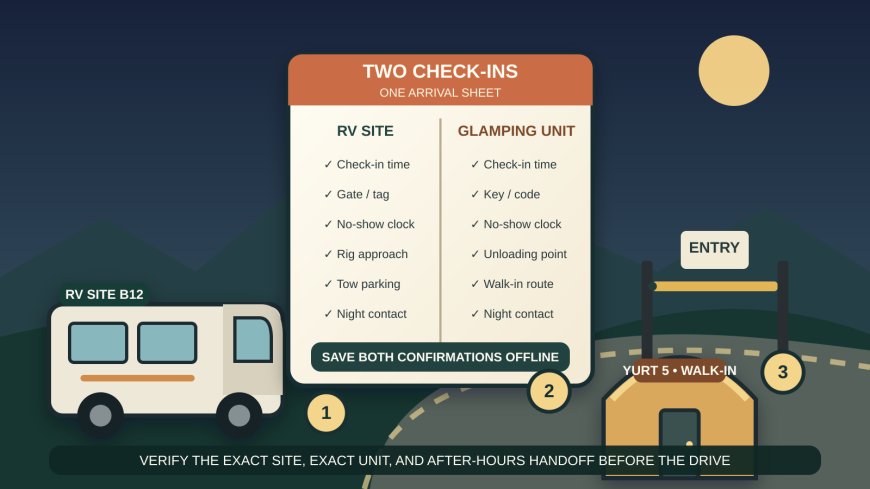
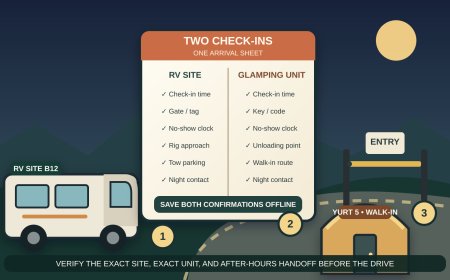
An RV site and a cabin, yurt, or furnished tent can have different check-in times, access methods, parking arrangements, and no-show clocks. Put both reservations on one arrival sheet before the group starts driving.
A mixed RV-and-glamping trip often begins with two confirmation emails and one optimistic sentence: “We’ll meet at camp.” That is not an arrival plan. The RV crew may be allowed into its site hours before the rental is ready. The cabin guest may need a key from an office that closes before the motorhome reaches the gate. A walk-in yurt can be “near parking” without being close enough to unload a week’s gear by hand in the dark.
The planning problem is the handoff between two accommodation types on arrival day. Use the worksheet for the named RV site and named roofed or furnished unit. A general campground FAQ is only the first layer.
Start with two reservation rows
Do not merge the reservations in your notes. Give each one a row, even when the same person paid for both.
| Field | RV site | Glamping unit |
|---|---|---|
| Reservation holder and phone | ||
| Confirmation number | ||
| Exact site or unit code | ||
| Check-in / check-out | ||
| Office or host hours | ||
| After-hours entry method | ||
| Key, code, tag, or registration step | ||
| No-show deadline | ||
| Legal unloading and overnight parking | ||
| Who can solve a problem after hours |
The separate rows matter because one agency can publish different procedures for different lodging types. Washington State Parks says check-in procedures vary by park and tells guests to use the confirmation or reminder email for the applicable time. Its general guidance lists campsites at 2:30 p.m. and roofed accommodations at 4 p.m., with different checkout times.[1] Those are useful examples, not times to copy into another campground’s worksheet.
Write the time zone beside every time. If the party crosses a time-zone boundary on travel day, “office closes at 6” is too easy to misread.
Build the arrival clock backward
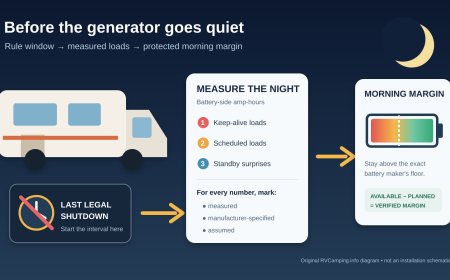
Choose the latest event that cannot be missed: office closing, gate closure, key pickup, orientation, shuttle, or no-show deadline. Work backward from that event, not from the group’s hoped-for dinner time.
Use four arrival estimates:
- 1. Normal ETA: route-app estimate plus planned stops.
- 2. Slow ETA: add fuel, food, traffic, and a conservative RV pace.
- 3. Office-safe ETA: the latest time that still leaves room to park the rig and reach check-in before staff leave.
- 4. After-hours ETA: the time at which the written late-arrival procedure becomes the only plan.
Then set a decision point. For example: “If the motorhome is not past Exit 84 by 4:30 p.m., Maya calls the park and switches the group to the after-hours plan.” A named person and trigger are more useful than “call if late.” The caller should not be the driver.
Do not assume that a national booking platform owns the local answer. Recreation.gov says its broad policies apply to most locations, but location-specific policies supersede them.[3] Save the exact facility page, confirmation email, and any direct written reply from the property.
Prove how each door opens
“Late arrival allowed” can mean several different things:
- the campsite remains assigned and the guest registers the next morning;
- a packet is left on an office board;
- the guest receives a gate code but still needs a cabin key;
- the rental has a lock combination in the confirmation email;
- a host must meet the guest at a stated time;
- late arrival is impossible for that accommodation.
Oregon’s William M. Tugman State Park gives a precise example: its entrance is open around the clock, and guests with a yurt or cabin reservation are directed to the combination in their confirmation email.[2] That does not establish the procedure at another Oregon park, much less a private campground. It shows the level of detail the worksheet needs.
For both reservation rows, answer:
- Does the entrance gate close or lock? How is it opened without following another vehicle?
- Does the RV need a windshield tag before entering its loop?
- Is the glamping unit’s key or code sent in advance, posted, or collected in person?
- Will the code work before the stated check-in time?
- Is cell service required to retrieve an email, text, app credential, or digital lock code?
- Can the confirmation and map be stored offline?
- If the code fails, which number is staffed at that hour?
- Must the group register the next morning, and by what time?
Treat the code like a house key. Share it only with the people assigned to that unit, store it offline on at least two charged phones, and do not put it in a group message that includes people who are not staying there.
Map unloading separately from overnight parking
A dot on a campground map does not show where a motorhome can turn, where a second car may stop, or how luggage reaches the rental. Seaquest State Park, for example, says guests park near its five yurts and continue to the units on foot.[4] That arrangement changes the arrival job: someone must find the correct legal parking area, unload only where permitted, and carry gear along the actual route.
Ask for an annotated map or mark a screenshot with these items:
- 1. RV entrance and any height, width, or one-way restriction.
- 2. RV site and the approach direction needed for a back-in site.
- 3. Glamping check-in point.
- 4. Rental unit and legal unloading point.
- 5. Overnight parking for every car and tow vehicle.
- 6. Path from parking to the unit, including distance, grade, steps, surface, and lighting.
- 7. Bathhouse and the route from both sleeping areas.
- 8. A meeting point that does not block a road, campsite, or emergency access.
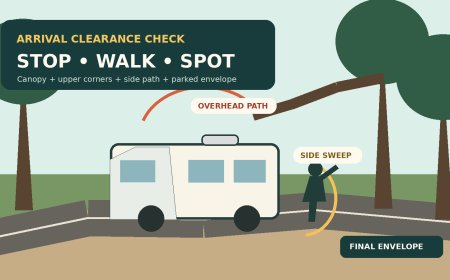
Do not park the RV at the rental “for five minutes” unless the operator explicitly approves that vehicle and location. A narrow cabin lane may not have turning room, weight capacity, branch clearance, or space for slides and mirrors. Likewise, do not send a cabin guest to wait inside the RV site before the RV reservation holder has checked in if the campground limits unregistered visitors or vehicles.
Assign the unloading crew before arrival. One person checks in. One person stays with children or anyone who should not be standing in a traffic lane. One person moves the passenger vehicle to overnight parking as soon as unloading is complete. The RV driver handles the RV and does not become the default luggage carrier at the same time.
Keep a no-show clock for each reservation
The group can lose one accommodation while believing the other check-in protected the whole booking. It does not.
Washington State Parks defines a no-show at 1 p.m. on the calendar day following the booked arrival and asks guests who will be a day late to call no later than their original arrival date.[1] Recreation.gov’s general policy says staff retain a campsite only through the following day’s departure hour and describes fees for no-shows, but it also warns that location-specific terms control.[3]
Record these answers separately:
- What action counts as arrival for the RV site: physical occupancy, office registration, online check-in, or a call?
- What action counts as arrival for the rental: collecting a key, opening the unit, signing a form, or speaking with staff?
- At what exact date and time can each reservation be released?
- If only one subgroup arrives, can that person preserve both reservations?
- May a person who is not the named holder check in? What identification or authorization is required?
- If a mechanical delay pushes arrival to the next day, which number must be called and when?
Keep the staff member’s name, call time, and written follow-up. A voicemail may document an attempt, but it is not proof that the reservation is protected unless the operator says so.
Use the first arrival as a controlled handoff
The first subgroup should not scatter across camp. Its job is to confirm facts and send one concise status update.
The National Park Service recommends talking with a ranger or host on arrival about current alerts, conditions, and regulations, including weather, environmental hazards, fires, wildlife, and food or trash rules.[5] Add property-specific changes to the update: closed loop, changed gate procedure, relocated key box, inaccessible path, burn restriction, water outage, or a unit substitution.
Use this message format:
ARRIVAL STATUS — [time and time zone]
RV site [code]: [ready / not ready / changed]
Rental [code]: [ready / not ready / changed]
Gate and office: [current instructions]
Overnight parking: [location]
Unloading route: [location and limit]
Current alert: [none or exact alert]
Meet at: [safe location]
Do not: [turn into cabin lane / unload at office / enter closed loop / other]
Photograph the site number, rental number, and posted after-hours instructions without capturing another guest or exposing the door code. If staff direct the group to a unit other than the one shown in the confirmation, stop and contact them before occupying it.
Do a five-minute night check
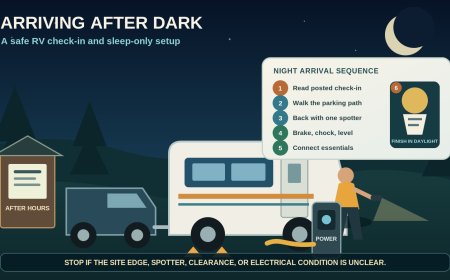
Arrival is not finished when the luggage crosses the threshold. The RV and rental need separate sleep-space checks.
For the rental, the U.S. Fire Administration advises vacation-rental guests to know the address, know two ways out of every room, confirm smoke and carbon-monoxide alarms, make sure exterior doors and windows can open, locate extinguishers, and choose an outside meeting place.[6] For the RV, use the owner’s manuals and the group’s normal setup checklist; do not assume a cabin alarm can be heard inside the rig.
Before anyone goes to bed:
- confirm the property address and exact unit/site numbers on every adult’s phone;
- identify the primary and alternate exit from the rental;
- keep both sleeping areas’ exits and outside paths clear of bags, carts, chairs, and vehicles;
- choose one outside meeting point away from the RV and rental;
- check the route between the two accommodations without treating either as an emergency shelter unless the property says it is;
- store the after-hours number and any gate-exit instructions offline.
If staff are gone and a serious problem cannot be resolved, do not improvise around a failed lock, blocked exit, missing alarm, unsafe electrical condition, or inaccessible path. Use the property’s emergency procedure and choose safe alternate lodging when necessary.
Copy-and-send arrival worksheet
Send this to the property while both reservations can still be changed:
Our party has RV reservation [number] for site [code/type] and glamping reservation [number] for unit [exact code/type], arriving [date]. Please confirm separately for each reservation:
1. Check-in and checkout times, office/host hours, and the exact no-show deadline.
2. The after-hours entrance, registration, key, and lock-code procedure, including the number staffed when the office is closed.
3. Whether the named reservation holder must be present and what another group member needs to check in.
4. The legal unloading point and overnight parking location for the RV, tow vehicle, and [number] passenger vehicles.
5. The route from parking to the rental, including distance, surface, steps, lighting, and whether carts or staff assistance are available.
6. Whether the first subgroup may preserve both reservations if the other vehicle is delayed.
7. A current campground map showing the RV site, rental, office, gate, bathhouse, unloading point, overnight parking, and emergency assembly area.
Please identify any answer that applies only to one accommodation or one exact unit.
Save the reply and both confirmation emails as offline files. On travel day, update the worksheet only from the property, its official alert channel, or onsite staff. The group is ready when either subgroup can arrive first, enter legally, protect both reservations, unload without blocking traffic, and tell the other vehicle exactly where to go.
Sources
- Washington State Parks: Camping — retrieved October 11, 2026.
- Oregon State Parks: William M. Tugman State Park — retrieved October 11, 2026.
- Recreation.gov: Rules and Reservation Policies — retrieved October 11, 2026.
- Washington State Parks: Seaquest Yurts — retrieved October 11, 2026.
- National Park Service: Camping Safely Step 2 — Upon Arrival — retrieved October 11, 2026.
- U.S. Fire Administration: Hotel and Vacation Rental Fire Safety — retrieved October 11, 2026.
What's Your Reaction?