
















Where Will Everyone Shower? The Mixed-Stay Bathroom Worksheet
A booking worksheet for mixed RV and glamping groups to verify the exact toilet and shower location, hours, access, cleaning closures, route, fees, supplies, child rules, and nighttime plan.

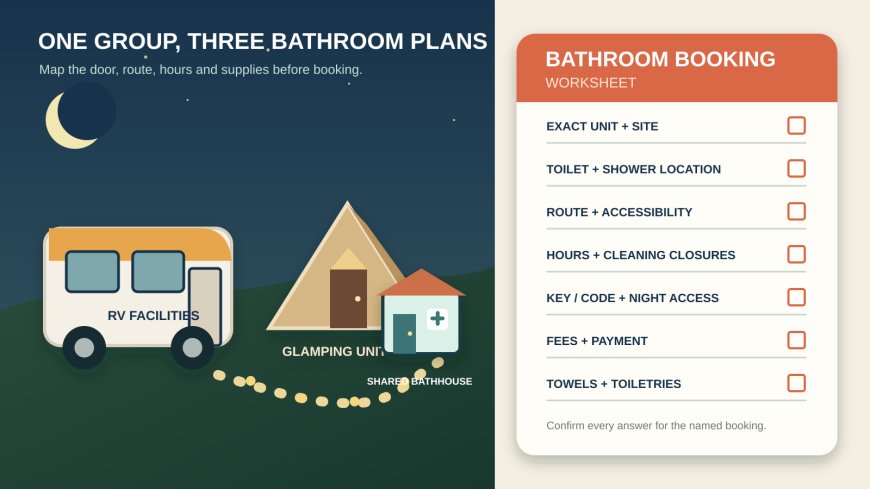
Put every sleeper, toilet, shower, route, access code, fee, and supplied item on one page before booking an RV site beside a cabin, yurt, or furnished tent.
A listing that says "bathroom available" has answered almost nothing. The bathroom may be inside the glamping unit, in a shared building down a dark path, or inside the RV with a small water heater and holding tank. A toilet might be open all night while the showers close early. Towels may be folded on the bed, available for rent, or entirely your problem.
Mixed RV-and-glamping groups need a bathroom plan based on the exact campsite and exact rental unit. This worksheet is for that decision. It is not a scorecard for properties, and the examples below are not rules you can carry from one campground to another.
Give every sleeping space its own row
Start with the reservation you are considering, not the property's broad "amenities" page. A campground can have several bathroom arrangements at once.
| Booking field | RV site | Glamping unit |
|---|---|---|
| Exact site or unit name/number | ||
| Toilet used overnight | ||
| Shower used | ||
| Private, single-user, or multi-user | ||
| Distance from the door | ||
| Route surface, grade, steps, and lighting | ||
| Hours and cleaning closures | ||
| Key, code, wristband, or registration needed | ||
| Shower price and payment method | ||
| Towels and bath products supplied | ||
| Backup if that facility is unavailable |
Do not turn "shared" into "open stalls" in your notes. Under Canvas, for example, describes its shared bathhouses as separate buildings with private, lockable rooms, located a one- to two-minute walk from Safari Tents. It also describes limited-hot-water pull-chain showers.[3] That is one operator’s setup. Your property may use a different room layout, locking arrangement, or water system.
The label on the lodging matters too. Oregon State Parks says guests in its rustic cabins and yurts use shared campground restrooms and showers, while deluxe cabins and deluxe yurts include a private bathroom with a shower.[1] Record the exact class shown on your confirmation rather than shortening both to "yurt."
Mark the real bathroom location
Ask the property to mark the bathroom your group will use on the current campground map. "Nearby" and "short walk" are not measurements. Request the distance from the specific RV site and rental unit, then ask what the route is actually like.
For each route, record:
- the legal starting point: unit door, RV pad, or accessible parking space;
- distance in feet or yards rather than minutes;
- pavement, compacted gravel, loose gravel, grass, boardwalk, or dirt;
- running slope, cross slope, steps, thresholds, curb cuts, and narrow points;
- lighting after quiet hours, plus any unlit section;
- standing water, mud, roots, snow, or other seasonal condition the property expects;
- doors or gates that must be opened, including their opening method;
- whether the route crosses a campground road;
- a second open restroom if the nearest one closes.
An "accessible unit" label does not tell you everything about a particular guest's trip to the toilet. The 2010 ADA Standards require an accessible route from site arrival points such as accessible parking and passenger loading zones to the accessible entrance they serve.[5] Oregon State Parks separately tells guests that accessible sites vary and recommends contacting its information team with questions about a site’s features.[2] Use those official descriptions as a reason to ask for facts, not as a promise that any route will meet one person’s needs.
For an accessibility check, ask the property to confirm the exact unit, parking space, route, restroom, toilet compartment, sink, and shower that are intended to work together. Ask about door widths, thresholds, turning space, grab bars, shower type and seat, controls, and whether a mobility device can remain dry and within reach. If a guest needs a specific feature, get that feature confirmed in writing. A ramp at the cabin does not prove that the path to the bathhouse or the shower itself will work.
Put hours, codes, and closures on one clock
A facility can exist on the map and still be unavailable when someone needs it. Make one 24-hour line for the stay and add:
- restroom opening and closing times;
- shower operating times, if different;
- scheduled cleaning windows for each building;
- quiet hours and any rule about walking or driving between loops;
- office hours for replacing a key or resolving a failed code;
- the date and time seasonal service begins or ends;
- the after-hours contact method.
Codes belong beside the facility they open. At Gulpha Gorge Campground, the National Park Service says onsite showers use a door code supplied in the reservation information.[4] Do not assume a campground gate code also opens a bathhouse, or that the cabin key admits RV guests. Ask whether every registered guest may use the facility, how many credentials the group receives, and what happens if a phone with the code is dead.
Save access instructions offline on two charged phones, but do not post a bathroom or gate code in a large trip chat. If the property issues a physical key, decide who carries it and how a separated group member gets back inside.
Cleaning and seasonal changes need their own lines because "open campground" does not mean "every shower open." Washington State Parks’ published 2026–27 winter schedule says Penrose Point’s lower restroom stays open without showers, while the middle and upper restroom showers close on different September and October dates.[6] That statement applies to Penrose Point and that schedule. It shows why a reservation date and a named building belong in the worksheet.
Ask what happens during cleaning. Is one section closed while another remains available? Is the accessible shower ever used for storage or taken out of service during cleaning? Where should a guest go during the closure, and is that alternate route usable at night? A reply of "restrooms cleaned daily" still lacks the time and fallback.
Price the shower, not just the stay
Put a dollar amount and payment method next to every shower option. Check whether the fee is included for registered campers, charged per use, limited by tokens, or paid by coin, card, app, or QR code. Ask where payment or tokens are available after the office closes.
Do not infer guest privileges from a public shower price. Oregon State Parks says showers are offered to registered campers, while individual parks may choose to offer $5 showers to non-campers when they have the resources; its page lists the participating parks as of February 2024.[2] A member of your group booked into a glamping unit may not have the same status as a day visitor, an RV-site guest, or a person registered under someone else’s reservation. Ask the property which reservation covers which people.
Use this cost row for each facility:
| Item | Confirmed answer |
|---|---|
| Included users or reservation types | |
| Price per shower or per time block | |
| Token/coin/card/app required | |
| Where payment is obtained | |
| Refund or replacement for a failed machine | |
| Time or hot-water limit |
Inventory what is actually supplied
"Furnished" does not reliably cover bathroom supplies. Oregon State Parks tells rustic cabin and yurt guests to bring their own bedding.[1] Under Canvas says it supplies bedding and bath towels. Its listed bath products include shampoo, conditioner, body wash, and hand sanitizer, while guests are advised to bring anything else they need.[3] Those two official policies point in opposite packing directions because they describe different products.
Make a yes/no list for each reservation:
- bed sheets, pillows, blankets, and sleeping bags;
- bath towels, hand towels, and washcloths;
- bath mat or a dry place to dress;
- shampoo, conditioner, soap, and hand sanitizer;
- toilet paper and a place for period products;
- hair dryer, mirror, outlet, and allowed appliance use;
- towel hooks, shelves, lockers, or a bench;
- fresh-towel exchange and the staffed hours for it;
- housekeeping frequency in a private bathroom;
- cleaning responsibility at checkout.
Pack the gaps by subgroup. The RV crew’s towels do not help the yurt guests if those towels are locked in the motorhome across camp. A small waterproof bathroom tote per sleeping unit is easier to manage than one communal bag.
Plan for children and nighttime trips
Do not assume a child may use a bathhouse alone merely because the path looks short. Ask the property whether it has rules about unaccompanied minors, adult supervision, family or all-gender rooms, occupancy, and use during quiet hours. Record the answer exactly; do not replace it with the group’s usual rule at home.
Before dark, an adult and each child should walk the approved route both ways. Identify the correct building, road crossings, alternate restroom, and a fixed meeting point. Check whether the unit door locks behind the person leaving and whether a child can operate any key, code, latch, faucet, or shower control. Under Canvas says its camps use solar pathway lighting and provide lights at shared bathrooms, but also says it limits light pollution.[3] That is enough reason to bring a light; it is not evidence about illumination at another property.
Assign an adult for nighttime bathroom trips before bed. Keep shoes, weather layers, a flashlight, the access credential, and the unit key in one known place. Never use the RV driver’s seat, roadway, another campsite, or an unapproved path as a shortcut.
Treat the RV bathroom as its own system
An RV bathroom can be a useful option only for people allowed inside the RV and only within the rig’s water, power, propane, and holding-tank limits. It is not an automatic backup for every cabin guest.
Record the RV’s fresh-water level, water-heater recovery, gray- and black-tank capacity, dump availability, and the owner’s guest rules. Decide whether the toilet is available overnight, whether showers are allowed, and who checks tank levels. Confirm campground rules before carrying wastewater, using an exterior shower, or moving the RV to dump. Do not promise the RV bathroom to the glamping subgroup until the owner and campground arrangements both support it.
If someone depends on the RV bathroom, map the route to the RV and confirm that the site can be entered after quiet hours. A locked RV, deployed steps, gravel pad, or narrow interior can end that plan quickly.
Copy-and-send bathroom worksheet
Send this to the property before the cancellation deadline:
Our group is considering RV site [exact site/type] and glamping unit [exact unit/type] for [dates]. Please answer for those two reservations, not for the property generally:
1. Which toilet and shower facility should each subgroup use? Is each one private, single-user, or multi-user?
2. Please mark each facility and alternate on a current map. What is the distance and route surface from the RV site, glamping door, and accessible parking?
3. What are the restroom hours, shower hours, cleaning closures, seasonal closures, and after-hours alternatives for our dates?
4. Does entry require a key, code, wristband, registration, or phone? Will every registered guest receive access?
5. What does each shower cost, who is eligible to use it, how is payment made, and where can tokens or change be obtained after office hours?
6. Which linens, towels, toilet supplies, and toiletries are supplied in the exact glamping unit and bath facility?
7. Which exact parking space, route, restroom, toilet, sink, and shower are designated accessible? Please confirm the features relevant to our guest: [list].
8. What rules apply to children, adult supervision, family rooms, and nighttime facility use?
9. If the named bathhouse closes or loses water, which facility may our group use instead?
If a response is limited to a particular unit, site, building, date, or registered guest type, please label that limit.
Save the reply with the confirmation and campground map. On arrival, check the posted hours and closures before the office shuts. The worksheet is finished when every person has a lawful, open, reachable toilet for the night and a shower plan that does not depend on a guess.
Sources
- Oregon State Parks: Cabins and Yurts Official source; retrieved October 12, 2026.
- Oregon State Parks: Statewide FAQ Official source; retrieved October 12, 2026.
- Under Canvas: Frequently Asked Questions Official source; retrieved October 12, 2026.
- National Park Service: Gulpha Gorge Campground Official source; retrieved October 12, 2026.
- U.S. Department of Justice: 2010 ADA Standards for Accessible Design Official source; retrieved October 12, 2026.
- Washington State Parks: Winter Schedule Official source; retrieved October 12, 2026.
What's Your Reaction?