























Malaquite vs. Bird Island Basin: the Padre Island RV campground choice
Compare Malaquite and Bird Island Basin for an RV stay at Padre Island: first-come sites, dry-camping services, fees, exact-site fit, and access planning.

By Romana
Padre Island National Seashore gives RV travelers two developed-campground choices without sending a large rig onto the beach: Malaquite on the Gulf side and Bird Island Basin on the Laguna Madre. Both are open year-round, first come, first served, and dry camping. That is where the similarity ends.
Malaquite is the better default for an RV stay centered on beach access, restrooms, cold-water showers, and an easier service routine. Bird Island Basin is the lower-cost, more stripped-down choice for travelers who want to fish, paddle, windsurf, or sit beside the laguna and can live with vault-style facilities and tightly arranged gravel sites. Neither official listing publishes a campground-wide maximum RV length, so the final fit decision must happen at an open site, not from a generic "RVs allowed" label.
The short answer
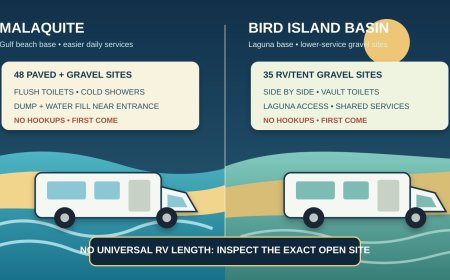
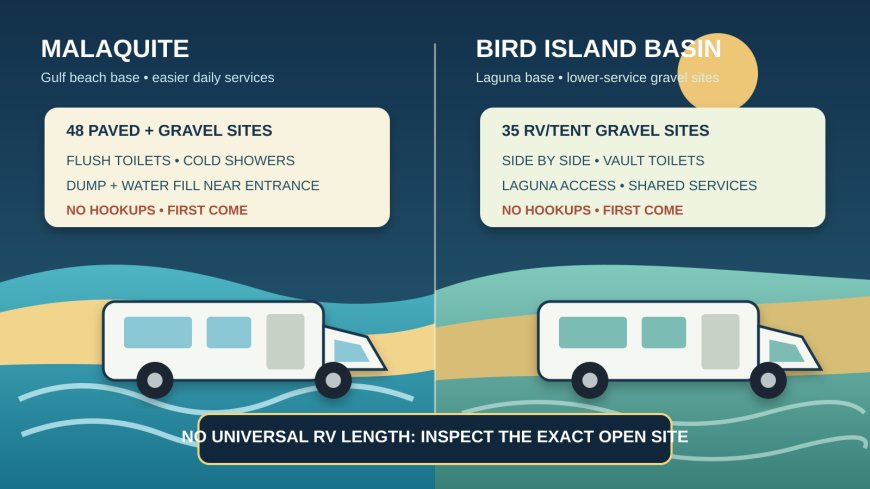
Choose Malaquite if this is your first visit, if anyone needs easier access to restrooms and showers, or if your daily plan points toward Malaquite Beach and the visitor center. Recreation.gov describes 48 paved and gravel sites, restrooms, cold-water showers, picnic tables, and some grills and shade structures. There are no hookups, but the park dump station and potable-water fill are on the campground approach.[2]
Choose Bird Island Basin if the Laguna Madre is the reason for the trip and your RV can fit fully within one of the side-by-side gravel sites. Recreation.gov lists 35 RV-or-tent sites plus 10 walk-in tent sites. A vault toilet is located at each end of the camping area. The listing does not show showers, hookups, or a dump station at the campground.[3]
Current NPS fee information lists Malaquite at $14 per night and Bird Island Basin at $8, before any applicable Senior or Access Pass discount. A valid overnight entrance pass is separate from the camping fee.[4] Check the fee page again before departure rather than treating those prices as permanent.
What both campgrounds have in common
All developed camping is first come, first served; neither campground accepts reservations. Campers register and pay at the self-service kiosk at the campground entrance.[1] That changes the arrival strategy. A reservation confirmation cannot hold a site while you finish a late drive from Corpus Christi.
Both campgrounds are open year-round under the park's general operating information, but "open year-round" is not the same as "unaffected by weather." The park's conditions page says Malaquite and Bird Island Basin are open unless an alert says otherwise, and it provides links for local weather, tides, and beach conditions.[6] Gulf storms, coastal flooding, wind, and temporary operational changes can still alter the trip.
There are no electric or water hookups anywhere in the park. NPS places the RV dump station and freshwater filling station beside the entrance to Malaquite, and makes them available to all park visitors.[1] Bird Island campers can use those shared facilities, but they must leave their campsite and drive to the Malaquite area to do it.
The park limits camping to 14 consecutive nights. After that, campers and their property must leave the park for at least 14 nights; the annual cap is 28 nights.[5] Noon is the checkout time for both campgrounds.[5]
Malaquite: the practical beach base
Malaquite sits about 100 yards from the Gulf. The NPS accessible map guide lists 48 tent-and-RV sites, flush toilets, running water, cold-water showers, and the dump and water-fill stations just outside the entrance.[7] Recreation.gov adds useful site texture: the inventory includes paved and gravel spaces, and some sites have grills or shade structures.[2]
That service package is modest, but it removes several daily chores. You can reach a toilet or shower without driving the RV. You can inspect tank levels, use the dump station, and refill freshwater on the way in or out. The visitor-center area also has park information, a store, restrooms, beach access, and outdoor showers; the current conditions page lists the visitor center as open daily from 9 a.m. to 5 p.m.[6]
Accessibility information is more specific here than at Bird Island. NPS identifies Malaquite sites 12 and 13 as having hard-surfaced paths linking the tables with the accessible toilet and shower facilities.[8] That does not guarantee that either site is open or that every feature meets a traveler's needs. Call the park before a long drive when a particular route, transfer space, restroom feature, or shower arrangement is essential.
Malaquite is the better choice for most first-time visitors because the campground reduces uncertainty. The tradeoff is a higher nightly fee and more activity around the visitor center and Gulf access. If you want quiet laguna frontage more than developed facilities, the extra services may not be worth paying for.
Bird Island Basin: camp for the laguna, not the amenities
Bird Island Basin faces the Laguna Madre. Recreation.gov lists fishing, birding, windsurfing, and kayaking as the campground's defining activities. Its 35 mixed RV-and-tent sites sit side by side on gravel; 10 additional sites are walk-in and tent-only. The camping strip has one vault toilet at either end, and the day-use zone occupies the space between them.[3]
That layout is the point and the warning. It gives direct access to a windy, shallow-water recreation area, but it is not a private, landscaped RV pad. Side-by-side sites put awnings, slides, doors, exhaust, and neighbor clearance under more pressure. A wide slide or a second vehicle can make an otherwise adequate parking length unusable.
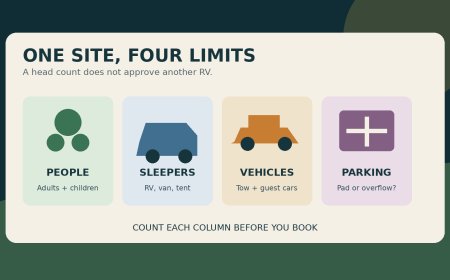
The superintendent's rules say Bird Island allows no more vehicles than the designated parking space provides, and all vehicles and equipment must remain within the designated site without impeding traffic or another campsite. The same rules cap Bird Island at one vehicle, one tent, and six people per site.[5] Travelers who bring both an RV and another vehicle should not assume the extra vehicle can spill into boat-ramp or day-use parking.
Bird Island is inexpensive because the service level is lower. There are no hookups anywhere in the park, and the shared dump and freshwater fill are by Malaquite.[1] Recreation.gov lists vault toilets but no campground showers.[3] Plan water, waste, and battery use before selecting the cheaper site; one extra service drive in a large motorhome can erase some of the convenience gained by camping beside the laguna.
The RV-length question has no single published number
The current NPS and Recreation.gov pages used for this guide do not publish an individual maximum RV length for each Malaquite or Bird Island site. They also do not provide a reliable campground-wide number that every pad can accept. The official statement that RVs are allowed is therefore an equipment category, not a promise that a 40-foot coach, a long fifth-wheel combination, or a trailer plus tow vehicle will fit.
Use a first-come campground fit check:
- Measure the RV in travel configuration, including hitch equipment, racks, ladders, spare tire, and anything carried at the rear.
- Towable owners should note two measurements: the camping unit alone and the complete hitched combination.
- Arrive in daylight. Walk an open site before committing to the turn.
- Check the usable parking surface, not the apparent open ground beside it.
- Place slides, steps, awning, and utility access on the sketch while keeping every component inside the site.
- Confirm where any second vehicle may legally go. Bird Island's one-vehicle rule deserves special attention.[5]
- If the RV cannot clear the lane and remain entirely on the designated pad, do not force the site.
Malaquite's paved and gravel inventory should offer more layout variety, but variety is not a length specification.[2] Bird Island's side-by-side gravel arrangement makes width and neighbor clearance as important as nominal length.[3] Large-rig owners should call the visitor-center information line before departure for current guidance, then still inspect the actual open space on arrival.
Power, water, waste, and generator planning
Neither campground can support a shore-power assumption. Start with a battery budget for refrigerator controls, lights, water pump, fans, device charging, and medical equipment. Coastal heat can make an air-conditioning plan the deciding factor; a dry campground is a poor match if the rig requires continuous shore power for safe occupancy.
The park's published quiet hours should be treated as a no-generator boundary, not as permission to run one at every other hour. Confirm the current generator rule at check-in. If you do use a generator, keep exhaust away from neighboring RV openings, tents, and shared paths. Bird Island's close spacing makes exhaust placement especially difficult.
Fill potable water and empty holding tanks before settling in. Malaquite campers can reach the shared stations at the campground entrance. Bird Island campers should decide whether they can complete the stay without moving the RV. A portable wastewater tote does not create permission to dispose of waste anywhere except an approved station.
No fuel or electric-vehicle charging is available inside the park. NPS says fuel and other missing services are available about 13 miles north, while the official directions route visitors to Park Road 22 through Corpus Christi and the JFK Causeway.[1][9] Fuel before entering, especially if a motorhome will make a service run while towing or carrying recreational gear.
Do not turn this comparison into a beach-driving recommendation
The two developed campgrounds are the safer comparison for conventional RVs because they avoid driving the home-on-wheels across active beach sand. NPS specifically says large two-wheel-drive RVs are not recommended for beach driving and recommends Malaquite or Bird Island Basin for RVs and camp trailers.[10]
Beach conditions can change with tides, storms, and soft sand. NPS limits two-wheel-drive access to North Beach and the section of South Beach ending at mile marker 5, while still recommending four-wheel drive. NPS also warns that water may reach the dune line in places when the high-tide forecast reaches 1.5 feet.[10] None of that makes a heavy RV a good recovery experiment.
If the developed campgrounds are full, the correct Plan B is a verified legal campground that fits the rig, not an improvised run down the beach after dark. Save at least one alternate before leaving Corpus Christi.
A departure-day decision card
| Question | Malaquite | Bird Island Basin |
|---|---|---|
| Main setting | Gulf side, short beach walk | Laguna Madre shoreline |
| Reservations | None; first come | None; first come |
| Hookups | None | None |
| Toilets | Flush toilets | Vault toilets |
| Showers | Cold-water showers | None listed at campground |
| Dump/freshwater | At campground approach | Shared station by Malaquite |
| Site layout | 48 paved and gravel sites | 35 side-by-side gravel RV/tent sites; 10 walk-in tent sites |
| Current regular fee | $14 plus valid entrance pass | $8 plus valid entrance pass |
| Best fit | First visit, beach access, easier daily services | Laguna activities, lower fee, self-contained stay |
| Rig caveat | Inspect the exact open paved or gravel pad | Fit everything within a narrow designated site; one-vehicle limit |
Bottom line
Malaquite is the better all-around RV campground at Padre Island National Seashore. Its flush toilets, cold showers, varied paved-and-gravel sites, beach access, and proximity to dump and water services make a dry-camping stay easier.[2][7]
Bird Island Basin wins only when the laguna is central to the trip and the RV can handle a close, gravel, low-service setup. It costs less, but the savings come with vault toilets, no listed showers, a one-vehicle limit, and a site layout that demands a careful width check.[3][5]
For either campground, arrive early enough to inspect the actual site. There is no reservation and no official universal RV-length promise. Verify current alerts, measure the rig as traveled, keep every part of the setup on the designated pad, and carry an outside-the-park backup.
Sources
- National Park Service: Camping at Padre Island National Seashore — accessed October 15, 2026.
- Recreation.gov: Malaquite Campground — accessed October 15, 2026.
- Recreation.gov: Bird Island Basin Campground — accessed October 15, 2026.
- National Park Service: Fees and passes — accessed October 15, 2026.
- National Park Service: Superintendent's Compendium — accessed October 15, 2026.
- National Park Service: Alerts and conditions — accessed October 15, 2026.
- National Park Service: Accessible Padre Island Map and Guide — accessed October 15, 2026.
- National Park Service: Accessibility — accessed October 15, 2026.
- National Park Service: Directions — accessed October 15, 2026.
- National Park Service: Driving down island — accessed October 15, 2026.
What's Your Reaction?