



























Victron SmartShunt 500A review: better battery data, no local display
Research-based Victron SmartShunt 500A review covering RV battery fit, installation accuracy, Bluetooth limits, setup and IP21 protection.

The Victron SmartShunt 500A is a strong fit for RV owners who want a proper state-of-charge estimate and can route every house-bank negative connection through one shunt.[2] It works especially well in a Victron system or in an RV where a phone is an acceptable display.[2][1]
Skip it if you need a permanent glanceable gauge, an audible alarm, a relay that can disconnect loads, or a device that protects the battery by itself.[2] The standard SmartShunt reports what the battery is doing.[2] It is not a battery-management system, low-voltage disconnect, fuse or charger.[2][3]
The central tradeoff is simple: the SmartShunt removes display wiring and puts detailed data in the VictronConnect app, but that makes Bluetooth range and phone access part of the experience.[2] Its state-of-charge number is also only as good as the installation, battery settings and synchronization behind it.[2][5][7]
This is a research-based review.[2] RVCamping.info did not purchase, install or physically test the Victron SmartShunt 500A.[2] The verdict comes from current Victron documentation, the exact Amazon listing identity and two independent hands-on reports.[4][5][7]
As an Amazon Associate, RVCamping.info earns from qualifying purchases. If you buy through an Amazon link in this article, we may earn a commission at no additional cost to you.
Check the Victron SmartShunt 500A listing on Amazon. Confirm ASIN B0856PHNLX and manufacturer part SHU050150050 before ordering.[4]
The exact model reviewed
This article covers the standard IP21 Victron SmartShunt 500A/50mV, part SHU050150050, sold on Amazon under ASIN B0856PHNLX.[3][4]
That identity matters because Victron now sells several nearby products.[2] The current family includes 300A, 500A, 1000A and 2000A versions in both standard IP21 and separate IP65 forms.[1] The Amazon ASIN reviewed here is the standard 500A model, not the newer IP65 500A version and not the 300A unit.[1][3][4]
The 500A rating is a current-path limit, not the capacity of the battery bank.[2] Victron supports battery-capacity settings from 1 to 9,999 amp-hours and a 6.5-to-70-volt supply range.[2] The shunt still must be sized above the largest charge or discharge current the RV can produce, including inverter loads and charging sources.[2][3]
What it measures and what it cannot do
The SmartShunt measures battery voltage and the current flowing through the shunt.[2] It uses those readings, along with settings for battery capacity, charge efficiency, Peukert behavior and the charged-state conditions, to calculate state of charge and estimated time remaining.[2]
The app can show voltage, current, power, consumed amp-hours, state of charge, time remaining, history and trends.[2] The auxiliary input can do one of three jobs: monitor a starter-battery voltage, watch the midpoint of a series bank, or read battery temperature with the optional Victron sensor.[2] One Aux terminal cannot do all three at once.[1][2]
The monitor does not know the condition of each lithium cell.[2] It cannot see a loose internal battery connection or replace a lithium battery's BMS.[2] It also does not open the circuit when the bank reaches a low state of charge.[2] Alarm conditions appear in VictronConnect while connected or can be passed to a GX device, but the standard SmartShunt has no buzzer, local screen or programmable relay.[2][3][5]
That boundary changes the buying decision.[2] If an owner needs an automatic load cutoff, the design requires correctly specified protection elsewhere.[2] If someone needs a warning that works without opening an app, a monitor with a local audible alarm or an integrated RV control system is the better fit.[2]
Who should buy it
The best buyer has a house battery bank whose capacity cannot be judged reliably from voltage alone, especially under changing loads and charging conditions.[2] This often includes solar-equipped RVs, lithium conversions and rigs with an inverter.[2]
It is also a good fit when the battery compartment is close enough for dependable Bluetooth or when the RV already has a Victron GX device.[2] A VE.Direct connection to a GX device can place the data on a local display and in Victron's remote-management system.[2][1]
Buy the 500A model only after checking the largest possible DC current.[2] A 3,000-watt inverter on a 12-volt bank can draw well above 250 amps before surge and conversion loss are considered.[2] That example is a sizing prompt, not a cable or fuse prescription.[2] Use the inverter maker's maximum-input specifications and the battery-system design values.[2]
The product also suits owners willing to configure the monitor from the battery manufacturer's data.[2] Victron's defaults are oriented toward lead-acid batteries, while its manual gives different guidance for common lithium settings such as Peukert exponent, charge efficiency and discharge floor.[2]
Who should skip it
Skip this version if the installation location can get wet.[2] The standard unit is IP21, and Victron says it is not waterproof and must be mounted in a dry location.[2] The separate IP65 family is the version to investigate for a damp compartment, but even an IP rating does not excuse exposed, loose or corroding high-current connections.[2][3][1]
Choose something with a physical display if checking a phone every time will become annoying.[2] Footprint Hero measured a roughly five-to-seven-second app connection delay and noted that there is no audible alarm at the shunt.[5] Panbo reached a similar conclusion about the lack of a display being fine in some installations but less attractive when Bluetooth is the only routine view.[5][7]
Also skip it when the electrical layout cannot put every house-bank load and charge source on the system side.[2] A hidden chassis ground, inverter negative, solar-controller negative or converter connection on the battery side bypasses the shunt and corrupts the state-of-charge calculation.[2]
Owners who want a plug-and-play fuel gauge should budget for professional installation and setup.[2] The physical device has few wires, but the high-current cable, lugs, torque, overcurrent protection and battery parameters still have to be right.[2]
The installation rule that decides accuracy
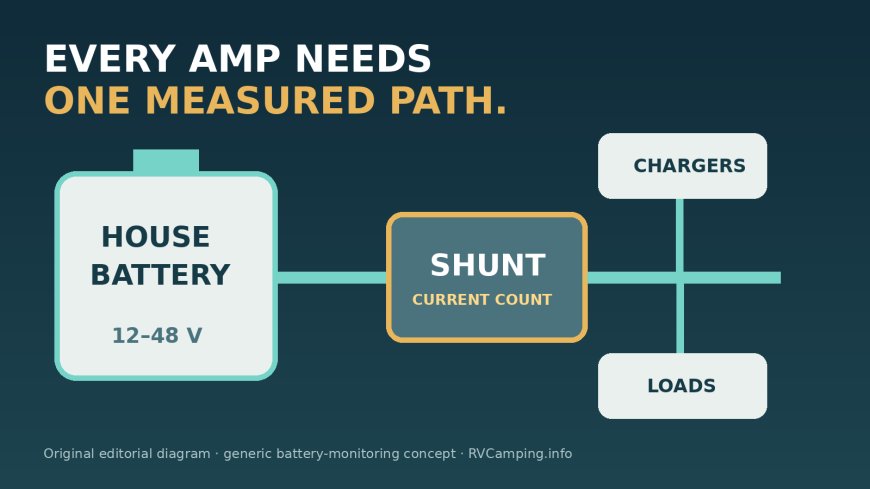
There should be one current path between house-bank negative and the rest of the RV's DC system.[2] The battery negative connects to the SmartShunt's BATTERY MINUS terminal.[2] Every load and every charging source connects downstream on SYSTEM MINUS, either directly or through a correctly sized negative bus.[2]
Victron explicitly warns that any load or charger attached on the battery side is excluded from the state-of-charge calculation.[2] This is the most common conceptual installation error because the voltage display may still look normal while amp-hour counting drifts.[2]
Use this pre-installation check:[2]
- Draw the present negative side before disconnecting anything. Include the inverter, converter-charger, solar controller, DC distribution panel, generator-start circuit, chassis bonds and any battery-to-battery charger.[2]
- Record the battery chemistry, usable bank capacity, system voltage and battery-maker charging guidance.[2]
- Find the maximum possible continuous and surge current from every inverter, charger and combined load condition. Confirm that 500A is suitable before choosing this model.[2]
- Confirm that all required cables and lugs fit the M10 shunt studs. Victron specifies a maximum 21 Nm torque for the 500A model's shunt bolts.[2][3]
- Choose a dry, protected mounting point with room for the heavy cables to land without twisting the shunt or loading its studs.[2]
- Plan a busbar if several large negative cables currently stack on the battery post. The shunt should measure the bank; it should not become a badly crowded cable organizer.[2]
- Disconnect every charging source and load according to the equipment manuals. Remove jewelry and protect against dropped tools because a battery can supply severe short-circuit current.[2]
- After wiring, account for every negative conductor. Only the shunt-to-battery cable belongs on the monitored bank's negative side.[2]
The two included fused red leads are for positive-voltage sensing and the optional Aux function.[2] They are not substitutes for the main negative cable, and the package does not solve high-current cable sizing or lug fabrication.[2][3]
Setup matters as much as wiring
A shunt counts current.[2] To turn that count into a useful percentage, it needs an accurate battery-capacity value and a trustworthy full-charge reference.[2] Enter the usable bank specification supplied by the battery maker rather than a hopeful number based on labels from mismatched or aged batteries.[2]
Victron identifies battery capacity, charged voltage, initial state of charge and Aux function as essential setup items.[2] For lithium iron phosphate, the manual recommends reviewing tail current, Peukert exponent, charge efficiency and discharge floor rather than blindly keeping the lead-acid defaults.[2]
Do not declare the bank 100% merely because an app opened for the first time.[2] Fully charge the bank under the battery manufacturer's procedure, verify the charged-state conditions and synchronize from a known full state.[2] If state of charge later climbs too quickly, never reaches 100%, stays stuck or drifts, inspect the settings and bypassed-current possibilities before performing a casual zero-current calibration.[2]
The time-remaining figure is an estimate based on current load and an averaging period.[2] It becomes less useful when an RV cycles large loads such as an inverter microwave, furnace blower or water pump.[2] Treat it as a moving estimate, not a departure deadline.[2]
Bluetooth range can be the deciding flaw
Victron's datasheet says the shunt and heavy electrical cables reduce Bluetooth range and gives 10 to 15 meters as a typical result, with conductive surroundings such as a vehicle chassis potentially making it unacceptable.[3]
Independent tests show why the installation location matters.[5][7] Footprint Hero measured 90 to 100 feet outdoors without obstructions but about 30 feet when the unit sat in an RV battery compartment.[5] Panbo also reported noticeably shorter range from a SmartShunt beside the batteries than from a BMV display-mounted radio.[7] Those are individual installations, not guaranteed distances, but the pattern is credible.[3][5][7]
Before final mounting, power the unit safely and test the app from the bed, dinette, driver's seat and outside service position.[2] Metal battery boxes and dense cable bundles can change the result.[2] If the useful range is poor, Victron documents the VE.Direct Bluetooth dongle as one option; a GX device and VE.Direct cable are the more capable route for local and remote monitoring.[2][3]
Do not buy the SmartShunt on the assumption that Bluetooth equals internet monitoring.[2] Direct Bluetooth is local.[2] Remote access requires additional compatible Victron hardware and connectivity.[2][1]
Standard IP21 versus IP65
The reviewed SHU050150050 is the standard IP21 SmartShunt 500A.[3][4] It belongs in a dry interior electrical space.[2][3]
Victron's current product family also lists an IP65 SmartShunt 500A.[1] That is a distinct product, not a firmware option or an enclosure upgrade for the ASIN reviewed here.[2] Buyers with a tongue-mounted battery box, exterior compartment or possible spray exposure should compare the exact IP65 part and its cable arrangement rather than assuming the Amazon title covers it.[1][2]
The same warning applies to the newer 300A model.[2] It may be enough for a smaller system, but it uses M8 connections while the 500A model uses M10 studs.[2] Swapping versions can change lug fit as well as current capacity.[2][3]
What the independent reports add
Footprint Hero tested the 500A SmartShunt for more than two months alongside three other monitors.[5] The reviewer discharged a 12-volt 100Ah lithium battery through a 2,000-watt inverter, charged it again and found the live readings and state-of-charge tracking useful.[5] The report also called out the weak points: no buzzer, app-only alerting, a short connection delay and reduced Bluetooth range in an RV compartment.[5]
Panbo installed a SmartShunt in an RV and reported that it behaved like Victron's BMV monitor without the separate gauge.[7] The reviewer liked the simpler installation and VE.Direct integration but noticed shorter Bluetooth reach because the radio sits at the shunt near the batteries.[7]
Neither report proves accuracy in a different RV.[2] They do support the main decision boundary: the SmartShunt is convenient when the app or a Victron network is the intended display, while the no-screen design and battery-compartment radio placement carry real costs.[2]
Inspection and troubleshooting
Inspect the installation after the first few trips and during battery maintenance.[2] Look for loose mounting, discolored insulation, heat at lugs, corrosion, moisture tracks, cable strain and movement at the studs.[2] Stop using the circuit and have it corrected if a connection heats or shifts.[2]
When the numbers look wrong, start with current direction.[2] Charging should show positive current and loads should show negative current under the standard configuration.[2] Then shut off known loads and charging sources and look for unexplained current.[2] A persistent difference may reveal standby loads or a conductor that bypasses the shunt.[2]
Do not use zero-current calibration to hide a wiring problem.[2] Victron says that procedure is rarely needed and requires proving that no current is flowing, which means physically disconnecting the system-side conductors rather than trusting appliance switches.[2]
Save the serial number, receipt, final settings and a wiring diagram.[2] Victron currently states a five-year standard warranty for power products and directs warranty and repair cases through its dealer network.[6] Seller identity matters because support is tied to the dealer path.[6]
Verdict
The Victron SmartShunt 500A is a capable battery monitor for an RV with a high-current 6.5-to-70-volt DC system, provided 500A covers the real maximum current and the standard IP21 enclosure stays dry.[2] It gives much better energy information than a voltage-only panel and integrates neatly with VictronConnect and optional GX hardware.[2][3][1]
Its strongest feature is not Bluetooth.[2] It is the ability to count all current entering and leaving the house bank and turn that into usable history and state-of-charge data.[2] That benefit disappears when one negative cable bypasses the shunt or when the battery settings are guessed.[2]
Buy it if app-based monitoring suits the way you camp and you can install one clean negative current path.[2] Skip it for a wet compartment, a must-see wall display or any plan that expects the monitor to protect or disconnect the battery.[2] It watches the system.[2] It does not take control of it.[2]
Sources
What's Your Reaction?