












Camco 22911 review: winter water help, but fittings can still freeze
Research-based Camco 22911 review covering -20°F use, GFCI setup, exposed-fitting freeze risk, leaks and model identity.

The Camco 22911 makes sense for an RV that will stay connected to city water through repeated freezes.[1] It is a 25-foot, 5/8-inch drinking-water hose with a built-in heating system, a current manufacturer rating of -20°F (-28°C), and a 120-volt cord.[1][3] Buy it if the run is short enough, you have a GFCI-protected outdoor receptacle, and you can protect the spigot, regulator, filter and RV inlet separately.[2] Skip it for occasional cold nights, dry camping, hookups longer than 25 feet, or any site that shuts off water in winter.
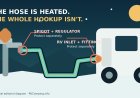
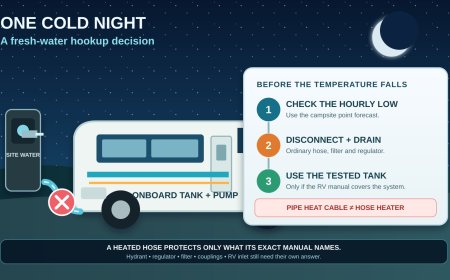
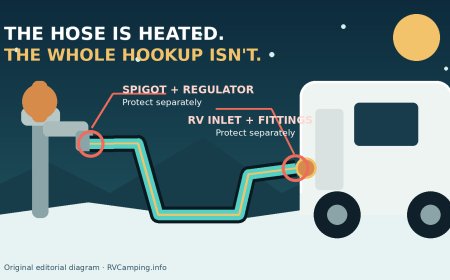
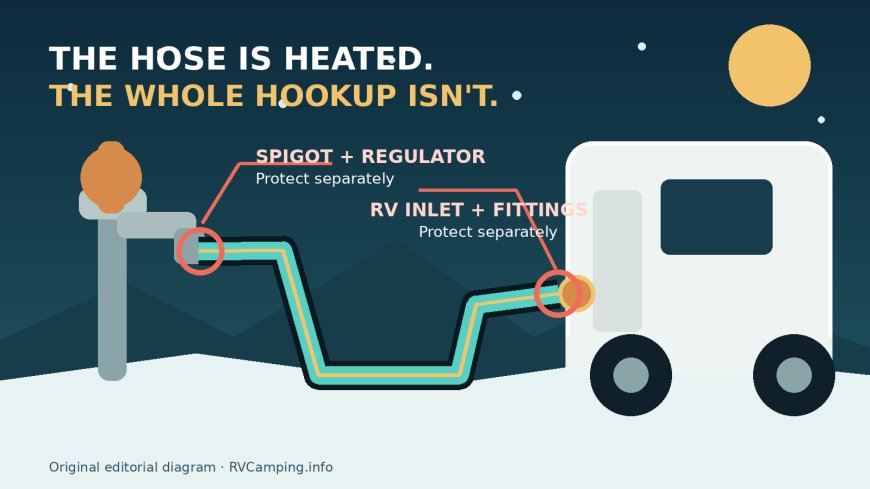
The big tradeoff is easy to miss: the hose heats the hose.[2] Camco's instructions explicitly say it does not protect the connections at either end.[2] A warm tube between two frozen fittings is still a failed water hookup.
This is a research-based review. RVCamping.info did not purchase, install, use or physically test the Camco 22911. The verdict comes from current product identity, manufacturer instructions, retailer specifications and attributed owner reports.
As an Amazon Associate, RVCamping.info earns from qualifying purchases. If you buy through an Amazon link in this article, we may earn a commission at no additional cost to you.
Check the Camco 22911 listing on Amazon. Confirm model 22911 and the -20°F rating on the page and package before ordering.
The model to look for
This review covers Camco model 22911, UPC 014717229111.[1] Camco's current storefront identifies it as a 25-foot heated drinking-water hose with a 5/8-inch inside diameter, -20°F rating and cETLus listing.[1] The matching Amazon page is ASIN B01ABONB0A and names model 22911.[3]
That identity check matters because Camco has sold several very similar blue heated hoses. Search results still surface model 22922, another 25-foot hose advertised to -40°F, under a different ASIN. Do not transfer that colder rating to the 22911. The 22911 reviewed here is the current -20°F model shown by Camco, Amazon and Home Depot.[1][3][4]
The model is built for a standard RV city-water setup, not for filling the fresh tank while disconnected.[2] It needs:
- a water source that remains available in freezing weather;
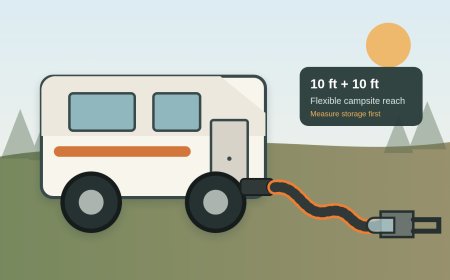
- 25 feet or less between the source and the RV inlet, without stretching the hose;[1]
- standard garden-hose connections;[2]
- a live 120-volt outdoor receptacle with GFCI protection;[2]
- separate freeze protection for everything outside the heated section.[2]
Measure the actual route around the pedestal, filter and regulator. A nominal 25-foot gap can become too long once you avoid tight bends and keep electrical connections out of puddles.[1][2]
What the 22911 does well
The product solves one narrow winter problem: standing water freezing inside the supply hose.[1] Camco rates the current 22911 to -20°F and lists a 5/8-inch inside diameter.[1] Amazon and Home Depot describe a thermostat-controlled heating cable that runs on 120 VAC, while the current Amazon listing also identifies a six-foot, 18 AWG power cord with an LED plug.[3][4]
The drinking-water construction is another reason to choose this over a homemade garden-hose setup. The Amazon listing describes the hose material as NSF/ANSI 61 certified for drinking water. It also lists lead-, BPA- and phthalate-free construction plus CSA low-lead certification to NSF/ANSI 372.[3] Those certifications concern the wetted materials and lead content; they do not purify questionable campground water.
The fittings can be oriented around the nearest outlet. Camco's instructions show female connections at both ends and a separate male adapter, so the power-cord end can face either the water source or the RV.[2] That is useful at pedestals where the 20-amp receptacle and hose bib sit together.
There is no reason to pretend the product is maintenance-free, though. It combines water, electricity, pressure, weather and two mechanical joints.[2] Every one of those deserves attention.
Who should buy it, and who should skip it
Buy the Camco 22911 if you spend weeks or months at a serviced site where overnight freezes are normal.[1] It can also suit a shoulder-season stay when draining and reconnecting a regular hose every cold night would be impractical.[1] The 25-foot length is easier to manage than a 50-foot heated hose when the pedestal is close.[1]
Skip it if you only face an isolated freeze. Filling the fresh tank, disconnecting the exterior hose and using the onboard pump is often the simpler plan, provided the RV's tanks and plumbing are protected for those temperatures. A heated hose cannot help if the campground shuts off the water or if your wet bay, pump line or underbelly freezes.
Also skip this exact model when:
- the forecast or wind exposure falls outside the -20°F product rating;[1]
- the hose must cross a road, sharp edge or plowed walkway;
- the only outlet requires an extension cord;[2]
- the available receptacle lacks GFCI protection;[2]
- you cannot keep the full hose in outdoor ambient conditions;[2]
- your hookup needs more than 25 feet of reach.[1]
Camco's instructions say not to use an extension cord, not to use a wet plug, and not to use a plug with a missing ground pin.[2] Those are purchase boundaries, not optional setup preferences.
The -20°F rating is not a whole-system promise
A temperature rating on the box is easy to read as a guarantee for the entire hookup. It is not. The test boundary is the heated hose, while a real RV connection can include a campground riser, hose bib, adapter, pressure regulator, water filter, elbow and city-water inlet.[2]
Camco states that the hose does not provide freeze protection beyond its connections.[2] That sentence should drive the installation. The short metal or plastic sections at each end can lose heat quickly, especially in wind. A filter can hold a larger pocket of water, and a regulator can freeze even while the neighboring hose stays flexible.
Use insulation that is appropriate for the application, keep it dry and follow the campsite's rules. Camco warns against combustible insulation around the hose.[2] Do not wrap over the thermostat or electrical parts unless the instructions for your exact package allow it. If the campground already protects its riser, ask before changing or covering anything.
The rating also assumes electricity stays on. A tripped GFCI, unplugged cord or pedestal outage removes active freeze protection.[2] The LED can confirm that power reaches the plug, but it cannot prove that every section of the heating cable is working.[3]
Setup: a safer order than connect-and-forget
Camco's instructions call for a deliberate sequence rather than connecting water and electricity at random.[2]
- Inspect the jacket, fittings, power cord, plug and ground pin. Retire the hose if anything is split, crushed, corroded, loose or exposed.[2]
- Check the forecast, pedestal-water status and site rules. Make sure the -20°F model rating leaves a reasonable margin for the expected conditions.[1]
- Plan the route. Keep the hose away from traffic, sharp edges, standing water and places where snow removal could catch it.[2]
- If the hose is stiff from cold, follow the package instructions for preheating before you uncoil it. Camco's instruction sheet says to energize it for 15 minutes, then unplug before making water connections.[2]
- Fully uncoil and extend the hose. Do not leave a powered section in a tight coil.[2]
- Put the male adapter on the end that gives the safest cord orientation. Keep the electrical plug and receptacle dry.[2]
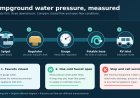
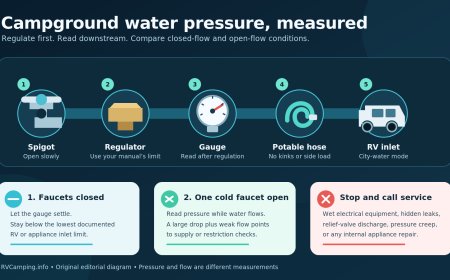
- With the hose unplugged, connect the water source and RV inlet. Add a drinking-water-safe regulator if required.[2] Camco recommends 40 to 50 psi.[2] Our separate Camco 40055 regulator review explains why reduced pressure and good flow are different questions.
- Turn on the water and inspect both fittings, the adapter and every accessory for leaks.[2]
- Flush the hose for several minutes before drinking, as Camco directs.[2]
- Plug it into the GFCI-protected outdoor receptacle only after the water side is leak-free.[2]
- Protect the unheated fittings and accessories without creating an electrical or fire hazard.[2]
Test the GFCI with its built-in test button according to the receptacle manufacturer's instructions. A glowing hose plug is not a substitute for working ground-fault protection.
Leaks and fitting failures deserve more weight than star averages
Owner reports are useful here because the likely failure is physical, not complicated software behavior.[5] One verified purchaser of the exact 22911 reported that the heating kept working during a three-week spell when daily temperatures stayed below 32°F.[5] In a later update, that owner said the hose pulled free at the fitting in its second season and released water before a neighbor shut off the supply.[5]
That is one account, not a measured failure rate. Still, it supports two practical choices: inspect the collars closely and shut off water when the rig is unattended. Camco's own instructions say not to leave the hose pressurized while unattended.[2]
A separate long-term Camco owner reported three seasons of good service before a hose failure and said Camco replaced it. That article does not identify model 22911, so it is evidence about the brand and product class rather than proof of this exact model's lifespan.[6]
The mixed evidence is more useful than a blanket claim that the hose is either reliable or unreliable. Heating performance and fitting durability are separate questions. A hose can prevent ice and still leak at a crimp, washer or adapter.
Carry spare potable-water washers and inspect for drips after the system has been pressurized for a while. Do not use excessive force to cure a leak.[2] Check alignment, washer condition and thread engagement first. A heavy heated hose can also put more leverage on an RV's city-water inlet than a light hose, so support the run rather than letting its weight hang from the fitting.[2]
Pressure, water quality and electrical limits
A heated hose does not regulate pressure. Camco recommends a 40-to-50-psi regulator in the instruction sheet.[2] Put the regulator where its own manufacturer directs, then protect it from freezing. If flow is poor, inspect the campground pressure, regulator, filter and inlet screen before blaming the hose diameter.
Nor does the hose make unsafe water potable. Camco says not to use it with microbiologically unsafe water or water of unknown quality.[2] Use a confirmed potable source. Keep this hose completely separate from sewer-rinsing equipment, and cap clean ends during storage.
On the electrical side, treat the full assembly as outdoor equipment.[2] Use the specified 120-volt supply and GFCI protection.[2] Keep the three-prong plug dry.[2] Do not cut, splice or repair a damaged heated section; Camco warns that doing so can cause serious injury or death.[2]
The exact current product page calls the 22911 cETLus listed, while Amazon identifies an LED-equipped 18 AWG cord.[1][3] Certification and an indicator light reduce uncertainty, but neither makes a damaged cable safe.
Storage and the first cold night
Before the first forecast freeze, set the system up during daylight. Run water, inspect every joint, confirm the GFCI and verify the plug indicator.[2][3] Then check again after dark when the temperature has fallen. The first cold night is a poor time to discover that an exposed fitting is icing outside the heated hose.[2]
When the hose comes off the rig, unplug it first, shut off the water, release pressure and disconnect.[2] Drain it fully.[2] Camco says to store the hose rolled in a dry place away from sunlight and not to pull hard on the fittings.[2]
Do not force a frozen hose into a tight coil. The instruction sheet says a frozen hose can be plugged in for 30 minutes to thaw so it can drain.[2] Inspect it again after any freeze event, especially at the collars and where the power lead enters the jacket.
Verdict
The Camco 22911 is a sensible 25-foot heated drinking-water hose for a stationary RV on a dependable winter hookup.[1] Its -20°F rating, drinking-water construction and reversible connection layout answer a real problem without a DIY heat-tape build.[1][2][3]
The product does not winterize the rest of the RV. The fittings remain exposed, the campground can turn off water, the GFCI can trip, and owner reports show that leak and collar failures deserve routine inspection.[2][5] Buy it for continuous cold-weather city-water use when the exact dimensions and electrical requirements fit. For a brief freeze, filling the tank and disconnecting the outside water system may be cheaper, simpler and easier to monitor.
Sources
- Camco Heated Drinking Water Hose -20, 25-foot, 5/8-inch ID (model 22911)
- Camco Heated Drinking Water Hose instructions
- Amazon listing: Camco 22911 25-foot heated water hose
- Home Depot listing: Camco 22911 specifications
- Verified-purchase owner report for Camco 22911
- RV Across America: long-term Camco heated-hose owner report
What's Your Reaction?