























Point Supreme Campground is already closed: plan a Cedar Breaks RV stay by season and exact site
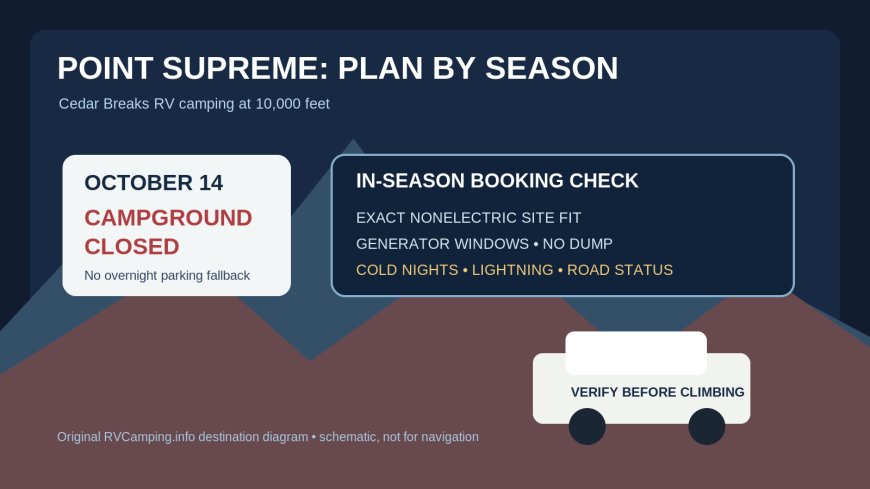
Point Supreme is closed for the 2026 season. Plan a future Cedar Breaks RV stay by exact nonelectric site, generator windows, high-elevation weather, dump strategy, and current road status.

By Romana
Point Supreme is the only developed campground inside Cedar Breaks National Monument, and NPS maintains a dedicated facility page for it.[1] It is not an October fallback. The park's current-conditions page says the campground is closed and normally operates only from June to mid-September when weather permits.[3] For a trip after the seasonal closing, the correct plan is an outside campground, not an overnight in an overlook or parking lot.
For next summer, Point Supreme can put a small or mid-size RV at roughly 10,000 feet with no electric hookup, short generator windows, potable water in season, flush toilets, and warm showers. The reservation still has to match the exact vehicle and site. "RVs allowed" is not a campground-wide length guarantee.
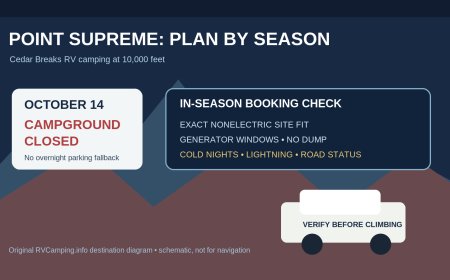
The October 14 answer: no in-park RV night
Cedar Breaks currently lists Point Supreme Campground as closed. The same update says State Routes 148 and 143 are open, but the roads and day-use facilities do not reopen the campground.[3] NPS separately states that camping is prohibited in parking lots and at overlooks.[2] An empty lot near the rim is therefore not a legal substitute for a campsite.
This distinction matters because other visitor facilities remain open later than the campground. The current-conditions page lists October 17, 2026 as the last day this season for the visitor center, park store, and museum, while Point Supreme has already closed.[3] A daytime visit and an overnight stay are two different permissions.
If you are traveling now, reserve a verified campground outside the monument before climbing to the rim. Confirm its opening date, nighttime check-in, hookups, dump access, and route. Do not rely on a map pin, an old review, or the presence of another parked RV.
What Point Supreme offers in season
Recreation.gov describes the approximate operating span as mid-June through late September. It lists flush toilets and warm showers, with the shower code supplied by the campground host.[5] The NPS campground inventory is more conservative about the usual close: mid-June to mid-September, subject to favorable weather.[2] Treat those ranges as planning boundaries, then verify the bookable dates and current conditions for the actual year.
The campground has 25 sites. NPS says seven are tent-only and there are no electric hookups.[2] Recreation.gov's current list identifies 18 individual sites as RV nonelectric and seven as tent-only nonelectric.[5] That is a useful cross-check, but it still does not assign your rig to one of the 18 RV sites.
There is seasonal potable water, but no dump station, camp store, ice sales, trash collection, cellular reception, or internet connectivity listed by NPS.[2] The closest services are spread in different directions: NPS points to Brian Head, eight miles north, for a small store, restaurants, Wi-Fi, and card-operated fuel; Duck Creek, ten miles southeast, and Panguitch, 33 miles away, also have fuel. Dump options are listed at Duck Creek, Panguitch, and a KOA in Cedar City.[2]
That service pattern favors arriving with food, legal waste capacity, fuel margin, and an offline copy of the reservation. Do not arrive needing the campground to function like a full-service RV park.
Match the exact site, not the longest site
The Recreation.gov facility page labels each reservable space by equipment type. Some are RV nonelectric; others are tent-only. Individual site records carry their own vehicle and driveway limits. For example, the current listing for site 22 shows a 25-foot maximum for several RV equipment types, a 30-foot gravel driveway, and a back-in entry.[5] That one record is evidence about site 22, not every Point Supreme pad.
Before paying, open the exact site page and record:
- the maximum RV, trailer, and vehicle length shown for that site;
- whether the limit applies to the camping unit, tow vehicle, or parking area;
- back-in, parallel, or other entry type;
- driveway length, width, grade, and surface;
- number of permitted vehicles;
- whether slides and steps can remain inside the site boundary;
- accessibility features you actually need;
- current fire and generator rules.
Recreation.gov says vehicles and trailers must stay within the assigned parking area, with camping equipment inside the site boundary and out of the roadway and vegetation.[5] If the tow vehicle will not fit with the trailer, find out where it may legally park before arrival. Do not assume the shoulder or neighboring site is overflow space.
A campground maximum quoted by a third-party directory is not enough. The safer booking method is boring: measure the RV as traveled, include racks and hitch equipment, then compare those dimensions with the fields on one reservable site. Save a screenshot or PDF of that record with the confirmation.
No hookups changes the power plan
Every Point Supreme RV site is nonelectric on the current reservation list.[5] Arrive with a battery and fuel plan that fits the stay without assuming all-day generator use. The current generator slots are 8–10 in the morning and 6–8 in the evening. Site-wide quiet time begins at 10 p.m. and ends at 8 a.m.[5]
Those two windows are constraints, not a promise that a particular generator will meet every other rule. Check fire restrictions, equipment condition, exhaust direction, neighbor spacing, and any updated host instruction. Do not route exhaust toward another campsite, a tent, an RV opening, or a common path.
Estimate loads before booking. Include furnace blower use on cold nights, lights, water pump, refrigerator controls, device charging, and any medical equipment. If the battery cannot support the overnight load between generator windows, choose a powered campground outside the monument rather than trying to stretch the rules.
Ten thousand feet is a camping condition
The campground sits at about 10,000 feet. Recreation.gov warns of variable summer weather, daytime highs averaging 60–70°F, nights often in the 30s and 40s, stronger ultraviolet exposure, and frequent afternoon thunderstorms. It also notes that elevation can cause shortness of breath or fatigue and advises slower movement, rest, and water.[5]
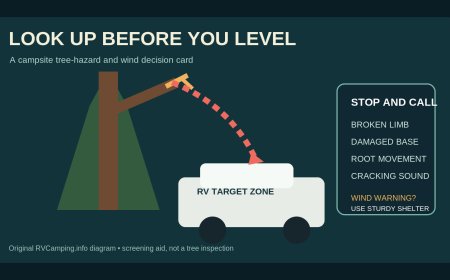
An August booking can still require a furnace plan and warm bedding. It can also require a quick retreat from an exposed trail when clouds build. The park's current conditions page says lightning is common and dangerous at this elevation, especially in the afternoon.[3]
Set up with that daily cycle in mind. Plan exposed walks earlier, keep rain layers accessible, know the enclosed shelter options, and avoid starting a long leveling job as a storm reaches the rim. Check the forecast and park alerts again on arrival; a reservation made months earlier cannot predict the day's wind, lightning, smoke, or road status.
Travelers who are not accustomed to elevation should give the first afternoon some slack. A full touring schedule, a complicated back-in, and a late generator-dependent dinner are a poor combination when someone feels headachy or unusually tired. If symptoms worry you, seek appropriate medical advice rather than trying to diagnose them from a camping article.
Choose the approach before towing uphill
NPS publishes four signed approaches. Southbound I-15 travelers can leave at Parowan and use Utah 143 for about 15 miles. Northbound I-15 travelers can exit at Cedar City, take Utah 14 for roughly 18 miles, then turn onto Utah 148 for four miles. From US 89, approaches use either Utah 143 through Panguitch or Utah 14 through Long Valley Junction.[4]
Those are official directions, not a report on today's construction, grade comfort, vehicle restrictions, or weather. Check Utah DOT conditions, the campground page, and your rig-specific route before departure. Use the approach the park and road authority support, not an unverified shortcut.
Season matters even outside campground dates. NPS says Utah 148 through the monument closes because of snowpack, on average from mid-November to mid-May. Utah 143 stays open almost year-round but can close temporarily during heavy snow and strong wind.[3] The road status on October 14 is open; that does not make the next storm or next month's status predictable.
Build a service loop before the rim
A practical arrival sequence is:
- Fill fuel where the combination can enter and exit without a difficult turn.
- Empty holding tanks at a confirmed operating dump station.
- Load food, ice, and any drinking water reserve before leaving the service town.
- Download the reservation, site map, park alerts, and approach directions.
- Recheck the assigned site's dimensions against the rig in its traveling configuration.
- Arrive during staffed hours when possible, especially on the first visit.
Do not wait until Point Supreme to discover a full black tank or a pad reserved for a shorter trailer. NPS lists no dump station at the park and no camp store.[2]
Recreation.gov says unoccupied reservations may be treated as no-shows at 11 a.m. on the morning after the scheduled arrival.[5] That policy should not be read as an invitation to arrive at any hour. Call the facility if delay, weather, or road trouble threatens the plan, and follow the current late-arrival instruction tied to the reservation.
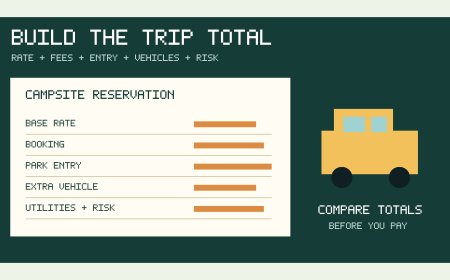
A booking card for Point Supreme
Save this with the reservation:
| Field | Trip entry |
|---|---|
| Season status | Open dates verified for the travel year |
| Site | Number and equipment type |
| Rig fit | RV length, total combination, height, width |
| Site geometry | Entry type, driveway dimensions, grade, surface |
| Utilities | Nonelectric; seasonal potable water status confirmed |
| Waste | Dump station selected before or after stay |
| Power | Battery estimate and generator-window plan |
| Weather | Forecast, lightning timing, nighttime low |
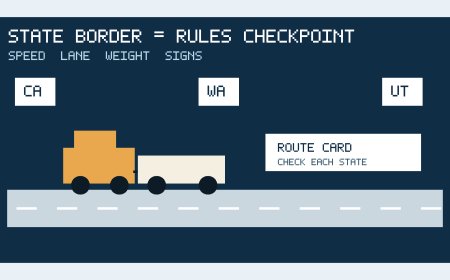
| Route | Official approach plus current Utah DOT check |
| Arrival | Check-in and late-arrival procedure |
| Services | Fuel, food, ice, cellular/Wi-Fi expectations |
| Alternate | Confirmed outside campground if weather or closure intervenes |
The alternate matters because opening and closing dates can move with weather.[5] It also gives a late-arriving driver somewhere legal to go instead of improvising in a pullout.
Bottom line
On October 14, 2026, Point Supreme Campground is closed.[3] Cedar Breaks' open roads and remaining daytime facilities do not authorize overnight parking, and NPS expressly prohibits camping at overlooks and in parking lots.[2]
For an in-season trip, Point Supreme works best for an RV that fits a specific nonelectric site, can manage power inside the two generator windows, arrives with waste and supplies planned, and is ready for cold nights and fast-changing weather around 10,000 feet. Verify the assigned pad line by line. Then verify the road and campground status again before towing uphill.
Sources
- National Park Service: Point Supreme Campground — accessed October 14, 2026.
- National Park Service: Cedar Breaks Campgrounds — accessed October 14, 2026.
- National Park Service: Cedar Breaks Current Conditions — accessed October 14, 2026.
- National Park Service: Cedar Breaks Directions and Transportation — accessed October 14, 2026.
- Recreation.gov: Point Supreme Campground — accessed October 14, 2026.
What's Your Reaction?