























The mushroom beside your campsite is not dinner
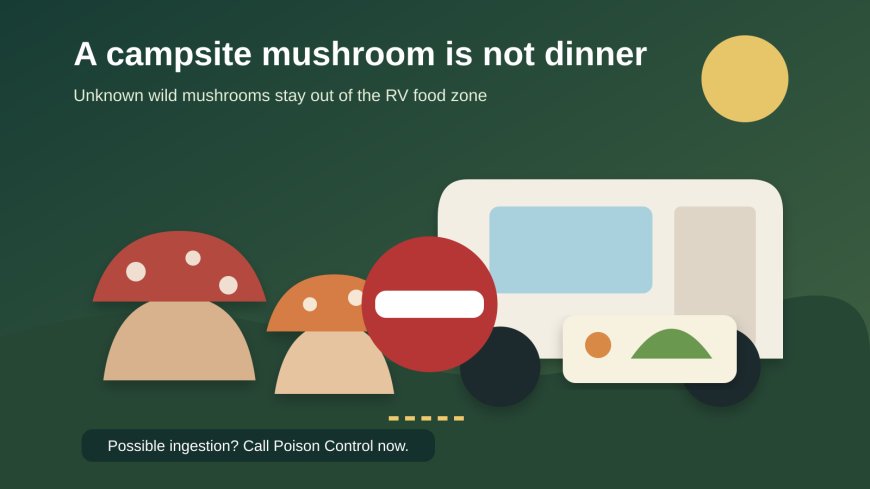
Keep unknown wild mushrooms out of the RV food zone, check collection rules, reject cooking as a toxin control and call Poison Control immediately after a possible ingestion.

The mushroom beside your campsite is not dinner
By Romana | October 15, 2026
A mushroom can appear beside the RV after one wet night. It can also resemble a species somebody remembers eating safely somewhere else. Neither fact makes it food.
CDC reported 39 suspected amatoxin mushroom poisonings in northern California from November 2025 through March 2026. Three people needed liver transplants and four died. Many patients had previously gathered similar-looking mushrooms in other countries.[1] This is not a problem that an RV stove, a photo app or a confident camp neighbor can fix.
The campsite rule is simple: unknown wild mushrooms stay out of the kitchen. Photograph them if you like, keep children and pets away, and leave them where they grow unless the land manager says collection is allowed and a qualified local expert has identified the specimen for food use.
Separate curiosity from the meal plan
Most campsite mushroom mistakes begin before cooking. Someone sees a familiar cap, compares a few pictures, and starts treating the find as an ingredient. That sequence turns uncertainty into commitment. Reverse it.
Keep foraging gear, collected plants and field specimens away from the RV's food-prep zone. Do not place an unknown mushroom on the cutting board, in a grocery bag, beside produce or in the refrigerator. Once fragments and soil enter the galley, it becomes harder to tell what touched the mushroom and whether a child or pet took a piece.
CDC's 2021 national analysis attributed an estimated 1,328 emergency visits and 100 hospital admissions in 2016 to accidental poisonous-mushroom ingestion. Among 556 patients in a separate 2016–2018 analysis, 48 had a serious adverse outcome.[2] The same report says poisonous and edible species can be hard for amateur foragers to distinguish and advises that wild mushrooms should not be eaten unless an expert identifies them.[2]
An expert is not a search result, an image-recognition app or a social-media poll. A photograph may omit the base, gills, bruising, spore color, habitat or other features used in identification. An old field guide from another region can also mislead. The 2026 CDC report notes that affected people mistook California mushrooms for edible varieties they knew from other countries.[1]
Check the collection rule before touching anything
Campground and public-land rules are location-specific. A valid fishing license, campsite reservation or permission to collect berries does not automatically authorize mushroom harvest. Check the exact park, forest, county or private-campground rule before collecting. If the rule is unclear, leave the mushroom in place and ask a ranger or land manager.
Even where limited personal collection is allowed, permission is not an identification. Legal to pick and safe to eat are two separate questions. Do not use the camp host, a neighboring RVer or a campground employee as a food-safety authority unless that person is also a qualified mushroom expert acting in that role.
Commercial mushrooms from a normal food retailer are the easy substitute. Keep the receipt or label, store them according to package directions and cook them with the rest of the meal. The wild specimen can remain a nature observation rather than an ingredient.
Cooking is not the rescue step
A cast-iron skillet, long boil, dehydrator or freezer does not turn a toxic mushroom into a safe one. CDC reports that neither cooking nor another preparation method neutralizes amatoxins.[1] Its national review likewise warns that cooking does not remove or inactivate mushroom toxins.[2]
Do not rely on folklore tests. An onion, silver spoon, insect bite, color change or pleasant smell cannot clear a mushroom for the table. Do not feed a small portion to one adult as a test. Some serious poisonings have delayed symptoms, so a quiet first hour proves nothing.
That delayed window matters in an RV. A group may break camp, lose cell service or drive hours from the nearest hospital before anyone becomes ill. The 2026 outbreak included people who developed abdominal pain, nausea, vomiting and diarrhea eight to 12 hours after eating foraged mushrooms.[1] Build the decision around that travel reality: do not create the exposure.
If somebody may have eaten one, stop the trip clock
Do not wait for symptoms and do not begin driving toward the next campsite. In the United States, call Poison Control at 1-800-222-1222 immediately for a possible wild-mushroom ingestion. Poison Control specifically advises calling right away when someone may have eaten a wild mushroom.[3] Call 911 for collapse, trouble breathing, seizure, severe confusion or another immediate emergency.
While following the poison specialist's instructions:
- note the time and estimated amount eaten;
- identify everyone who ate the same meal, including anyone without symptoms;
- keep the original mushroom, trimmings and meal leftovers separate from other food if that can be done without handling them unnecessarily;
- take clear photos of the cap, underside, stem, base and the place where it grew;
- save packaging or ingredient labels from the rest of the meal;
- write down symptoms and when each began;
- share the campsite name, road access, GPS coordinates and nearest ranger or campground contact.
Do not induce vomiting or give a home remedy unless Poison Control or a clinician tells you to. Do not throw away every remaining specimen before the specialist says whether it may help identification. Keep children and pets away from the saved material, and wash hands after any necessary handling.
If symptoms improve, do not assume the danger has passed. The 2026 CDC report describes amatoxin poisoning as capable of causing liver failure and death.[1] Follow the full medical plan even if nausea or diarrhea settles during the drive or while waiting for care.
Clean the RV galley after a near miss
If an unknown mushroom entered the food area but nobody ate it, discard any food it directly contacted. Wear disposable gloves if available, collect all fragments, and keep them apart from ordinary meal scraps until you are sure no exposure occurred. Wash the cutting board, knife, counter and sink with dish soap and potable water, then apply the normal food-contact-surface sanitizing method used for the RV kitchen.
Check the floor, dinette and pet area for dropped pieces. Small children and animals explore under benches and around picnic tables, which is exactly where fragments can disappear. Do not compost the mushroom at camp or toss it where wildlife can reach it.
If a person or pet may have swallowed any amount, cleaning waits. Call first. For a pet exposure, contact a veterinarian or animal poison service promptly; the human Poison Control number serves people.
Put the decision in the pre-trip briefing
A useful group rule fits on one line: "Nothing gathered at camp enters the food zone without permission and expert identification."
Tell children not to touch or taste mushrooms and to show an adult where they found one. Give adults the Poison Control number before the trip and save an offline map to the nearest emergency department. Remote camping turns response time into part of food safety.
The meal plan should never depend on finding wild ingredients. Pack a substitute for anything the group hoped to forage. A store-bought carton of mushrooms costs little compared with the uncertainty of a field identification made at dusk beside a camp stove.
Source note: This RVCamping.info workflow draws on CDC outbreak and national surveillance reports plus Poison Control response advice. It is a prevention and emergency-preparation guide, not a mushroom-identification guide.
Sources
- Amanita Species Mushroom Poisonings — Northern California, November 2025–March 2026 — CDC MMWR; 39-case outbreak, transplant and death outcomes, misidentification patterns, delayed symptoms and heat-stable amatoxins.
- Health Care Utilization and Outcomes Associated with Accidental Poisonous Mushroom Ingestions — United States, 2016–2018 — CDC MMWR; national estimates, serious outcomes and expert-identification advice.
- Mushroom poisoning: Don't invite the “death angel” to dinner — Poison Control; immediate U.S. poison-center contact guidance for suspected ingestion.
What's Your Reaction?