




















Micro-Air EasyStart Breeze 399 review: lower startup surge, same running load
Research-based EasyStart Breeze 399 review covering RV AC compatibility, installation, generators, 30-amp limits and Bluetooth diagnostics.

The Micro-Air EasyStart Breeze 399 makes sense for RV owners whose air conditioner starts harshly, overloads a correctly sized generator at compressor startup, or needs a gentler inrush profile on limited power.[1] It is also useful when Bluetooth fault data would save a trip to the roof.[1][4]
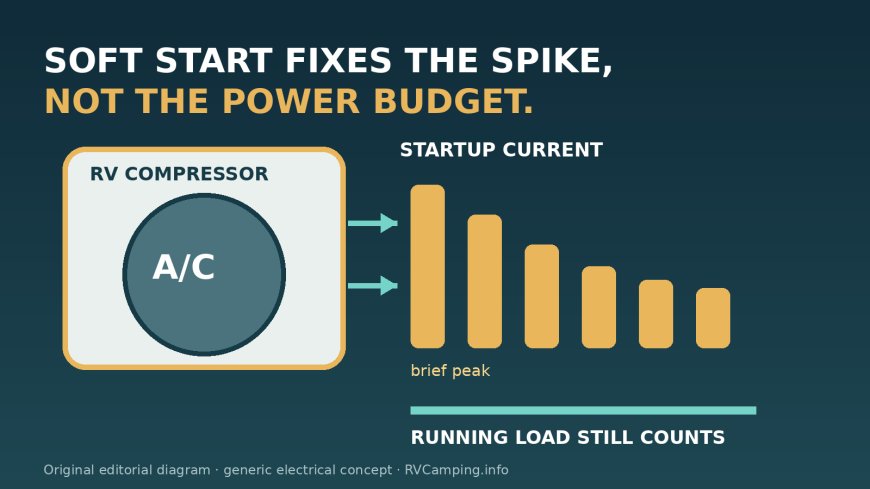
Skip it if you expect a soft starter to make a small battery bank run air conditioning all night, to let a 30-amp pedestal carry more than 30 amps, or to cure low voltage, a failing compressor or undersized wiring. The Breeze reduces the brief startup surge. It does not erase the air conditioner's steady running load.[1][7]
That distinction is the whole review.[1] A successful compressor start is only the first few seconds of a much longer power problem.[1]
This is a research-based review.[1] RVCamping.info did not purchase, install or physically test the Micro-Air EasyStart Breeze 399.[1] The verdict comes from current Micro-Air product and installation documents, the exact Amazon listing, a measured demonstration from the National RV Training Academy and a long-term RV owner installation report.[1]
As an Amazon Associate, RVCamping.info earns from qualifying purchases. If you buy through an Amazon link in this article, we may earn a commission at no additional cost to you.
Check the Micro-Air EasyStart Breeze 399 listing on Amazon.[1] Confirm ASIN B09ZZX67V1 and the Bluetooth Breeze 399 identity before ordering.[6]
The exact model reviewed
This article covers the Bluetooth-equipped Micro-Air EasyStart Breeze 399 sold on Amazon under ASIN B09ZZX67V1.[6]
Micro-Air's current product page identifies the sellable SKU as ASY-399-X20-BL. The company's specification sheet shortens the base model to ASY-399-X20, while the Amazon listing uses model 399. Those labels appear to describe the same Breeze family, with the current product-page suffix identifying Bluetooth. Still, check the carton and unit label rather than assuming every 399 offer includes the same harness, app support or installation kit.[1][3][6]
The Breeze is the newer, smaller RV-focused model in the EasyStart line.[1] Micro-Air says its enclosure is 40% smaller than the older 364 and publishes dimensions of 5.75 by 3.5 by 2 inches with a 40-inch wire harness.[1] The current page specifies 100 to 125 VAC at 50 or 60 Hz for this RV product.[1]
Do not substitute the 230-volt Flex 398 merely because an Amazon title mentions RV use.[1] The Breeze 399 is the manufacturer's current 120-volt RV-specific product.[1] The exact air conditioner, supply voltage and wiring still have to match.[1]
What it changes
An RV air conditioner compressor briefly demands much more current while it starts than it draws after it is running.[1] EasyStart learns the compressor over five successful starts and then shapes that startup instead of hitting the motor with one abrupt surge.[2][4]
Micro-Air claims up to a 75% reduction in starting current. That is a ceiling, not a promise for every compressor, temperature and power source. The National RV Training Academy published one demonstration in which the observed startup peak fell from about 70 amps to 14 amps, then settled at 10.2 amps. It is a useful example, but one installation is not a universal result.[1][8]
The practical benefit is easier starting on a generator, inverter or limited hookup that can support the air conditioner's running load but struggles with inrush. It can also soften the compressor's audible thump and provide fault information through the app.[1][3][4]
What the Breeze does not do matters just as much:[1]
- It does not lower the pedestal breaker's rating.[1]
- It does not turn a 20-amp receptacle into a 30-amp circuit.[1]
- It does not supply missing energy from a battery.[1]
- It does not correct unsafe low voltage or a weak connection.[1]
- It does not make a generator's continuous output larger.[1]
- It does not replace load management when two air conditioners and other appliances share one 30-amp service.[1]
The RVgeeks report that two running air conditioners can consume roughly 25 to 28 amps before a water heater, converter-charger, refrigerator or microwave joins the load. They also added a warning after a reader described tripping a 30-amp pedestal with two air conditioners and a charger running. A Breeze can help both compressors get started. It cannot keep the total below 30 amps once everything is running.[7][1]
Who should buy it
The best candidate has already answered three questions.[2]
First, can the intended power source carry the air conditioner's normal running load?[2] A generator that produces enough continuous power but stumbles only during startup is a strong use case.[2] A generator that is overloaded after the compressor settles is not.[2]
Second, is the air conditioner electrically and physically compatible? The Breeze is for the 100-to-125-volt RV application described by Micro-Air, and installation requires access to the compressor C, S and R conductors. There must also be a secure mounting location inside the air-conditioner enclosure without pinched wires, blocked fans or contact with hot and moving parts.[2][1]
Third, is the owner comfortable proving the installation rather than guessing? Identifying compressor terminals is not a color-matching exercise. Micro-Air warns that it is easy to mistake the compressor R wire for another conductor. Owners who cannot verify the wiring diagram, disconnect every power source and work safely around capacitors should use a qualified RV or HVAC technician.[2]
A good buyer is therefore an RVer who uses a suitable portable generator or inverter, has an otherwise healthy 120-volt air conditioner, and wants to solve a measured startup problem.[2] The Bluetooth diagnostics are a bonus, not the main reason to buy.[2]
Who should skip it
Skip the Breeze when the real problem is steady demand.[7] If the air conditioner draws more running current than the generator, inverter, cable or pedestal can provide, softening startup will not fix the mismatch.[7]
Also skip it until an existing fault is diagnosed.[7] Hard starting can come from poor voltage, loose or overheated connections, a weak run capacitor, damaged wiring, a fan problem or a compressor near failure.[7] Adding electronics before finding the cause can hide the symptom without fixing the system.[7]
Battery-powered shoppers need a full energy budget. A soft start may let an inverter survive compressor inrush, but the battery still supplies the air conditioner's running watts minute after minute. Solar panels only replace energy when conditions and array size allow. They do not make nighttime cooling free.[7][1]
Owners who are not prepared to open the rooftop or basement unit, alter compressor wiring and complete the learning process should budget for professional installation.[7] Micro-Air's warranty terms exclude third-party labor reimbursement, including installation and service fees.[5]
One Breeze per compressor
A Breeze controls one compressor.[7] An RV with two air conditioners needs one correctly installed soft starter on each compressor if both are expected to gain the startup benefit.[7]
Even then, two units on 30-amp service require active load management.[7] Turn electric water heating off, understand what the converter-charger is doing, account for the refrigerator and avoid microwave use while both compressors run.[7] Voltage sag on a crowded campground loop can raise current and erase the small margin left below the breaker rating.[7]
Do not use the installation as a reason to ignore campground rules.[7] If a campground restricts air-conditioner use or generator hours, the restriction still applies.[7]
Installation is simple only when the wiring is understood
Micro-Air's quick guide shows four EasyStart leads and six electrical relationships. Orange connects to compressor S. Black connects at compressor C. Compressor R is removed from line voltage and connected only to EasyStart brown. EasyStart white connects to the old compressor R line-voltage point. Existing start-assist devices are disconnected.[2]
That description is concise because it assumes the installer can positively identify C, S and R. Wire colors vary. Previous repairs may have changed connectors. Some air-conditioner models need specific diagrams or mounting treatment.[2]
Use this safer decision sequence:[2]
- Record the air-conditioner manufacturer, complete model number, serial number, voltage and locked-rotor information from its label.[2]
- Find the model-specific wiring diagram and Micro-Air installation guidance.[2]
- Confirm that the Breeze 399 is the correct 100-to-125-volt product for the exact unit.[1]
- Disconnect shore power, stop and isolate the generator, disable the inverter and open the air-conditioner breaker.[2]
- Verify absence of voltage with suitable test equipment.[2] Treat capacitors as energized until they are safely handled according to the air-conditioner service procedure.[2]
- Inspect the run capacitor, terminals, connectors and insulation for heat damage or corrosion before adding the Breeze.[2]
- Identify compressor C, S and R by the diagram and circuit, not wire color alone.[2]
- Remove any incompatible start-assist components exactly as Micro-Air directs.[2]
- Mount the Breeze and route the 40-inch harness so vibration, the fan, sharp sheet metal and the shroud cannot damage it.[1]
- Close every electrical cover and reinstall the shroud before restoring power.[2]
The Breeze enclosure is marketed as IP65 and weather resistant, but the air-conditioner shroud and electrical compartment remain the first line of protection.[1] Do not leave the module loose on a roof or assume an enclosure rating excuses poor mounting, standing water or damaged cable entries.[2]
The five learning starts matter
After installation, Micro-Air says to let the compressor complete at least five successful cycles on normal mains power before moving to a limited source.[2] Its Bluetooth manual recommends shore or utility power on a circuit that would normally run the compressor.[4] If a generator or inverter is the only option, economy mode should be off during learning.[4]
A start counts only when the compressor runs, not when the fan alone comes on.[4] During a relearn, Micro-Air instructs owners to let the compressor run for at least 30 seconds, shut it down and repeat until five starts are complete.[4]
The learned profile is not a setting to reset casually.[4] Micro-Air lists specific reasons for relearning: the run capacitor changed, the Breeze moved to another motor, corrected miswiring left faults, or the first learning session used a poor source.[4]
After learning, test the intended generator or inverter under realistic conditions. Turn off unrelated loads for the first trial. Let the air conditioner cycle off and restart after the anti-short-cycle delay. Then add other loads one at a time while watching voltage and current. A successful no-load driveway start does not prove that the whole RV power plan works on a hot campsite.[4]
Bluetooth helps diagnose; it does not control temperature
The official app can show status, live current, last-start peak, learned starts, faults and the short-cycle prevention timer.[4] It can also upload diagnostic data to Micro-Air when the phone has internet access.[4]
The app is not a thermostat and does not switch the RV air conditioner on or off.[4] Bluetooth communication also requires the Breeze to be powered.[4] If a fault or control system removes power from the module, connection may not be available until the electrical problem is addressed.[4]
The current reading has another boundary.[4] Micro-Air says it measures current through the EasyStart white lead, which covers most compressor demand but not necessarily the fan, pumps or every branch of the air-conditioner system.[4] Do not use it as a whole-RV ammeter.[4]
Micro-Air specifically warns that last-start peak is not the number to use for generator sizing.[4] Generator compatibility depends on voltage stability, continuous load, waveform, ambient conditions and what else is connected.[4] Test the real combination rather than choosing a generator from one app screenshot.[4]
Leave protection settings alone unless Micro-Air or a qualified technician directs a change.[4] The manual warns that changing fault limits or disabling protection can damage the compressor or Breeze.[4]
Generator and inverter checks
Before the first limited-power run, check both startup and steady operation:[4]
- Compare the air conditioner's measured running demand with the generator's continuous rating, not only its surge rating.[4]
- Include the blower fan and other RV loads.[4]
- Use the generator manufacturer's altitude and temperature derating guidance.[4]
- Keep portable generators outdoors and well away from doors, windows and vents.[4] Never run one in an RV compartment unless the RV was engineered for that installed generator.[4]
- Verify grounding and neutral-bond requirements for the exact RV, transfer equipment and generator.[4]
- Watch voltage through compressor startup and after several minutes of running.[4]
- Stop if a plug, receptacle, adapter or cord becomes hot, discolored or loose.[4]
For an inverter, confirm its continuous output, short surge behavior, transfer configuration, battery-cable capacity and low-voltage limits. Then calculate battery runtime from measured AC energy use and conversion loss. The Breeze solves inrush. The inverter and battery must solve everything after it.[4]
Warranty needs more than the word "extended"
Micro-Air's standard limited warranty covers manufacturing defects for two years from delivery to the original purchaser, subject to its written terms.[5] Third-party purchases are handled through the reseller, and Micro-Air says it does not reimburse third-party installation or service fees.[5]
The separate Double Down coverage is narrower than the product-page badge may suggest.[5] It applies to an RV rooftop air conditioner less than six years old at purchase and installation, must be registered within 30 days with the air-conditioner serial number, lasts within the same two-year period and excludes labor.[5] The terms also require other applicable air-conditioner warranties to be pursued first and may require return shipping at the owner's expense.[5]
Save the Breeze receipt, seller record, air-conditioner model and serial number, installation photos and registration confirmation.[5] If warranty coverage matters, read the current terms before installation rather than after a failure.[5]
Reliability and inspection
A roof-mounted electronic module lives with heat, vibration and moisture.[4] Inspect the installation at the start of cooling season and after any rooftop service.[4] Look for a loose enclosure, rubbed insulation, strained connectors, corrosion, water tracks, overheated terminals and anything that can contact the fan.[4]
Use the app's fault history as a lead, not a verdict.[4] A low-voltage or stall fault can originate upstream.[4] Check pedestal voltage, plugs, adapters, transfer equipment, breaker connections and the air conditioner's own components before blaming the Breeze.[4]
The RVgeeks describe using EasyStart units on their motorhome and emphasize that model-specific steps can differ. NRVTA's measured demonstration shows how large the reduction can be on one system. Together, they support the product's basic purpose. Neither proves that every compressor will start from every advertised generator.[7][8][4]
Verdict
The Micro-Air EasyStart Breeze 399 is a sensible RV air-conditioner upgrade when startup inrush is the measured obstacle and the available source can already carry the running load. Its compact 120-volt RV design, five-start learning process and Bluetooth diagnostics give owners more than a basic start capacitor.[1][2][4]
The catch is electrical reality.[1] It cannot create amperage, repair low voltage or stretch a small battery through hours of cooling.[1] Two air conditioners can still consume almost an entire 30-amp hookup after both are running.[7]
Buy it for a healthy, compatible air conditioner when you can install and test it correctly.[1] Skip it when the proposed fix begins with "maybe this will let the undersized system handle it." Measure the running load first.[1] If that number does not fit, a softer start will not rescue the plan.[1]
Sources
- Micro-Air EasyStart Breeze product page
- Micro-Air EasyStart Breeze quick installation guide
- Micro-Air EasyStart Breeze specification sheet
- Micro-Air EasyStart Bluetooth operation manual
- Micro-Air legal and warranty terms
- Amazon listing: Micro-Air EasyStart Breeze 399
- RVgeeks: Micro-Air EasyStart Breeze overview and installation
- National RV Training Academy: measured Micro-Air EasyStart demonstration
What's Your Reaction?