























A Sno-Park permit is not an overnight RV reservation
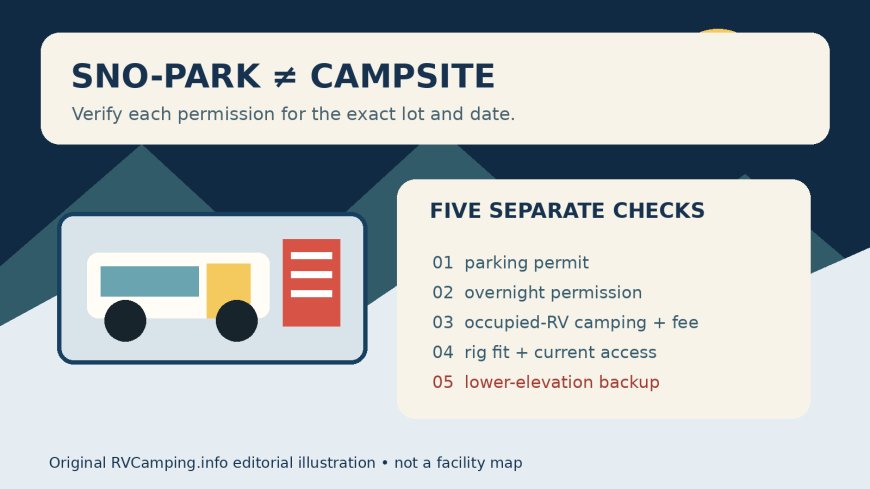
A permit-first winter route card that separates daytime parking, overnight permission, occupied-RV camping, added fees, rig fit and backup stops.

A Sno-Park permit is not an overnight RV reservation
By Romana | October 15, 2026 | RV Camping
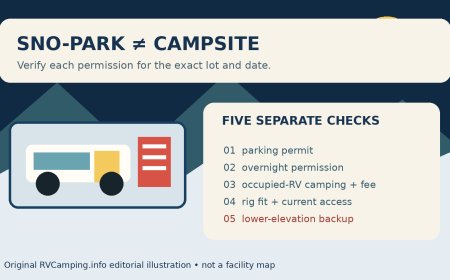
Quick answer: Treat a Sno-Park as a managed winter parking facility, not an automatic campsite. Before building one into an RV route, verify four separate permissions for the exact lot and date: vehicle parking, overnight parking, camping in the RV, and any added fee or permit. Then check the lot’s operating hours, current access, plowing priority, vehicle fit and a legal backup. A permit on the windshield answers only the permit question.

Source credit: This planning guide is based on current Washington State Parks, Oregon Department of Transportation and Caltrans pages retrieved October 15, 2026. It does not claim a stay at any listed facility, and it does not replace posted signs, land-manager directions or live road conditions.
A winter map can make a plowed mountain lot look like a convenient overnight waypoint. That visual shortcut is risky. The same “Sno-Park” label can describe a day-use lot that closes at dusk, a lot where overnight RV parking is allowed for an additional charge, or a parking program whose public page says nothing about camping. The useful unit of research is the individual facility, not the program name.
Split one question into four
Do not ask only, “Do I have a Sno-Park permit?” Make four rows on the route card:
- May this vehicle park here today? Record the required base permit, any additional trail-area permit, display method and vehicle-specific rule.
- May it remain after the posted closing time? Look for explicit overnight permission or prohibition and the lot’s hours.
- May occupants sleep or camp in the RV? Parking permission and camping permission are not interchangeable.
- Is there a separate overnight charge, registration step or reservation? Record the amount only from the current facility page or land manager, not from an old trip report.
Washington’s statewide page says Sno-Park parking requires a one-day or seasonal permit and may also require a special groomed-trails permit. Its one-day permit runs only until midnight on the written date.[1] That describes parking authorization and duration. It does not, by itself, promise an RV camping space after midnight.
Washington State Parks makes the distinction visible in its own winter-camping guidance: many Sno-Parks allow RV parking, but Hyak, Gold Creek and Cabin Creek are named as places without overnight parking; the agency also says some Sno-Parks charge RV campers an overnight fee in addition to the Sno-Park permit and tells travelers to check with the land manager.[2] The program-wide permit and the lot-specific overnight answer are separate documents.
Use Hyak as the “permit does not equal camping” test
Hyak Sno-Park is a clear example. Its facility page lists a Sno-Park permit requirement, operating hours of 8 a.m. to dusk and “No overnight parking allowed.”[3] A valid permit does not erase either the hours or the overnight prohibition.
Put that logic into the route card:
- Facility: Hyak Sno-Park
- Base parking permit: required
- Additional area requirement: verify the current special-fee rule
- Published hours: 8 a.m. to dusk
- Overnight parking: not allowed
- RV camping: therefore not a route-night option
- Action: use only within current hours, then move to a separately verified overnight location
This is not a claim that every Washington Sno-Park has Hyak’s rules. It is the opposite: the individual page can narrow what the general permit page appears to offer. Check the exact lot every time.
Treat an “RV parking” sentence carefully
Washington’s winter-camping article says Lake Easton allows RV camping in a parking lot and gives a nightly price in addition to the Sno-Park permit.[2] That is explicit enough to justify further planning, but it still is not a reservation confirmation for a future date. Prices, seasons, capacity, access and procedures can change.
Before relying on a lot that appears to allow winter RV camping, contact the listed land manager and record:
- exact winter dates when overnight use is offered;
- whether the use is first-come or reservable;
- the current nightly fee and payment method;
- arrival deadline and what to do if staff are absent;
- maximum motorhome length or complete tow-vehicle-and-trailer length;
- whether a trailer may remain attached;
- where snow-removal lanes, turnarounds and emergency access must stay clear;
- generator, quiet-hours, fire and waste rules;
- whether toilets or potable water are operating;
- whether the lot can close during storms, avalanche work or highway closures.
Write the staff member or agency contact, date and exact answer on the route card. “A blog said RVs can stay” is too weak for an arrival after dark in active snowfall.
In Oregon, do not read beyond the parking page
Oregon DOT describes Sno-Parks as designated winter recreation parking areas. Its page says a displayed permit is required from November 1 through April 30, warns that highway plowing takes priority over Sno-Park plowing, and directs travelers to find a safe, legal place rather than park along the road.[4]
Those statements support a parking plan. They do not establish that every Oregon Sno-Park permits sleeping in an occupied RV. If the exact facility listing and land manager do not expressly answer the overnight question, mark the route card unknown, not allowed.
For an Oregon stop, verify these as separate lines:
- the current permit and where it must be displayed;
- who manages the exact lot;
- whether overnight parking is allowed;
- whether occupied-vehicle camping is allowed;
- the current hours and posted signs;
- whether plowing, storm operations or a full lot can make the stop unavailable;
- a second legal overnight location reached before the driver’s stop time.
ODOT also warns that a driver who leaves a vehicle on a signed no-parking section of state highway or shoulder can be ticketed and towed.[4] A full Sno-Park is not permission to place a long RV on the approach shoulder.
Do not turn a chain-up pullout into a campsite
A chain installation area answers a different road-safety problem. Caltrans tells drivers to get the vehicle entirely clear of the travel lanes on the right before fitting chains and to use a safe pull-off beyond the end-of-control sign for removal.[5] That guidance identifies where to complete a short equipment task safely. It does not describe an overnight RV facility.
Keep three symbols separate on the winter route map:
- chain-up or chain-off area: temporary equipment work only unless another official rule expressly says more;
- Sno-Park: winter recreation parking governed by its permit, hours and lot-specific rules;
- verified overnight stop: occupied RV stay expressly allowed for the date and configuration.
A place can serve more than one function, but the traveler needs official confirmation for each function. Do not infer overnight permission from pavement, lighting, trash cans, other parked RVs or a location pin.
Audit whether the complete rig fits winter operations
Legal permission is only one gate. A plowed passenger-car lot may still be a poor choice for a motorhome or attached trailer. Confirm the combined length, width, height and turning path with the land manager. Ask whether snowbanks reduce usable space and whether the exit can be blocked by vehicles arriving later.
Plan the parking maneuver before the rig enters:
- Can the combination turn around without backing into a snowbank or trail entrance?
- Is there a marked RV area, and must the trailer be detached?
- Where will plows stack snow overnight?
- Can slides, steps or stabilizers remain inside the assigned footprint?
- Is the surface level enough for the RV’s appliance and chassis limits?
- Will departure require chains or traction devices before reaching the highway?
Do not deploy slides, awnings, mats, chairs or leveling equipment into another stall, a plow lane or an emergency route. An overnight fee is not a promise of campsite-style space.
Build a two-stop backup, not one hopeful pin
Winter lots can fill or become inaccessible. Oregon says highways have higher plowing priority than Sno-Parks.[4] Hyak’s page also notes that grooming can be suspended during a pass closure or high avalanche danger.[3] Neither fact means a particular lot will be closed on a particular future night; both are reasons to avoid treating one parking pin as guaranteed shelter.
Record two backups:
Backup A should be a lower-elevation campground, RV park or other occupied-RV location whose winter operation and arrival procedure are confirmed.
Backup B should be a legal place to stop earlier if the pass, lot or final approach becomes unsuitable. It should not require crossing the same problem segment that defeated the first plan.
Set a decision time while there is daylight and fuel margin. If the primary lot’s permission, access or space cannot be confirmed by that time, use the backup. Do not arrive at a full snow lot and begin researching shoulder parking from the driver’s seat.
The call sheet to save offline
For every winter overnight candidate, save one page with:
- facility name, coordinates and managing agency;
- travel date and date the information was checked;
- base parking permit and any additional permit;
- overnight-parking answer;
- occupied-RV camping answer;
- fee, payment method and reservation status;
- operating hours and arrival procedure;
- complete rig dimensions and stated fit limit;
- plow-lane, trailer, generator, fire and waste rules;
- official condition page and phone number;
- Backup A, Backup B and the switch time.
Use yes / no / unknown, not a blank. An unknown permission is a reason to call or choose another stop. It is not a flexible yes.
Recheck at three moments
When choosing the route: verify the facility’s published purpose, manager and winter permit system. Reject any location that has no authoritative overnight answer.
The day before travel: recheck the individual lot page, road conditions, weather, permit status and the two backups. Confirm any time-sensitive price or operating detail with the manager.
Before the final climb: stop legally, update the road and lot status, and compare the live signs with the saved call sheet. Posted restrictions and on-scene directions control. If the lot is closed, full or incompatible with the rig, take the backup before passing the last safe diversion.
The disciplined question is not “Can an RV fit in that snowy parking lot?” It is “Has the manager authorized this exact use, and can the complete rig enter, stay and leave without interfering with winter operations?” A Sno-Park permit may be one part of that answer. It is never the whole reservation.
Sources
- Sno-Park Permits — Washington State Parks — permit types, one-day validity and additional groomed-trail permit; accessed October 15, 2026.
- Warm-up to winter camping — Washington State Parks — agency examples of overnight RV use, added fees and lots without overnight parking; accessed October 15, 2026.
- Hyak Sno-Park — Washington State Parks — lot hours, permit requirement, land manager and no-overnight rule; accessed October 15, 2026.
- Parking in Winter Recreation Areas — Oregon Department of Transportation — Oregon permit season, plowing priority and roadside-parking warning; accessed October 15, 2026.
- Chain Controls / Chain Installation — Caltrans — safe pull-off instructions for installing and removing chains; accessed October 15, 2026.
What's Your Reaction?