





















Before storage or travel, check a flooded RV battery without guessing the water level
Confirm a serviceable flooded battery, set a no-spark acid-safe work area, inspect every cell, and follow the exact manual's charge-and-water sequence.


By Romana | October 13, 2026
A battery with removable vent caps may need an electrolyte check before a long storage period or a travel day. That does not make cap removal a routine step for every RV battery. This job is only for a confirmed flooded, serviceable lead-acid house battery whose exact manual permits owner watering.
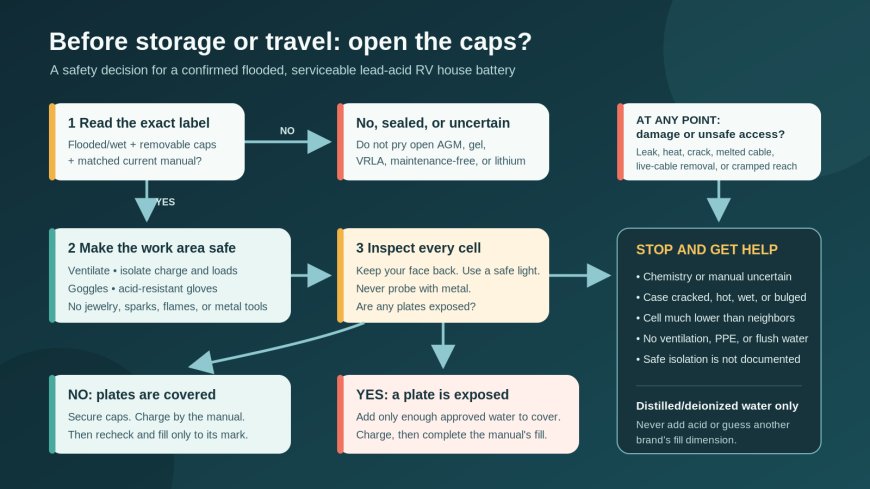
Do not open an AGM, gel, valve-regulated lead-acid (VRLA), "maintenance-free" lead-acid, or lithium battery. Do not use this checklist to identify chemistry by case shape. Read the label and model number, then obtain the current battery manual. Trojan says water should never be added to its AES/AGM or gel batteries. U.S. Battery says never to remove an AGM battery's caps.[1][2]
This guide handles one narrow decision: whether a serviceable flooded cell is safe to inspect, whether it needs water now, later, or not at all, and when to stop. It does not choose a storage state of charge, a disconnect position, or a charging profile. Those belong to the exact battery, RV, converter or inverter/charger, and solar-controller manuals.
Start with a label check, not a screwdriver
Photograph the battery label where it sits. Record the maker, full model number, voltage, and every chemistry or construction term. Look for the manual's own words: flooded, flooded/wet, vented, removable vent caps, watering, or an approved remote watering system.
Stop if the label is unreadable, the model cannot be matched to a current manual, or the enclosure hides the battery type. A vent-looking feature is not permission to pry. Some sealed batteries have safety valves that are not service caps.
The installed location matters too. If reaching the caps requires lifting a heavy battery, removing live cables, leaning over exposed terminals, defeating a hold-down, or working in a cramped compartment, this is no longer a simple owner inspection. Have a qualified RV electrical or battery technician do it under the applicable manuals.
Set up for acid, current, and gas
A 12-volt house battery can still deliver enough fault current to heat a tool or jewelry rapidly. Flooded electrolyte contains sulfuric acid, and charging can release a flammable mixture of hydrogen and oxygen. The Bureau of Reclamation's battery-safety manual is written for large stationary systems, not RV ownership, but the hazards it identifies still explain the conservative boundary: guard against sparks, protect eyes and skin, keep ventilation open, and have immediate flushing water available.[3]
Before touching a cap:
- Park outside or open the battery compartment exactly as the RV and battery manuals require. Never work in an unventilated compartment.
- Turn off charging sources and loads in the required sequence. Shore power, generator, solar, alternator charging, inverter functions, and automatic generator start can create different live paths. If the manuals do not give a safe isolation sequence, stop.
- Remove rings, watches, bracelets, and other metal jewelry. Keep flames, smoking materials, and spark-producing work away.
- Wear chemical splash goggles, acid-resistant gloves, and protective clothing. A face shield adds splash coverage but does not replace goggles.
- Put clean flushing water within immediate reach before opening anything. Know the battery manual or safety data sheet's first-aid directions.
- Use only insulated tools required by the manual. Keep tools and loose hardware off the battery top.
- Keep distilled or deionized water in a clean, clearly identified container. Never bring acid, electrolyte additives, or a metal funnel to the job.
Trojan lists eye protection, acid-resistant gloves, distilled or deionized water, insulated tools, and baking soda among its maintenance equipment. It also says to keep sparks and flames away, avoid direct electrolyte contact, and never add acid.[1] U.S. Battery similarly calls for ventilation, acid-resistant gloves, goggles, protective clothing, insulated tools, and secure vent caps after maintenance.[2]
Baking soda is for neutralizing a small spill on an exterior surface when the product instructions allow it. It does not belong in a cell. Do not put a neutralizing solution on skin or in eyes; use water and follow the product safety data sheet and emergency medical guidance. The Bureau of Reclamation instructs workers to flush an acid splash with water for at least 15 minutes and obtain medical attention, but the battery's current safety data sheet and emergency services control your response.[3]
Inspect the outside before opening a cell
Use a light that will not create a spark. Do not open the battery if you find a cracked case, bulging, wetness or residue that could be electrolyte, a hot case, damaged cables, a loose or melted terminal, a missing vent cap, or a strong unexplained odor. Isolate the area without touching leaked material and call the battery maker, RV service provider, or emergency services as the condition requires.
Fluid on top is not a cue to add more water. Trojan and U.S. Battery both say it can indicate overfilling or overcharging on a flooded battery.[1][2] Correct the cause before travel or unattended storage.
If the battery is clean, cool, upright, intact, and safely accessible, clean loose dirt from around the cap area without pushing debris into a cell. Follow the battery manual for the cap design. Set removable caps with the underside protected from contamination; do not balance them on a dirty battery tray.
Read every cell, then choose one of three actions
Shine the safe light across the opening rather than putting your face over it. Do not insert a metal object. Check every cell because one low cell can be hidden by five normal ones.
1. Plates are exposed: protect them before charging
Both manufacturer manuals in this package make an exception to the normal "water after charging" sequence. If plates are exposed, add only enough approved water to cover them, then charge under the exact manual. Finish watering after the full charge.[1][2]
That is a stop-and-correct condition before storage or travel. Do not fill to the final mark while the battery is discharged. Electrolyte expands during charging, so premature final filling can contribute to overflow. An unexpectedly low cell, especially when other cells are normal, also deserves manufacturer or technician review rather than repeated topping off.
2. Plates are covered, but the level may be below the final mark: charge first
Replace and secure every cap before charging. Use the battery maker's approved charging profile in a ventilated location. U.S. Battery explicitly warns that removing caps during charging is an explosion hazard; Trojan also requires secured caps and ventilation.[1][2]
After the battery reaches the manual's fully charged condition and the manual says it is safe to inspect, shut down charging again through the required sequence. Reapply the same PPE and no-spark setup. Then fill each cell only to that model's specified mark or geometry.
Do not import a measurement from another brand. The U.S. Battery manual in this package specifies a level 1/4 inch (6 mm) below the bottom edge of its fill-well tube for the covered products. Trojan directs owners to its own Figure 5, which distinguishes a standard vent well from a vent well with a level indicator.[1][2] The lesson is not to average those instructions. Use the one that belongs to the battery in front of you.
3. Level is correct: add nothing
More water is not preventive maintenance. Overfilling can push electrolyte out during charging, leave acid on the case or tray, and reduce the intended headspace. Refit the caps exactly as the manual shows and wipe only as directed. Record the date and result.
Use water, not additives
For the Trojan products covered by its guide, the instruction is distilled or deionized water only. U.S. Battery also specifies distilled or approved water and says never to add anything else.[1][2] Do not add sulfuric acid to replace water lost in normal service. Do not add tap water, bottled drinking water, Epsom salt, or a battery "rejuvenator" unless the exact current battery manual expressly requires that product.
Pour slowly with a clean nonmetallic tool approved by the maker. Stop at the specified level. If visibility is poor, access is awkward, or the cell geometry is unclear, stop rather than filling by feel. A maker-approved remote watering system follows its own inspection and filling procedure; do not remove it merely to use a generic checklist.
Close the job before the RV moves
Secure every cap and confirm the battery hold-down and compartment cover are in their documented positions. Remove tools and the water container. Check that no liquid, rag, or loose hardware remains near the terminals. Restore charging and loads only in the sequence required by the RV and component manuals.
For travel, verify the battery is restrained, upright, dry, and ventilated. For storage, continue with the battery's specified full-charge, isolation or maintenance-charge plan and its inspection interval. An electrolyte check does not prove that a battery is charged, healthy, or safe to leave unattended.
Write down:
- battery make and full model;
- date, charge state at inspection, and whether plates were exposed;
- cells that received water and the approximate amount;
- exterior wetness, corrosion, heat, or cable defects;
- the manual revision used;
- who will recheck the battery and when.
A cell that needs much more water than its neighbors, repeated exterior wetness, rapid water loss, or a battery that runs hot points to a charging, leakage, or cell problem. Stop treating the symptom and get the battery and charging system checked before the next trip or storage period.
Source note: This RVCamping.info procedure compares current official manuals from Trojan Battery Company and U.S. Battery with federal battery-safety guidance. Manufacturer dimensions and sequences apply only to the products covered by those manuals. The exact battery, RV, charger, solar, and safety-data-sheet instructions take precedence.
Sources
- Trojan AES, AGM, Gel and Flooded User's Guide — Trojan Battery Company, document 2023005; safety, inspection, flooded-only watering, charging, and sealed-battery boundaries.
- Deep Cycle Battery User Manual — U.S. Battery Manufacturing Company; safety, inspection, flooded-only watering, fill-well level, and charging precautions.
- Storage Battery Maintenance and Principles, FIST 3-6 — U.S. Department of the Interior, Bureau of Reclamation, April 2020; explosive, electrolyte, PPE, flushing, and ventilation hazards. Its operational requirements are for Reclamation facilities, not RV owners.
What's Your Reaction?