























Don’t let firewood become cargo: build a boundary-safe RV campfire plan
A stop-by-stop RV plan for checking fire rules, buying compliant local wood, keeping source proof, and handling leftovers without crossing boundaries.

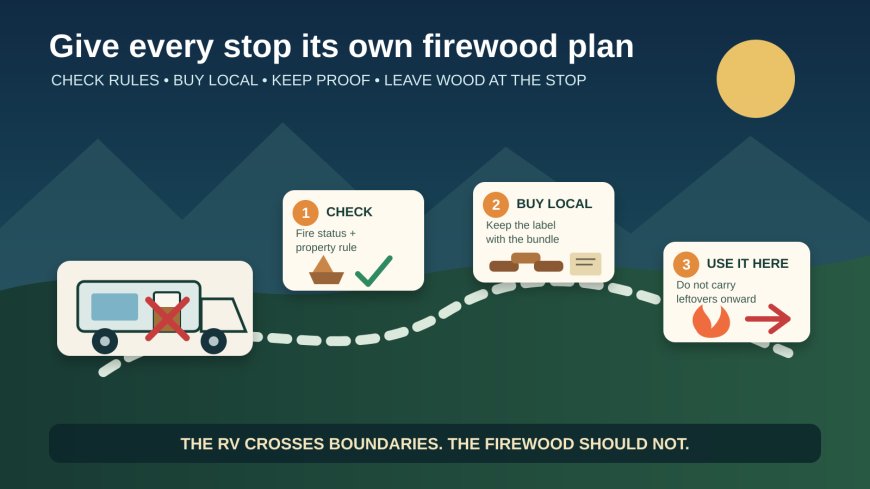
Don’t let firewood become cargo: build a boundary-safe RV campfire plan
By Romana | October 15, 2026 | RV Camping
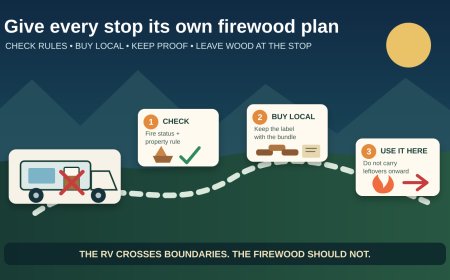
Quick answer: Leave home firewood at home. For every overnight stop, first confirm that fires are allowed, then check the destination’s firewood rule and arrange a local or properly certified bundle near that stop. Keep its label or receipt until the wood is gone. Buy only what you expect to burn, and never carry leftovers to the next campground.

The bundle beside the garage looks harmless. On a multi-state RV trip, though, it can become the one piece of cargo that fails at a state line, a quarantine boundary, or a campground gate.
There is no useful nationwide mileage number that makes every load legal. Rules can come from a state, a pest quarantine, a park system, or an individual property. USDA’s Animal and Plant Health Inspection Service warned on October 1, 2026 that multiple states restrict untreated firewood within a state or across state lines and told travelers to follow the rules for every place where they camp.[1] The practical response is not a thicker stack of wood in the pass-through. It is a stop-by-stop purchase plan.
Make firewood part of route planning, not packing
Plan firewood at the same time you record fuel stops, arrival windows, and gate codes. Add one row for each campground:
| Stop | Fire status | Property rule | Legal source | Proof to keep | Leftover plan |
|---|---|---|---|---|---|
| Campground A | Check 24–48 hours before arrival | Link or phone confirmation | Camp store or nearby seller | Receipt/label | Burn there or ask host |
| Campground B | Check again | Link or phone confirmation | New local bundle | Receipt/label | Do not move onward |
| Campground C | Check again | Link or phone confirmation | New local bundle | Receipt/label | Burn there or leave as directed |
That last column matters. Firewood is not like a bag of charcoal that automatically follows the RV to the next reservation. USDA advises using wood at the place where it was obtained and not taking the remainder to another site.[1] The National Park Service gives the same return-trip advice: do not haul campground wood home; ask whether it may be left at the site or with the host.[2]
The cheapest plan is often to buy one small bundle after arrival. If the weather turns wet, a burn ban starts, or everyone goes to bed early, you have not paid for a stack that now needs a legal disposition.
Run four checks for every stop
A campground listing with a fire-ring icon answers only one question: the site has a ring. It does not prove that a fire will be permitted on your dates, that outside wood is allowed, or that a store will be open when you arrive.
1. Is a fire permitted now?
Check the land manager’s current alerts shortly before the stay. Look for a burn ban, seasonal restriction, air-quality rule, red-flag closure, or a ban on wood fires while gas appliances remain allowed. The National Park Service tells campers to review park sites or Recreation.gov for current fire restrictions and collection rules before packing fire supplies.[2]
Record the date and time of the check. If the official page is vague, call the campground. A screenshot can help you remember what you read, but staff direction at arrival controls what happens on the property.
2. May outside firewood enter the property?
Read the exact campground or park rule. Do not stop after reading a statewide summary. A property can be stricter than the surrounding state, and one managing agency may treat certified wood differently from a private campground next door.
Wisconsin shows why the property check cannot be skipped. Its Department of Natural Resources says firewood from more than 10 miles away may not enter state parks and other DNR lands unless it qualifies under the state-certified exception.[4] The same agency warns that tribal and non-DNR campgrounds may set different policies, including whether they accept certified bundles.[4]
Your route card should therefore name the property and managing agency, not merely the state. “Wisconsin: okay” is not a decision record. “Lake X campground, operated by Y, outside wood prohibited; camp store closes at 7 p.m.” is useful.
3. Does a state or quarantine boundary restrict the route?
Treat each state line as a fresh firewood decision. Then look for pest quarantine boundaries inside the state. USDA notes that restrictions can apply both within states and across their borders.[1]
New York offers a clear example of why a generic “under 50 miles” rule is unsafe. New York prohibits untreated firewood from entering from another state or country. Untreated wood grown in New York is limited to 50 straight-line miles from its source or origin, and moving personal-cut wood requires a self-issued certificate.[3] A separate pest quarantine can impose a tighter boundary; New York directs travelers to obey whichever rule is more restrictive.[3]
The takeaway is not to memorize New York’s numbers for every trip. It is to ask four precise questions:
- Where was this wood grown or sourced?
- Is it untreated or covered by an accepted treatment certification?
- Which state, quarantine, and property boundaries will the RV cross before the wood is burned?
- What document must travel with the bundle?
If any answer is uncertain, do not load the wood.
4. Where will you buy a compliant bundle?
Choose a primary seller and a backup before leaving reliable service. Start with the campground. If it does not sell wood, ask staff for nearby sources that meet the property rule. Record hours, payment method, distance from the route, and whether late arrival makes the plan impossible.
The NPS suggests checking whether the campground sells firewood and, if it does not, locating the nearest source in advance.[2] Its general guidance favors wood obtained within 10 miles of the destination and treats 50 miles as too far for a default assumption, while still directing travelers to verify local limits.[2] A park-specific limit, state rule, or quarantine wins over that general planning guidance.
Do not assume that a convenience store near the interstate is local to a campground another hour away. Ask where the wood came from and inspect the label before paying.
Read “heat-treated” as a documented claim
“Dry,” “seasoned,” and “kiln-dried” are not automatic substitutes for an accepted certification. New York says air seasoning is not an approved treatment for transported firewood, and kiln processes vary; its unrestricted category requires a specific treatment and label.[3]
For packaged wood, look for:
- the mark of the certifying state or federal program;
- the producer’s name and address;
- treatment wording required by the destination;
- a readable, attached label rather than a seller’s verbal assurance;
- a receipt that identifies the source when the rule calls for one.
The National Park Service says most packaged heat-treated wood with a USDA APHIS or state treatment seal is considered safe to move, but advises buying at the destination when certification is unclear.[2] USDA likewise tells buyers to look for a state or federal mark on heat-treated packages.[1]
Certification is not permission to ignore the campground. Wisconsin’s DNR accepts Wisconsin-certified wood on DNR properties, yet it explicitly says other properties may decide differently.[4] Send the campground a photo of the proposed label if you need a ruling before arrival, and keep the reply with the reservation.
Build the purchase around RV arrival realities
A good ecological rule can still fail as a travel plan if the store closes before the RV gets there. Add the following to the arrival card:
- seller name and phone number;
- closing time on the arrival day;
- after-hours purchase method;
- cash, card, or honor-box requirement;
- bundle quantity you expect to use;
- backup activity if fires are prohibited or wood is unavailable.
Late arrival deserves special attention. Do not “solve” a 9 p.m. check-in by buying questionable wood 150 miles earlier. Bring a meal that does not depend on a fire and plan an evening that works without one. Wisconsin even suggests reducing open-fire demand by cooking with another permitted fuel or choosing a different nighttime activity.[4]
A firewood-free first night also protects campground neighbors from an arrival-time scramble. Park, level, connect what you need, and deal with wood in daylight.
Keep proof with the bundle, not in an email maze
Put the receipt and label in a clear bag or take one photo that shows the entire label. Save it in the same offline trip folder as the campsite confirmation. Name the file by date and stop, such as 2026-10-18-stop2-firewood-label.jpg.
Keep these details until the bundle is used:
- purchase date and place;
- stated source or origin;
- certification agency and mark, if applicable;
- producer information;
- intended campground;
- the property rule you checked.
This is not paperwork for its own sake. New York requires source documentation for purchased untreated wood and a specified label for its approved heat-treated category.[3] A loose bundle with no readable origin can turn a simple gate conversation into surrendering the wood.
Handle leftovers before checkout
Do not move unused wood to the next stop simply because both campgrounds allow fires. The second property may sit outside the permitted radius or beyond a quarantine line.
Use this order:
- Buy less at the start.
- Burn only while fires are permitted and fully extinguish the fire according to campground rules.
- Ask the host whether clean, unused pieces may remain for another camper.
- Follow the property’s disposal instruction if wood cannot stay.
- Never dump wood beside a road, trailhead, or closed fire ring.
Wisconsin tells campers to use their wood at each vacation stop rather than carry it to another destination.[4] USDA’s 2026 reminder gives the same direction for leftovers.[1]
Do not try to “make it safe” by removing bark, wrapping the bundle, spraying it, or leaving it in a hot storage bay. Those improvisations are not treatment certifications.
A 10-minute predeparture firewood audit
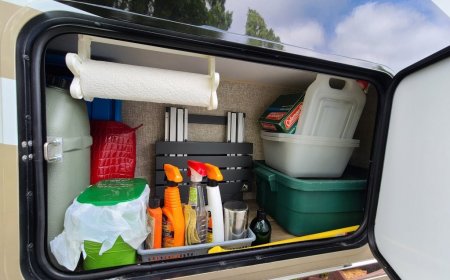
Before the RV leaves home, walk the exterior compartments. Firewood gets forgotten behind leveling blocks, chairs, and grills.
- Remove loose logs, kindling, bark, and wood scraps.
- Check the truck bed, toad, roof box, and rear cargo tray.
- Delete “bring wood” from the shared packing list.
- Add a fire-status link and local seller to each campground row.
- Download rules and seller details for places with weak cell service.
- Pack a fire-independent dinner and one no-fire evening option.
- Tell everyone in the group that an unused bundle does not transfer to the next stop.
This plan has one hard rule: every campground gets its own firewood decision. The RV can cross three states in a day. The wood should not.
Sources
- Help Protect America’s Trees: Buy Firewood Where You Burn It — USDA APHIS (published October 1, 2026; retrieved October 15, 2026).
- I Didn’t Know That!: Don’t Move Firewood — National Park Service (retrieved October 15, 2026).
- Firewood and Invasive Pests — New York State Department of Environmental Conservation (retrieved October 15, 2026).
- Firewood Rules and Resources — Wisconsin Department of Natural Resources (retrieved October 15, 2026).
What's Your Reaction?