
























Indian Well Campground for RVs: The 30-Foot Ceiling Is Only the First Test
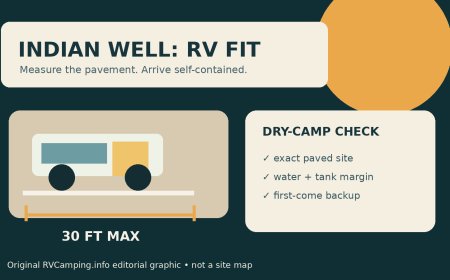
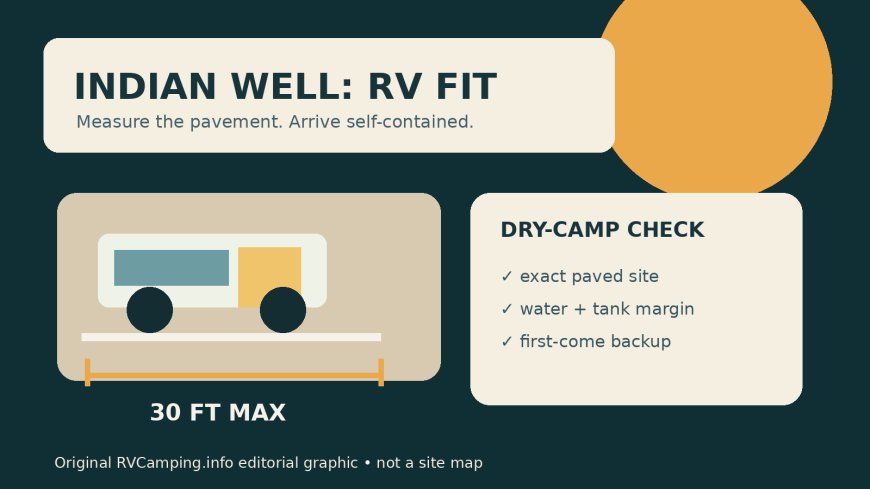
Indian Well suits compact, self-contained RVs that can fit the exact paved site and arrive with a dry-camping and first-come backup plan.

Indian Well Campground for RVs: The 30-Foot Ceiling Is Only the First Test
By Romana
October 14, 2026
Indian Well Campground is the only developed campground inside Lava Beds National Monument. It puts you half a mile from the visitor center and Cave Loop, keeps part of the campground open through winter, and does not make standard-site campers fight an online reservation window. It also asks RV travelers to accept a few hard limits: no hookups, no showers, no dump station, first-come selection, and pavement that must contain the whole setup. [1][2]
That combination suits a small motorhome, camper van, truck camper, or compact trailer far better than a long towable. The published 30-foot maximum is a screening number, not a promise that every open site will fit every 30-foot rig. Recreation.gov warns that not all sites can accommodate motorhomes, and individual driveways vary. Site A1, for example, lists a 26-foot paved driveway. [4]
The useful booking question is therefore not simply, “Am I under 30 feet?” It is, “Can I arrive self-contained, choose a pavement envelope that holds the RV and tow vehicle, and live with no reservation for a standard site?”
The quick fit decision
Indian Well is a strong match when all of these statements are true:
- Your motorhome, trailer, or camper is no longer than 30 feet, and your complete parked combination can stay on the selected site's pavement.
- You can arrive with enough onboard water and tank capacity for a dry stay.
- You are comfortable selecting a standard site after arrival rather than reserving one.
- A campground near cave access matters more than electric service, a dump station, or showers.
- You can tolerate a backup plan if the suitable paved spots are already occupied.
Choose another base if your RV exceeds the posted ceiling, your trailer and tow vehicle cannot fit without borrowing another campsite, anyone in the party needs guaranteed electrical service, or a late arrival would leave you unwilling to search for an acceptable site in the dark. The reservable group site does not solve the RV problem: the park prohibits RVs and camper trailers there. [1][4]
What “first come” requires in practice
The 43 standard sites are first-come, first-served. The official process is to occupy an available standard site, buy the required permit at the campground information or self-registration station, and attach it to the site post. The superintendent's rules require the permit within 30 minutes of occupying a site. You cannot pay to hold a standard site for someone else. [1]
That process rewards a daylight arrival. In daylight you can walk the parking strip before committing, see where the asphalt ends, check the approach angle, and decide whether steps or slides will conflict with vegetation or the neighboring living area. A nominal equipment label cannot show those details.
Do not treat an empty neighboring pad as overflow. The park requires vehicles and camping equipment to remain within the designated paved parking spot. If the rig encroaches into an adjacent campsite, the published rule says that additional spot must also be purchased. Extra vehicles may use designated overflow near the A-Loop bathrooms or visitor center when space is available. [1][4]
The safest arrival sequence is short:
- Stop before threading the whole rig around an uncertain loop.
- Walk candidate pads and backing approaches if doing so is safe.
- Confirm the RV, tow vehicle, and any second vehicle can be parked legally.
- Pick the smallest site that works rather than occupying a large pad that another rig may need.
- Pay promptly and display the permit.
Because standard sites cannot be reserved, carry a same-day alternative outside the monument. A backup is especially important on holiday weekends, during pleasant shoulder-season weather, or when one loop is seasonally closed.
A-Loop and B-Loop are not interchangeable
A-Loop is the dependable year-round piece of Indian Well. B-Loop typically closes from mid-November to mid-March, though current conditions control. On October 14, 2026, the park's conditions page listed both loops open and described all standard sites as first-come. It also listed the camping fee as $20. [2]
That status can change after this guide is written. Check the conditions page on the morning of travel, not just when building the itinerary. A reduced loop count matters more to RVs than tents because only part of the total inventory may have a usable driveway and approach for your combination.
The campground includes back-in and pull-through pavement, but the equipment ceiling still applies. A pull-through can simplify the maneuver without creating more legal length. Inspect the actual boundaries and do not assume the curved pavement will accept a long rear overhang or leave room for a tow vehicle.
Dry camping means planning tanks before arrival
Indian Well has drinking-water spigots and flush toilets, but it has no individual water hookup, sewer hookup, electric hookup, shower, or RV dump station. [1][4] A potable-water spigot is not permission to attach a hose continuously or to fill in a way that blocks shared access. Use the posted setup and campground instructions.
Arrive with the black and gray tanks empty. Set a water budget based on the people, nights, weather, cooking plan, and whether everyone will use the campground toilets. If the onboard fresh tank needs filling, confirm the current filling arrangement with park staff rather than assuming every spigot is designed for an RV hose.
Battery planning should be similarly conservative. Estimate the loads that cannot be skipped: lighting, water pump, furnace controls and blower in cold weather, refrigerator controls where applicable, alarms, and any medical equipment. Solar production is weather- and shade-dependent. Generator operation must follow posted rules and quiet hours; it is not a substitute for arriving with a healthy battery bank.
A camper who must have shore power for health equipment should use a campground with confirmed hookups. “We can probably run the generator” is not a reliable accessibility plan.
Use the campground as a cave base, not an RV touring loop
The campground's best feature is its position. Recreation.gov places it about half a mile from the visitor center and Cave Loop. [4] Leave the RV settled when possible and use a smaller vehicle, bicycle where appropriate, or walking routes that match the party's abilities.
Lava Beds is not a single-show-cave stop. The NPS caving page tells visitors to obtain a free cave permit, clean gear before entering, and follow white-nose-syndrome screening rules intended to protect bats. It also calls for at least one light per person plus backup lights, sturdy footwear, and protective equipment suited to the cave. [3]
That changes the campsite packing list. Put helmets, lights, spare batteries, gloves, and cave clothing where they can be reached without unloading the entire RV. Keep dirty cave gear isolated after use. Do not carry boots or equipment from one cave region into another without following the park's decontamination instructions.
The visitor center is the right first stop for cave status and route advice. A cave's difficulty is not measured only by distance. Low ceilings, loose rock, darkness, uneven lava, and tight passages can turn a short route into a poor match for part of the group. The RV is a base camp, not evidence that every nearby cave is casual.
The approach deserves a fuel and weather check
Lava Beds is remote enough that fuel, groceries, repairs, and cell service should be handled as route-planning items. The NPS directions page identifies approaches from Tulelake and other regional highways; follow current park directions rather than letting a navigation app improvise a shortcut on unfamiliar roads. [5]
Before leaving the last reliable service town:
- top up fuel with the return distance and detours in mind;
- download the park map and reservation-free backup options;
- check current road, cave, loop, and fire conditions;
- confirm the RV's height and width, even though length gets most of the attention;
- secure loose interior items for rural pavement and abrupt braking;
- make the final calls or messages while service is available.
Wildfire restrictions can also change what “camp kitchen” means. The conditions page listed no campground fire restrictions on the research date, but that is a live status, not a season-long promise. [2] Check again at arrival and obey the posted order for wood fires, charcoal, and stoves.
A site-walk checklist for compact RVs
A 24-foot motorhome and a 20-foot trailer towed by a pickup can have very different parking needs. The trailer itself may be under the limit while the connected combination is much longer. At Indian Well, the pavement rule makes the parked arrangement decisive.
Walk these points before backing:
- Where does the legal pavement begin and end?
- Can the tow vehicle remain on the same pad after unhitching, or must it use allowed overflow?
- Is there room for the entry step without placing it into the road or another site's space?
- Can required slides deploy without touching vegetation or crossing a boundary?
- Will the rear overhang clear the inside of a curve and any fixed object?
- Can the driver leave later without asking a neighbor to move?
- Is the site reasonably level within the RV and leveling-equipment limits?
If a site only works by putting tires off pavement, letting the tail swing over another pad, or inventing a parking place, it does not work. Pick another site or leave for the backup campground.
Who should choose another base
A private or public campground outside Lava Beds will be more practical for rigs over 30 feet, travelers who need reservations, anyone requiring shore power, and crews that need a dump station during a longer stay. It may also be the better choice for a one-night arrival after dark. The trade is a daily drive to Cave Loop.
Indian Well makes the most sense for a compact, genuinely self-contained RV and a traveler willing to make the campground's limitations part of the plan. Arrive early, measure the actual pavement, register promptly, and keep enough tank, battery, and route margin to leave without improvising.
Sources
What's Your Reaction?