
























One dead RV outlet may point to a GFCI somewhere else
Map every RV GFCI and protected outlet, run the installed device's test procedure, and know when a failed reset or repeat trip requires service.

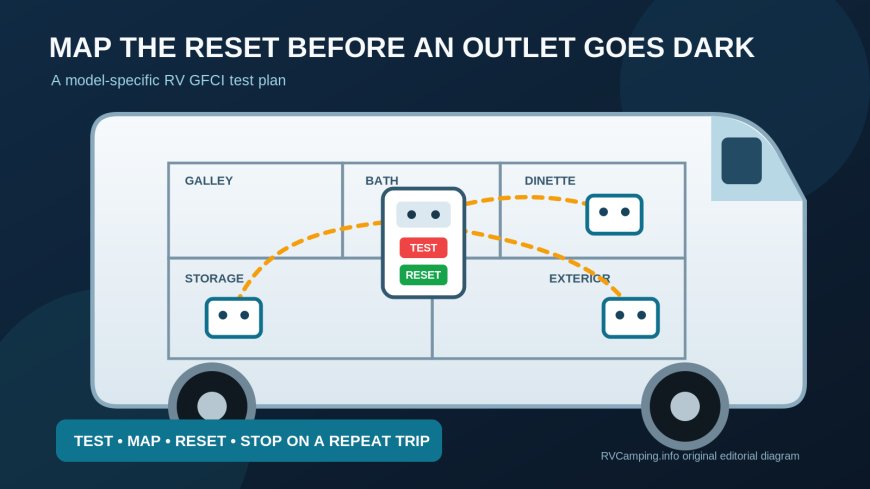
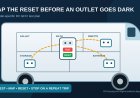
An RV receptacle can go dead while its breaker still looks normal. The control you need may be a TEST/RESET device in the bathroom, galley, exterior compartment, or another location that seems unrelated to the failed outlet. One GFCI can protect receptacles farther along the same circuit, so the outlet with no power is not necessarily the outlet that tripped.[2][3]
Build a small GFCI map before that happens. The job is to identify which outlets lose power when each installed GFCI is tested, record the relationship, and stop if the device does not behave exactly as its instructions say. This is an operating check, not a wiring project.
What a GFCI does, and what it does not do
A ground-fault circuit interrupter is designed to cut power quickly when current leaves its intended path. That protection matters around sinks, bathrooms, exterior receptacles, and other places where electricity and moisture may meet. CPSC advises GFCI protection at kitchen counters, bathrooms, and outdoor receptacles, with a monthly test to confirm operation.[1]
A GFCI is not the same thing as the RV's branch-circuit breaker. Leviton's GFTR1 instructions say the device does not protect against overloads or short circuits, and it cannot eliminate every possible shock hazard.[2] A breaker may remain set while a GFCI has opened the protected part of the circuit. The reverse can also happen: a breaker or power-source problem can leave a GFCI without the supply it needs to reset.
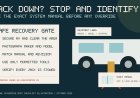
Do not reduce the diagnosis to "press RESET harder." First establish safe conditions, then follow the exact RV and GFCI manuals.
Stop before testing if the scene is unsafe
Do not touch receptacles, plugs, or electrical controls with wet hands, bare wet feet, or while standing in water. Winnebago gives that warning for the coach electrical system.[3] Disconnect from the hazard and seek qualified help for any of these conditions:
- smoke, arcing, buzzing, crackling, scorching, melted plastic, or a hot electrical odor;
- water inside a receptacle, electrical box, cord end, or appliance;
- a loose, broken, blackened, or visibly damaged receptacle;
- a shock or tingling sensation from the RV, appliance, plumbing, or metal trim;
- a GFCI that trips again after loads are removed;
- a breaker that trips repeatedly or will not remain set; or
- any uncertainty about safe power isolation.
For smoke, fire, active arcing, or an immediate shock hazard, move people away and call emergency services. Do not reconnect power to reproduce the symptom.
Make a one-page outlet map
Start with the manuals and the RV's electrical labels. Record the coach year, make, model, floorplan, and the current GFCI make and catalog number. A generic RV manual or a different floorplan can point you in the wrong direction.
Draw a rough floorplan and mark every accessible 120-volt receptacle. Include the easy-to-miss locations: exterior entertainment bay, wet bay, refrigerator compartment service outlet, under-bed storage, dinette, overhead cabinets, bathroom, galley, TV cabinet, and basement compartments. Do not remove panels or enter service-only spaces to find one.
Next, mark every device with TEST and RESET buttons. Some RVs may instead use a GFCI breaker or another protective arrangement. Do not copy the Elora layout into a different coach; its manual shows one RV-specific example in which a single GFCI network covers outlets in multiple areas.[3]
Give each accessible receptacle a short name such as GALLEY-A, BATH-A, or CURBSIDE-EXT. Leave a blank beside it for the controlling GFCI.
Run the map test without opening anything
Use the procedure printed on the installed device and in the exact coach manual. If those instructions differ from this checklist, the installed-device and coach instructions control.
- Park, secure the RV, and work in dry conditions. Keep children and pets away from the test area.
- Turn off and unplug sensitive or high-draw equipment on the circuit. Note anything that must not lose power, including medical equipment. Do not run a planned trip test if interrupting that load would create a hazard.
- Establish the normal 120-volt power source required by the coach manual. Confirm the GFCI's normal indicator state if the device has one.
- Plug a small, known-working lamp or listed receptacle tester into one outlet. Avoid improvised probes or exposed conductors.
- Press the GFCI's TEST button exactly as its instructions specify. Confirm that the GFCI face and the test load lose power. Leviton's instructions call for testing both the GFCI and any receptacles it protects downstream.[2]
- Move the test load through the other accessible outlets while the GFCI remains tripped. Mark every outlet that is off with that GFCI's location.
- Press RESET as the device manual directs. Confirm that power returns and the normal status indication matches the instructions.
- Repeat with the next GFCI, one device at a time.
- Photograph the completed map and store a copy with the RV manual.
This process answers a practical question: "Which reset controls this dead outlet?" It does not certify the wiring, grounding, polarity, weather resistance, or code compliance. A plug-in tester also has limits; use it only as its maker directs and do not treat one light pattern as a complete electrical inspection.
Read the result as pass, isolate, or stop
Pass
The installed unit changes to the documented tripped state, the mapped downstream outlets lose power, RESET restores power, and the normal indicator returns. Record the date and result. Both CPSC and the Winnebago manual call for at least monthly testing; use the schedule in the exact installed-device and coach documentation if it is more demanding.[1][3]
Isolate the load
If a GFCI trips during normal use, unplug every appliance on the protected circuit before one reset attempt. The Elora manual gives that sequence and says repeated tripping requires electrical inspection and repair before reuse.[3] Reconnect nothing until the circuit remains stable and the suspected appliance has been evaluated. CPSC likewise advises unplugging an appliance that repeatedly trips protection or has delivered a shock, then having it repaired or replaced.[1]
Do not keep resetting while adding loads back one by one if there was water, heat, visible damage, or a shock. Those findings move the decision directly to stop.
Stop and arrange service
Stop if the TEST button does not interrupt power, RESET will not restore the documented normal state, an indicator shows a device fault, the face is damaged, or the unit trips again with loads unplugged. Leviton's GFTR1 instructions say a unit that cannot reset after its prescribed test, or cannot return to the documented green status, must be replaced.[2] That is a model-specific instruction, not a universal light-code chart.
Do not remove the receptacle, swap LINE and LOAD conductors, tighten terminals, or install a replacement unless you are qualified and authorized to do the work. The Leviton installation sheet warns that power must be off before wiring work and that a miswired GFCI may not provide protection.[2] An RV adds shore power, inverter, generator, transfer equipment, and tight construction to the problem. A qualified RV electrical technician should identify the source, isolate all supplies, and match the replacement to the circuit, enclosure, environment, and coach documentation.
The monthly card
Keep this card near the electrical panel:
- [ ] Dry conditions; no visible damage, heat, odor, water, or shock report
- [ ] Exact RV and GFCI manuals available
- [ ] Sensitive and high-draw loads safely shut down or unplugged
- [ ] Each GFCI reaches its documented trip state
- [ ] Every mapped downstream outlet loses power
- [ ] RESET restores the documented normal state
- [ ] No repeated trip after loads are removed
- [ ] Result and date recorded
- [ ] Map updated after any electrical service or appliance change
A good map saves time, but its larger value is restraint. It tells you where a normal reset belongs and where owner troubleshooting ends. One failed test, one repeated trip, water, heat, damage, or a shock report is enough reason to leave the circuit off and get qualified help.
Sources
- CPSC and NESF Urge Consumers to Plug Into Electrical Safety — Monthly GFCI testing, protected-location, and repeated-trip guidance; consulted October 15, 2026.
- Leviton GFTR1 Installing and Testing a GFCI Receptacle — Device function, downstream protection, monthly test, status indication, replacement, and installation cautions; consulted October 15, 2026.
- 2027 Winnebago Elora Operator Manual — RV-specific outlet grouping, test/reset sequence, repeated-trip response, and electrical precautions; consulted October 15, 2026.
What's Your Reaction?