























Wahweap vs. Lone Rock vs. Lees Ferry: choose the right Glen Canyon RV base
Compare Wahweap, Lone Rock, and Lees Ferry for RV reservations, hookups, dry camping, sand access, current 2026 services, and trip geography.

By Romana
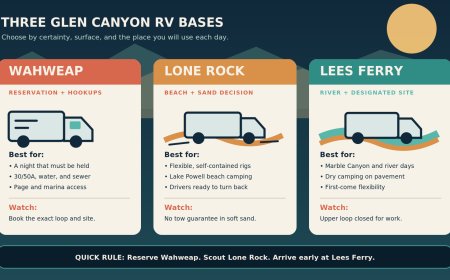
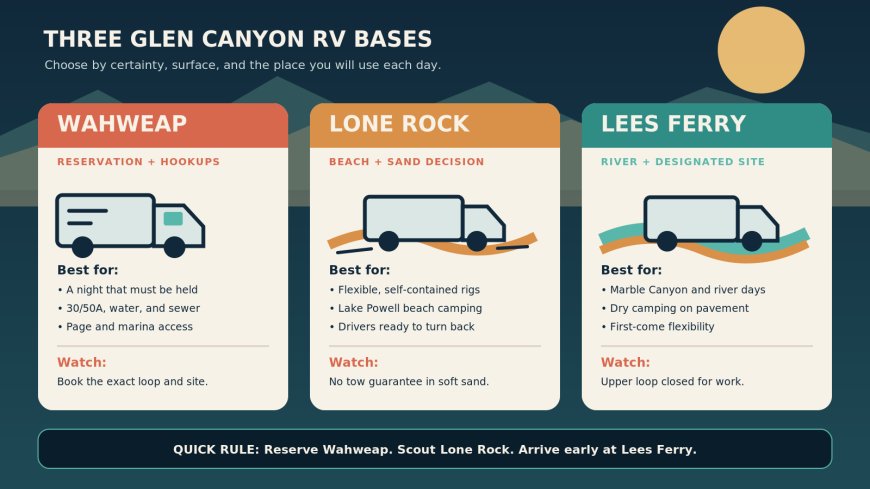
Three public-land campgrounds near Page can look interchangeable on a map. They are not. Wahweap is the reservation-and-hookups choice. Lone Rock trades a marked pad for beach camping and a sand decision. Lees Ferry is a dry, designated-site campground beside the Colorado River, 42 road miles from Page, with fewer sites available during a current renovation.
The best choice depends less on scenery than on four practical questions: Do you need a guaranteed place? Does the RV need shore power? Are you willing to drive onto sand? Is the trip about Lake Powell and Page, or the Colorado River and Marble Canyon?
This comparison reflects official pages checked October 15, 2026. Glen Canyon's seasonal services and construction status can change, so use it to select a plan, then verify the exact dates before departure.
The short answer
| If this describes the trip | Start with | Main catch |
|---|---|---|
| You want a reservable base near the Wahweap marina and need full hookups | Wahweap RV & Campground | It is concessioner-operated; book with the operator, not as an NPS first-come site |
| You want to camp by Lake Powell and can assess sand with a self-contained rig | Lone Rock Beach | No assigned pad, no reservation, increasing sand near the water, and no guaranteed tow |
| You want a quieter Colorado River base near Marble Canyon | Lees Ferry Campground | No hookups or reservations; the upper loop is currently closed |
| You need certainty but not hookups | Reserve a Wahweap dry site | The operator lists some self-contained-RV sites only to 30 feet, so match the exact booking |
| You have a long or heavy combination and do not want a sand recovery problem | Wahweap, after exact-site confirmation | Do not treat the operator's largest-site claim as permission for every site |
| You arrive after a long drive with no backup | Wahweap reservation | Lone Rock and Lees Ferry cannot promise a vacancy |
The choice is really certainty, surface, or geography
Wahweap sells certainty. Its official page lists 139 full-hookup sites with 30- and 50-amp electric service, water, and septic. It also lists 112 dry sites for tents or self-contained RVs in Loops 2, 3, and 4.[5] The campground requires registration, and late arrivals receive a map and directions posted at the store.[5]
Lone Rock sells flexibility, not certainty. It is an NPS primitive beach camping area with no assigned paved pad. The NPS says roads become increasingly sandy toward the water and warns that towing is not guaranteed if a vehicle gets stuck.[3] A campsite close to the shoreline can therefore be a poor bargain for a heavy motorhome, a low-clearance trailer, or a tow vehicle that is already near its traction limit.
Lees Ferry sells a different location. It sits on the Colorado River near Marble Canyon, not at the Wahweap marina complex. NPS puts it 42 miles from Page by US 89 and US 89A, followed by a five-mile paved entrance road.[4] That makes it useful for river access, Navajo Bridge, and a Marble Canyon itinerary, but inefficient for repeated trips back to Page or Wahweap.
Reservations: only Wahweap can anchor the itinerary
NPS states that its Glen Canyon campgrounds do not take reservations. Paying online for an NPS site does not reserve one; campers must first occupy an available site.[1] That applies to the NPS-operated choices in this comparison, Lone Rock and Lees Ferry.
Wahweap is different because it is operated by the park concessioner. NPS directs campers to book concessioner campgrounds through the concessioner, and the current Wahweap page provides its own booking path.[1][5]
That division should change how you build the trip:
- Book Wahweap if the night must be guaranteed.
- Treat Lone Rock or Lees Ferry as same-day occupancy decisions.
- Keep a legal alternate outside the park when choosing either NPS option.
- Do not pay an NPS campground fee until you have selected an open place; the payment itself does not hold a campsite.[1]
A late Friday arrival is not the time to discover this distinction. If the campground is only one stop in a tightly scheduled route, the reservation is worth more than a prettier unassigned patch of shore.
RV fit: read three different kinds of limits
Wahweap's operator says its full-hookup sites accommodate rigs up to 45 feet, with only a very limited number of sites over 70 feet. It allows two vehicles per site.[5] The same page says only some of the self-contained-RV dry sites accommodate an RV up to 30 feet.[5]
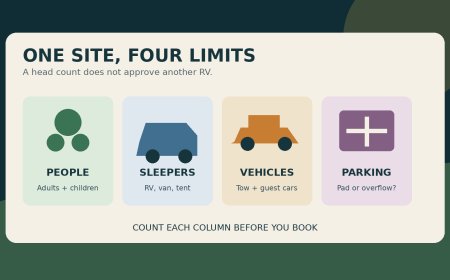
Those numbers describe different inventory. A 38-foot fifth wheel may fit a full-hookup site and fail the dry-loop limit. A 45-foot motorhome plus a towed car also raises a parking question that the motorhome length alone does not answer. Before paying, confirm:
- the motorhome or trailer length entered in the booking;
- total truck-and-trailer length if the tow vehicle must remain on the site;
- number of vehicles;
- back-in or pull-through geometry;
- slide, awning, and step clearance;
- whether the assigned site, not merely the campground, accepts the combination.
Lone Rock has no rectangular pad to compare with a specification sheet. Fit depends on the approach you are willing to drive and the firm surface you can reach without blocking another camper. Walk questionable sand first. Stop on firm ground before momentum becomes the only plan. Unhitching a trailer after the tow vehicle starts digging is already too late.
Lees Ferry uses designated sites, so it removes the beach-surface gamble. It does not remove the occupancy gamble: NPS lists no reservations, and the upper loop is closed for renovations while the lower loop remains open.[1][4] A smaller open inventory calls for an earlier arrival and a backup, not creative parking outside a marked site.
Services: do not count the entrance station as a hookup
Wahweap is the only full-hookup choice of the three. The operator lists water, septic, and both 30- and 50-amp service in the hookup loops. Coin-operated laundry and showers are at the store, and Wi-Fi is available but may vary with location, weather, and use.[5]
The current NPS seasonal-hours page lists Lone Rock camping, restrooms, micro-flush and vault toilets, showers, potable water, and RV dump services as open.[2] The dedicated Lone Rock page also describes the beach itself as primitive, tells visitors to carry supplies in and out, and says there is no potable water or RV pumpout at the beach camping area.[3]
Read those pages together rather than pretending they agree. On October 15, the central service facilities are listed open, but an RV parked out on the sand does not have water, sewer, trash pickup, or a hookup at the campsite. Fill, dump, and secure drinking water at the service point while it is operating. Arrive able to contain wastewater if a service closes or is unavailable.
Lees Ferry is dry camping. NPS currently lists 54 designated sites, no hookups, potable water, a modern bathroom, and a seasonal dump station. The same status page lists the dump station open and warns that construction may close part of the campground.[2] The upper-loop closure is the part that matters now.[1][4]
For a cold October night, the power distinction is simple. Wahweap hookups can run normal RV systems within the pedestal and onboard equipment limits. At Lone Rock and Lees Ferry, every furnace-blower hour comes from the house battery unless another permitted source replaces it. Build the overnight energy budget before choosing the view.
Access: pavement is not the same promise at all three
Wahweap is the most conventional arrival. The practical work is confirming the assigned site's length and the operator's current registration hours. If arriving late, follow the posted assignment process rather than choosing an empty-looking pad.[5]
Lone Rock begins simply from Highway 89, but the final choice belongs to the driver. NPS says the road becomes sandier nearer the water and offers no guaranteed towing service.[3] Lake level changes can also move the desirable shoreline farther from firm access. A beach that worked for someone else's four-wheel-drive truck is not proof for a long Class A or a two-wheel-drive tow vehicle.
Use a stop rule at Lone Rock:
- stop if you cannot identify a firm route back out;
- stop before a dip, side slope, or loose section that prevents turning around;
- stop if the trailer will force a tighter track than the tow vehicle can follow;
- stop when darkness hides the surface;
- choose a higher, firmer camp even if it is farther from the water.
Lees Ferry's access is paved from the park entrance, but geography adds mileage. Fuel and a store are available at Marble Canyon near the entrance; more services require additional travel.[4] This is the campground for a river-centered stay, not a clever substitute when a Wahweap itinerary is already full.
Dates and current status for October 15, 2026
Wahweap's NPS seasonal listing tells visitors to check campground and store hours with Lake Powell Resorts.[2] That is the right final check because concession operations, site inventory, and rates can change independently of NPS campground rules.
Lone Rock is currently listed open, including camping and the central water, shower, restroom, and dump services.[2] Those services are seasonal. Save a screenshot before departure and still verify at arrival; a freeze, repair, or operational change can alter the list.
Lees Ferry is open year-round, 24 hours a day, but the campground's upper loop is closed for renovations.[2][4] The lower loop remains open.[1] This is not a full campground closure, and it is not normal capacity.
Parkwide rules also cap one stay at 14 nights and total campground use at 30 nights during a calendar year. The default NPS quiet period is 10 p.m. through 6 a.m., unless a sign sets another schedule.[1]
A three-minute choice before booking
Choose Wahweap when all four statements are true:
- A reservation needs to hold the night.
- Page, Wahweap, or Lake Powell is the trip's center.
- The exact site accepts the RV and accompanying vehicle.
- The value of hookups or a confirmed dry site justifies the quoted total.
Choose Lone Rock when all four statements are true:
- Everyone accepts first-come camping.
- The rig can remain self-contained at the campsite.
- The driver is willing to reject soft sand instead of forcing it.
- A legal Plan B is available if the beach is crowded or access feels wrong.
Choose Lees Ferry when all four statements are true:
- The Colorado River and Marble Canyon matter more than Page convenience.
- Dry camping works for the full stay.
- First-come occupancy is acceptable.
- The group understands that only the lower loop is open during the current renovation.
Save this arrival card
| Check | Wahweap | Lone Rock | Lees Ferry |
|---|---|---|---|
| Booking | Concessioner reservation and assigned site | No NPS reservation | No NPS reservation |
| Electrical service | Full hookups available; dry loops also offered | None at campsite | None |
| Water and dump | Confirm selected site and current campground facilities | Current central services listed open; none at beach campsite | Potable water and seasonal dump currently listed open |
| Surface | Assigned developed site | Sand increases toward water | Designated site reached by paved road |
| Current constraint | Verify operator hours and exact inventory | Sand, self-recovery limits, seasonal services | Upper loop closed |
| Best backup | Confirmed dry or hookup reservation | Developed campground near Page | Campground near Marble Canyon or Page |
The arrival card should also carry the RV's measured traveling length, total combination length, height, fuel range, freshwater level, holding-tank capacity, and the latest screenshots from the operator and NPS status pages.
Bottom line
Wahweap is the practical choice for a scheduled trip or an RV that needs hookups. Lone Rock is the flexible beach choice for a self-contained rig whose driver can say no to bad sand. Lees Ferry is the river choice, separated from Page by 42 miles and currently operating with its upper campground loop closed.
Do not choose by the word "waterfront." Choose by reservation risk, power needs, surface, and the place you plan to visit each day. That decision will matter after sunset, when the tanks are full, the battery is dropping, and the next available campground is no longer a short drive.
Sources
- National Park Service: Camping at Glen Canyon — accessed October 15, 2026.
- National Park Service: Seasonal Hours — accessed October 15, 2026.
- National Park Service: Lone Rock Beach — accessed October 15, 2026.
- National Park Service: Lees Ferry — accessed October 15, 2026.
- Lake Powell Resorts & Marinas: Wahweap RV & Campground — accessed October 15, 2026.
What's Your Reaction?