






Before You Roll In: Verify Campground Check-In and Late-Arrival Rules
A practical pre-trip method for confirming campground check-in, check-out, gate access, no-show deadlines, and after-hours arrival steps before driving an RV.

Before You Roll In: Verify Campground Check-In and Late-Arrival Rules
By Romana
A reservation confirms that a campsite has been booked. It does not tell you whether the entrance gate will be open when your RV gets there, where to find a site assignment after the office closes, or whether you must report to the office the next morning.
Those details matter on an RV travel day. A fuel stop takes longer than expected, traffic builds, and a planned 5 p.m. arrival becomes 9:30. The fix is a short verification job done before departure, while you still have service and somebody may still be answering the campground phone.
This guide draws on the official reservation policies of Oregon State Parks, California State Parks, Recreation.gov, and Texas Parks and Wildlife. Their rules illustrate why a booking-platform policy is only the first layer. Recreation.gov says individual facility policies can supersede its site-wide rules.[3] Texas defines a late arrival as one outside the normal time frame and tells visitors to call the park to verify its policy.[4]
Find the rule that belongs to your exact stay
Start with the confirmation email or reservation record, not a general web search. Confirm all of these details:
- campground and loop name;
- site number, if the booking is site-specific;
- arrival and departure dates;
- local time zone;
- stated check-in and check-out times;
- office or kiosk hours;
- gate-closing time;
- late-arrival contact number;
- instructions for permits, vehicle tags, keys, or gate codes.
The campground page should be your second stop. A reservation service may describe the broad no-show rule while the facility page explains the locked gate, after-hours board, self-registration envelope, or morning check-in deadline. On Recreation.gov, the platform itself warns that exceptions are common and that location-specific policies control.[3]
Do not assume that every campground in one park system uses the same clock. Oregon’s statewide baseline opens sites to arriving campers at 4 p.m. and requires departing campers to leave by 1 p.m.; a park can change either time and communicate the change on the camping receipt.[1] California says check-in begins at 2 p.m. at most parks and directs campers to verify the actual time in the confirmation; its general check-out time is noon.[2]
Write the verified times in one place. A calendar note titled with the campground name works better than a screenshot buried among trip photos.
Separate four deadlines that sound alike
Campground language gets confusing because “late arrival” can refer to several different moments. Record each one separately.
1. Site check-in time
This is the earliest time the site should be ready for you. It is not necessarily the office opening time, gate closing time, or the start of a reservation for cancellation purposes. California, for example, treats noon as the reservation start for its cancellation calculations even though check-in begins at 2 p.m. at most parks.[2]
2. Office or kiosk closing time
This determines whether staff can complete an ordinary check-in. If your route estimate lands after closing, you need the after-hours procedure even when the campground gate stays open.
3. Gate or access cutoff
A campground can have an unstaffed entrance that remains open, a coded gate, or a gate that closes to vehicles. Texas says most state parks close their gates when day use ends at 10 p.m., while noting that hours vary and must be checked with the park.[4] “My site is reserved” is not a substitute for an access code.
4. No-show deadline
This is the point at which the operator may cancel the remaining reservation or apply a penalty. Under Recreation.gov’s general policy, a campsite is held until check-out time on the day after scheduled arrival. A no-show also carries a $20 service fee and forfeiture of the first night’s recreation fee.[3] Oregon generally holds a reservation until 1 p.m. the next day, then may cancel it if the camper has not checked in.[1]
These broad policies still do not grant permission to arrive through a closed gate. Access instructions and no-show rules answer different questions.
Call with a precise arrival estimate
If any part of the written instructions is missing or contradictory, call the campground itself. Do this before the office closes, not from the gate.
A useful call is short:
“I have site 42 reserved under [last name] for tonight. Our current arrival estimate is 9:30 p.m. local time in a 32-foot motorhome. Will the vehicle gate be open, and what must we do tonight and tomorrow morning to keep the reservation?”
Then ask only what the written policy did not settle:
- Is there a latest vehicle-entry time?
- Will a gate code, permit, site assignment, or key be waiting, and where?
- Must the registered guest show identification in person?
- Is there a quiet-hours restriction on backing in, leveling, slide deployment, or generator use?
- What is the deadline to report to the office the next morning?
- Whom should you contact if the arrival slips again after the office closes?
Get the employee’s name and note the call time. This is not about building a case against the campground. It gives the next employee enough context if the late-arrival list was prepared before your call.
Save an offline arrival packet
Cell service often weakens at exactly the wrong point: near the campground, after dark, on unfamiliar roads. Put the information where it works offline.
Save or print:
- the full reservation confirmation and confirmation number;
- a campground map with the entrance, loop, and site marked;
- the campground’s direct number and any after-hours number;
- written late-arrival instructions;
- the gate code, if the campground supplied one;
- the tow vehicle and RV license-plate numbers;
- any required pass, discount credential, or identification note.
Treat a gate code as private access information. Keep it in the trip record rather than a public map review or social post.
If the park assigns sites on arrival, confirm how the assignment is displayed after hours. California notes that some parks make assignments when campers arrive, while others are site-specific.[2] A confirmation without a site number may be normal, but it creates one more step to verify.
Plan a quiet setup, not a full campsite build
Late arrival changes the safest and most considerate setup sequence. Before the trip, decide what can wait until daylight.
At night, the goal is to park legally, establish only what the RV needs for the night, and keep noise and bright light down. If the site and campground rules allow it, that may mean chocking, leveling enough for safe equipment operation, connecting shore power, and checking that slides have clearance before moving them. Rugs, chairs, awnings, outdoor kitchens, and decorative lights can wait.
Use a spotter for backing. Agree on hand signals before entering the loop, and stop if the spotter disappears from the mirror or camera view. If the site boundary, branches, pedestal, picnic table, or neighboring gear cannot be seen clearly, ask the host or ranger for help or use the fallback plan. A reservation is not a reason to force a difficult maneuver in the dark.
Do not run a generator simply because arrival was delayed. Quiet hours and generator hours can be different, and the facility rule should already be in your arrival packet.
Know when to stop short
Every late-arrival plan needs a decision point. Choose it before towing or driving the final miles.
Stop short when the campground cannot confirm entry, the instructions require arrival before a gate cutoff you will miss, severe fatigue makes backing unsafe, or the approach road is not sensible for your rig after dark. The fallback might be a legal overnight stop, a commercial campground with staffed late check-in, or another place you have confirmed in advance. Never assume a roadside pullout or retail parking lot allows overnight RV use.
If you will miss the first night entirely, contact the campground and update or cancel the booking instead of silently becoming a no-show. California holds reservations until noon the following day; campers arriving later must notify the park by noon each day to preserve the rest of the stay.[2] Recreation.gov’s general rule also uses the following day’s check-out time as the no-show boundary.[3] The exact consequences depend on the system and facility, which is why the call belongs in the plan.
Recheck the day before departure
Policies, staffing, road access, and gate procedures can change after the reservation is made. On the day before travel, open the reservation record again and compare it with the facility page. Look for alerts and messages from the operator. Verify that the campground phone number saved in your packet is the facility’s number, not only the reservation service call center.
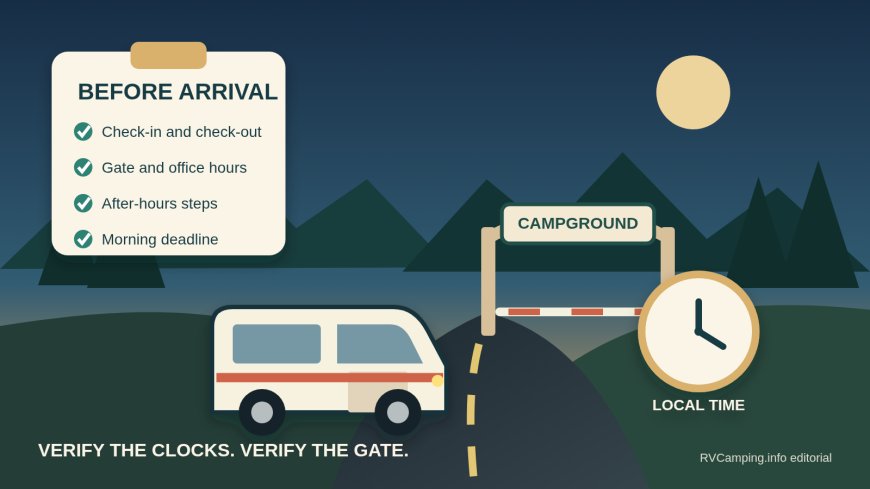
Your final trip note should fit on one screen:
- Check-in: earliest arrival time
- Office closes: local time
- Gate: open, coded, or locked at a stated time
- After-hours action: exact steps and location
- Morning action: office deadline, if required
- No-show cutoff: date and local time
- Check-out: departure time
- Fallback: confirmed alternative and decision time
A booked campsite is only one part of an arrival plan. Verify the clocks, verify the gate, and keep the after-hours instructions with the driver.
Sources
What's Your Reaction?