




















How to wash produce safely at an RV campsite
Verify potable water, keep raw-food mess away, rinse a meal-sized produce batch over a catch basin, and dispose of every drop under local rules.

How to wash produce safely at an RV campsite
Quick answer: Use only water you have verified as safe for drinking to wash fruits and vegetables.[3] Rinse produce under running water, rub it with clean hands, scrub firm items with a clean produce brush, and dry it with a clean towel.[1][2]
Do not use soap, detergent, bleach, or an improvised sanitizer on food. Keep produce away from raw meat and its tools. With a small RV sink, wash a meal-sized batch over a clean basin, catch the water, and send it to the disposal point required by the campground or land manager.[5]
A gallon jug can disappear surprisingly fast when it has to cover coffee, handwashing, dinner, and dishes. That makes it tempting to give lettuce a quick dunk in a bowl or to rinse tomatoes in whatever spigot is closest. Neither shortcut answers the first question: is the water safe to use on food?
The best campsite produce station is small and deliberate. It is not a miniature home kitchen. It has one verified clean-water side, one dirty side, a controlled stream, and a plan for every drop after it leaves the food.
Verify the water before unpacking the salad
Treat produce-washing water as drinking water because some of it can remain on the food. CDC guidance for camping specifically lists washing fruits and vegetables among the ways unsafe water can make a person sick.[3] Clear water is not proof. A mountain stream, an unmarked hose bib, or water from an RV tank with an uncertain fill history is not automatically potable.
At a developed campground, check the spigot label and the host's current notices. Ask whether the outlet is potable if the sign is missing or ambiguous. A blue handle, good taste, or a neighbor filling a jug is not verification. If a notice is posted, read which type it is and follow the local directions. CDC distinguishes boil-water, do-not-drink, and do-not-use advisories; those categories require different responses.[4]
During a boil-water advisory, CDC says to use commercially bottled water or properly boiled tap water for food preparation. Keep clear water at a full rolling boil for one minute, or three minutes above 6,500 feet, then cool it in a clean, covered container.[4] A common pitcher or RV filter does not cancel a boil notice.[4]
A do-not-drink or do-not-use notice is different. Boiling does not remove harmful chemicals or toxins. Use commercially bottled water or another source allowed by local officials rather than trying to rescue the suspect supply.[3][4]
If you are drawing from a lake, stream, or other untreated source, CDC ranks boiling first for destroying germs; its next choice is filtering followed by disinfection. Treatment has limits, especially with cloudy water and chemical contamination, so follow the agency's method and product directions rather than inventing a bleach ratio.[3] For an RV site near services, carrying known potable water is usually simpler.
Decide what to wash at home and what to wash at camp
Prewashing everything before departure sounds like an easy water-saving move. FDA frames washing as a step to take before preparing or eating produce, and it advises drying after the rinse.[1] For camp planning, that makes washing at the meal the default. Prewashing at home can still make sense for sturdy items when you dry them fully, pack them in a clean container, and keep perishable produce cold.
The practical split is simple:
- Leave delicate berries, loose greens, herbs, and mushrooms unwashed until the meal, unless they are part of a ready-to-eat package.
- If you wash sturdy produce at home, dry it completely with a clean towel before it enters a clean container.
- Keep the original label on packaged greens. FDA says produce marked "pre-washed" or "ready-to-eat" can be used without another wash.[1]
- Wash whole melons, cucumbers, apples, avocados, and other items at the site before cutting if you did not wash and dry them at home.
The peel still matters when nobody plans to eat it. FDA advises washing produce before peeling or cutting so dirt and bacteria on the outside are not carried inward by the knife.[1] Cut away bruised or damaged sections and discard produce that looks rotten.[1]
Do not wash a whole trip's supply merely because the station is set up. Wash what the next meal needs, dry it, then break down the station. Small batches use less water and reduce the chance that clean produce gets splashed while raw food or dishes move through the same cramped sink.
Build a two-zone station beside the RV
An RV sink is often both food-prep space and dish basin. Before produce enters it, remove food scraps and clean the sink, faucet controls, nearby counter, colander, knife, cutting board, and produce brush. USDA warns that the sink and tools can cross-contaminate produce, especially after contact with raw meat, poultry, seafood, or their juices.[2]
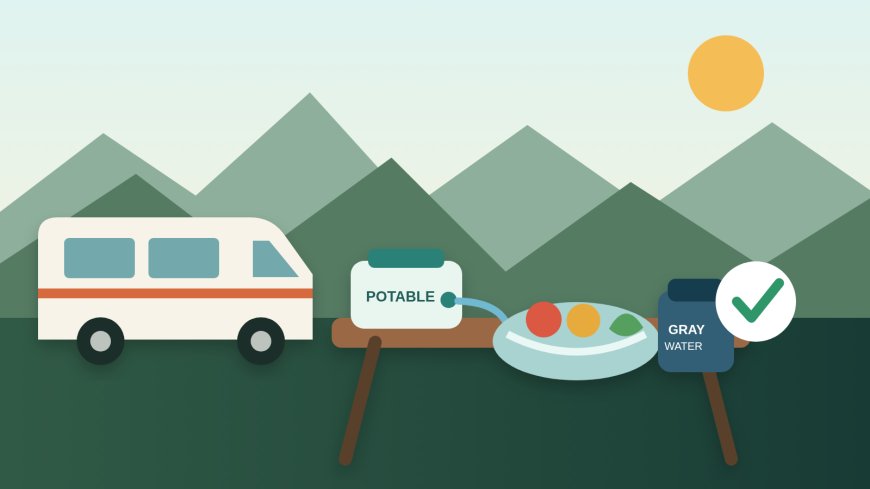
If the galley has just handled raw meat, the safest low-water choice is often to move the produce wash outside. Set a clean food-grade basin on a stable table. Place the potable-water jug or controlled-flow dispenser above it. The basin catches runoff; it is not a soaking bowl.
Make two zones:
- On the clean side: verified potable water, clean brush, clean colander, paper towels or a freshly laundered cloth, clean cutting board, and the serving bowl.
- On the dirty side: unwashed produce, trim container, used towels, and the covered wastewater bucket.
Wash hands with soap and clean running water before handling food. CDC calls for at least 20 seconds and says to wash again after handling uncooked meat, poultry, seafood, flour, or eggs.[6] Hand sanitizer can be useful when soap and water are unavailable, but it does not turn a dirty hand into a produce-washing tool.
Keep raw meat below and away from produce in the refrigerator or cooler. Do not park a thawing package in the produce basin. FDA recommends separate cutting boards when possible and hot, soapy washing of boards, dishes, tools, and counters between raw animal foods and produce that will be eaten without cooking.[1]
Use a controlled stream, not a shared bath
FDA and USDA consumer guidance calls for washing fresh produce under running water.[1][2] At an RV, "running" does not have to mean opening the faucet fully wide until the gray tank groans. A jug with a narrow spout, a pump dispenser, or a faucet set to a thin stream can provide flowing potable water while the catch basin keeps it out of the drain.
Work in this order:
- Wash and dry your hands.
- Put only one type of produce in the clean colander or hold it over the basin.
- Run potable water over every surface while rubbing gently with clean hands.
- Use a dedicated, clean brush on hard-skinned foods, including cucumber and melon.[1]
- Let the final rinse drain away rather than pooling around the food.
- Dry the produce with a clean cloth or paper towel; FDA notes that drying can further reduce bacteria on the surface.[1]
- Move the food directly to the clean board or serving bowl.
Do not start with the cleanest-looking item and keep the same bowl of water for everything. Standing wash water can collect soil and transfer it to the next tomato or handful of greens. The captured water is wastewater after it touches food or the basin; do not pour it back into the fresh-water jug and do not use it for a final rinse.
A spray bottle is a poor substitute for a rinse. It can spread droplets around a tiny galley and may not move loose soil off the food. A short, controlled stream over a basin is easier to direct and easy to stop between pieces.
Skip soap, produce wash, and home chemistry
Produce is not a countertop. FDA advises against applying dish soap, detergents, or commercial washes to fruit and vegetables because porous food can absorb residues, and the safety and effectiveness of commercial washes are not known.[1] USDA gives the same warning about detergent, soap, and commercial produce washes.[2]
Do not add household bleach to the produce basin. Do not improvise with dish soap, disinfecting wipes, alcohol, or a sanitizer meant for hard surfaces. This is separate from sanitizing an empty food-contact basin or cutting board according to the product label. Clean the equipment, rinse it as directed, then use plain potable water on the food.
Vinegar, salt, or lemon juice may be part of a recipe, but they should not be presented as a reliable produce-disinfection step. Washing reduces bacteria; it does not eliminate every organism.[1] For travelers at higher risk of severe foodborne illness, CDC identifies cooked produce as a safer choice than raw produce.[6]
Catch the wastewater and follow the rule where you camp
Produce rinse water is gray water. It can contain soil, food particles, soap from an inadequately rinsed basin, and odors that attract wildlife. The correct disposal point depends on the campground, park, forest, state, and sometimes the specific site.
Check the campground rules before setup. In a full-hookup site, route sink water through the RV's closed gray system and empty it only where allowed. If you use an outdoor basin, cover the catch bucket and carry it to the designated utility drain, gray-water sink, or dump station named by the operator. Never assume that a fire ring, storm drain, vault toilet, shrub line, or bare patch is acceptable.
A concrete example shows why local checking matters: Yosemite requires camp wastewater to go into designated utility drains and sewage to designated dump stations.[5] Other properties may direct campers to a dishwashing sink, require all gray water to remain in the RV tank, or publish a backcountry dispersal method. Follow that site's posted rule rather than carrying a technique from another park across state lines.
Strain or scrape solid food into trash before transport if the local facility instructs you to do so. Keep the wastewater container separate from potable-water containers, mark it clearly, and clean it away from the produce side after disposal. Do not store the dirty bucket above food during travel.
A compact RV workflow that is easy to repeat
Before dinner, run this sequence:
- Confirm: Read the spigot label and current water notices. Set aside bottled or treated water if the supply is uncertain.
- Separate: Move raw meat, its package, and its tools away. Clean the produce-contact station.
- Stage: Put a catch basin under the stream and place clean tools on one side, unwashed food on the other.
- Rinse: Wash one meal-sized batch under a thin flow of potable water. Rub, brush firm produce, and dry.
- Cut: Move the washed food to a clean board. Refrigerate cut produce promptly when it is not being served.[2]
- Close: Capture the wastewater, wipe the station, and carry the water to the locally approved disposal point.
That order protects the scarce resource that matters most: clean water. It also keeps the small sink from becoming a meeting place for dirty lettuce, raw-chicken packaging, breakfast dishes, and a clean salad bowl. At camp, separation is mostly a matter of timing. Give produce the station to itself, then close the job before the next one begins.
Sources
- U.S. Food and Drug Administration: Selecting and Serving Produce Safely
- USDA Food Safety and Inspection Service: Washing Food: Does it Promote Food Safety?
- Centers for Disease Control and Prevention: Water Treatment Options When Hiking, Camping, or Traveling
- Centers for Disease Control and Prevention: Drinking Water Advisories: An Overview
- National Park Service: Campground Regulations, Yosemite National Park
- Centers for Disease Control and Prevention: Preventing Food Poisoning
What's Your Reaction?