








Four hours, one thermometer: an RV refrigerator outage plan
Know when an RV refrigerator outage crosses the four-hour line, which foods to discard, what can stay, and how to judge the freezer separately.

How to protect the cold food you can still save, sort the rest without guesswork, and stop a tripped RV fridge from becoming a second emergency.
The lights may still work when an RV refrigerator stops cooling. Shore power can drop, a breaker can trip, a propane refrigerator can fault, or a compressor fridge can lose its power source. For food safety, the cause matters less than two facts: when active cooling stopped and how warm the food became.
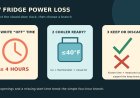
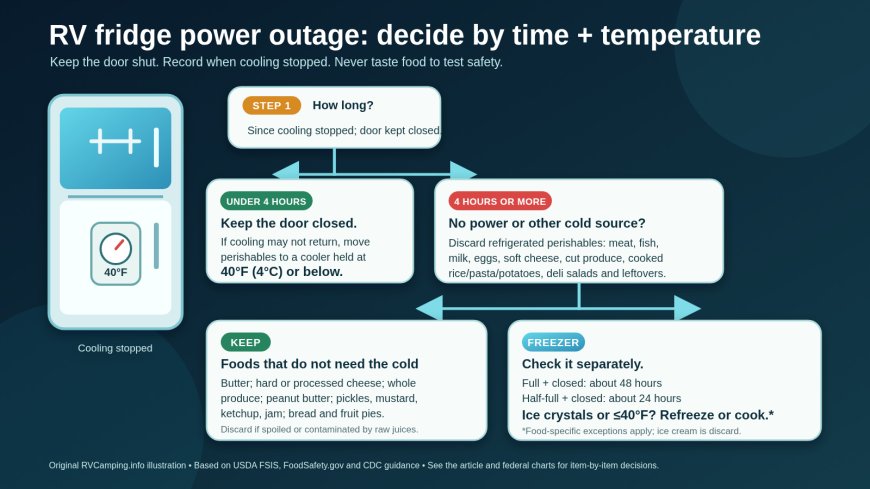
A closed refrigerator keeps food safe for up to four hours during a power outage. A full, unopened freezer holds temperature for about 48 hours; a half-full one for about 24 hours.[1][3] Those are planning limits, not permission to ignore the thermometer.
The short answer: Keep the door shut. Before four hours, move perishable food to a cooler with enough ice or frozen gel packs to hold 40°F (4°C) or below if cooling will not return. At four hours without power or another cold source, discard refrigerated perishables. Do not taste food to test it.[1][2][3]
Start the clock when cooling stops
Write down the time as soon as you notice the failure. If you do not know when the refrigerator stopped cooling, you do not have a trustworthy four-hour starting point. Check a campground outage notice, an energy-management display, a battery monitor, or anything else that can narrow the timeline, but do not turn an estimate into a fact.
Then close the refrigerator and freezer. Every inventory check lets cold air out. The federal four-hour refrigerator guidance assumes the door stays closed as much as possible.[2][3]
Put your effort into restoring cooling or preparing a cold transfer:
- Confirm that the refrigerator has truly stopped cooling; follow the RV and refrigerator manuals for safe troubleshooting.
- Leave the food compartments closed while you check shore power, breakers, fuses, fuel supply, fault codes, or the selected operating mode.
- Get a cooler, ice or frozen gel packs ready before opening the door.
- If the outage may reach four hours, transfer refrigerated perishables while there is still time and keep the cooler at 40°F or below.[1][3]
An appliance thermometer is far more useful here than the temperature setting on the control panel. CDC recommends keeping one in both the refrigerator and freezer; normal targets are 40°F or below in the refrigerator and 0°F or below in the freezer.[3]
The four-hour rule and the two-hour rule answer different questions
This is where otherwise careful advice gets muddled.
The four-hour figure describes how long an unopened refrigerator can protect food after power loss. Once the refrigerator has been without power or another cold source for four hours, CDC says to throw out refrigerated perishables such as meat, fish, cut produce, eggs, milk and leftovers.[3] FoodSafety.gov gives the same four-hour direction for meat, poultry, fish, eggs and leftovers.[2]
The two-hour figure applies when you know a food was above 40°F. FoodSafety.gov's item-by-item table tells readers to discard most refrigerated perishables after more than two hours at 40°F or above.[2] Its emergency guidance also shortens that warm-exposure limit to one hour when temperatures are above 90°F (32°C).[4]
Do not add the limits together. Four hours without power plus two warm hours is not a six-hour allowance. If reliable temperature records show that a perishable food crossed 40°F earlier, its warm-exposure clock has already started. If there is no reliable time or temperature history after a long outage, use the conservative discard rule rather than smell, appearance or a hopeful reading taken after the fact.[1][2][3]
What goes in the trash
After four hours without power or another cold source, discard the perishable contents of the refrigerator. The FoodSafety.gov chart specifically places these common RV foods in the discard column:[2]
- raw or cooked meat, poultry, fish and seafood;
- lunch meat, hot dogs, bacon and sausage;
- milk, cream, yogurt, sour cream and soft cheese;
- leftovers, pizza, casseroles, soups, stews, stuffing and gravy;
- shell eggs, cooked eggs, egg dishes, custards and quiche;
- cut fruit, cut vegetables, packaged pre-cut greens and cooked vegetables;
- cooked rice, pasta and potatoes;
- meat, tuna, chicken, egg, macaroni and potato salads;
- opened creamy dressings, fish or oyster sauce, and opened spaghetti sauce.
Shredded cheese and low-fat cheese also belong in the discard group. Hard cheese is treated differently, which is a good reminder not to sort the whole dairy bin with one decision.[2]
Opened mayonnaise, tartar sauce and horseradish have their own line in the federal chart: discard them after more than eight hours over 50°F (10°C).[2] Do not stretch that narrow exception to creamy dressings, dairy foods or deli salads.
Throw out food that smells odd or has changed color or texture, but do not treat normal smell or appearance as proof of safety. Never taste questionable food.[1][2][3]
What can usually stay
The same FoodSafety.gov chart lists several foods that can be kept after the refrigerator warms:[2]
- butter and margarine;
- hard cheeses such as Cheddar, Colby, Swiss, Parmesan, provolone and Romano;
- processed cheese and grated Parmesan or Romano in a can or jar;
- whole, uncut fresh fruits and vegetables;
- opened fruit juice and opened canned fruit;
- dried fruit;
- peanut butter;
- jelly, relish, mustard, ketchup, olives and pickles;
- Worcestershire, soy, barbecue and hoisin sauces;
- opened vinegar-based dressings;
- bread, rolls, tortillas, muffins and cakes without custard or cheese filling;
- fruit pies, waffles, pancakes and bagels.
"Keep" does not mean "keep forever." Check the package instructions, avoid cross-contaminated food, and discard anything moldy or otherwise spoiled. USDA notes that high-acid condiments such as mustard, ketchup, relish, pickles, non-creamy dressings, jam and jelly may be safe yet spoil sooner.[1]
If raw meat juices leaked onto bread, salad greens or another ready-to-eat item, USDA says to discard the contaminated food.[1] A power outage does not erase ordinary cross-contamination rules.
Treat the freezer as a separate decision
Do not empty the freezer just because the refrigerator crossed four hours. If its door stays closed, a full freezer can hold temperature for about 48 hours and a half-full freezer for about 24 hours.[1][3]
When power returns, check the thermometer and each package. Frozen food with visible ice remaining, or a measured temperature no warmer than 40°F, can be refrozen or cooked, though quality may decline.[2][3] Food that has thawed and spent more than two hours at 40°F or above usually goes in the discard column; the FoodSafety.gov frozen-food chart gives the exact call by food type.[2]
Ice cream and frozen yogurt are notable exceptions: the chart says to discard them even if they still contain ice crystals.[2] Hard cheese, bread, plain cakes, flour and nuts are among the frozen items the chart allows to be refrozen even after thawing, subject to the conditions in the table.[2]
Do not judge a soft freezer package by touch alone when a thermometer or visible ice crystals can give better evidence.
A practical salvage setup for an RV
A small RV refrigerator can warm quickly once people begin opening it, so decide what you need before touching the latch. Set the cooler beside the refrigerator, open the ice, and have separate bags or bins ready for "keep," "discard" and "check the federal chart."
Move the most perishable food first: meat, seafood, milk, eggs, soft cheese, cut produce and leftovers. Pack cold sources around the food rather than placing one gel pack on top. Keep a thermometer in the cooler and add ice as it melts; USDA says the cooler must stay at 40°F or below.[1]
Avoid using outdoor air, snowbanks or a picnic table as a refrigerator. FoodSafety.gov warns that outdoor temperatures vary and that food left outside can be exposed to animals and unsanitary conditions.[2]
Before throwing food away, take a few photos and make a simple list if you may file an insurance claim. Do that quickly and without repeatedly warming food you are trying to save. Seal discarded food well so it does not leak in the RV or attract wildlife at the campsite.
Build a better outage kit
The useful kit is small:
- one appliance thermometer for the refrigerator and one for the freezer;
- a cooler large enough for the refrigerated perishables you would actually try to save;
- frozen gel packs or containers of frozen water;
- a marker, tape and a note card for recording the outage time;
- access to the full FoodSafety.gov refrigerated and frozen-food charts.
Freeze items you will not need soon, group freezer food together, and find out where block ice is sold before bad weather or a planned campground shutdown. Those steps buy time without inventing a new safety limit.[1][2][3]
A refrigerator full of food makes it tempting to negotiate with the clock. Do not. Keep the door closed, record what happened, use a thermometer where it can answer the question, and make the discard decision by food type. Replacing groceries is frustrating. Food poisoning on a travel day is worse.
Source note: RVCamping.info created this RV-specific decision guide from current USDA FSIS, FoodSafety.gov and CDC food-safety guidance. The illustration is original and is not a substitute for the agencies' complete food tables.
Sources
[1] Keep Your Food Safe During Emergencies: Power Outages, Floods & Fires
[2] Food Safety During Power Outage
What's Your Reaction?