

















Canned food in a hot RV: when to move it, inspect it, or throw it out
Use federal storage guidance to place canned food in a hot RV, reject damaged cans, open them cleanly, and refrigerate leftovers without inventing a universal heat cutoff.

Canned food in a hot RV: when to move it, inspect it, or throw it out
By Romana | September 26, 2026 | Cooking
Quick answer: A factory-sealed, shelf-stable can does not need refrigeration simply because it is in an RV. It does need a cool, dry storage spot and an intact container. USDA calls storage below 85°F best and warns that heat above 100°F harms canned goods, but those statements are storage guidance, not a universal discard formula for every can after a certain number of hot hours. Move cans before the RV heats up, follow any "Keep Refrigerated" label, and reject cans that are swollen, leaking, deeply rusted, or badly dented.[1][2]

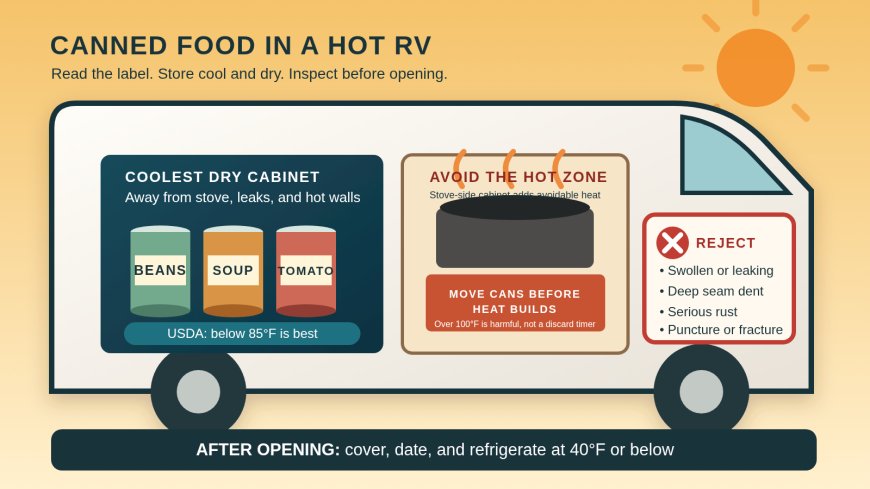
The useful RV pantry check has three parts: read the label, choose the coolest dry cabinet available, and inspect the container before opening. Original illustration by RVCamping.info.
The label decides whether the can is shelf stable
Start with the words on the package. USDA notes that not every canned product can sit at room temperature. Some canned ham and seafood products are sold with a "Keep Refrigerated" instruction.[1] Those belong in a refrigerator from purchase onward, even while unopened. Do not treat the metal can as proof that the food is shelf stable.
For a product sold as shelf stable, the sealed container and commercial heat process are what make pantry storage possible. That protection changes after opening. Once the seal is broken, bacteria can enter, and USDA directs consumers to refrigerate unused portions.[1]
An RV pantry therefore needs two lanes:
- Unopened and labeled shelf stable: store in a cool, dry cabinet while the container remains sound.
- Labeled "Keep Refrigerated," or already opened: keep under refrigeration according to the label and federal cold-storage guidance.
If the label is missing or unreadable, do not guess at the product's storage category. Use the manufacturer's product page or consumer line to identify it. A handwritten inventory can preserve the product name, lot code, best-by date, and storage instruction if a paper label is likely to peel off in a damp compartment.
USDA's heat guidance is not an RV discard clock
USDA's shelf-stable food guidance contains two different temperature statements. It calls storage below 85°F best. It warns that canned goods are harmed by temperatures above 100°F and that spoilage risk rises sharply as storage temperature increases.[1]
Neither statement says that every commercially canned food becomes unsafe the moment an RV cabinet reaches 85°F or 100°F. The source does not provide a universal time-at-temperature table for ordinary canned goods, and it does not define a single post-trip discard threshold. Can construction, food acidity, peak temperature, duration, repeated heating, container condition, and manufacturer instructions all matter.
That distinction is important in a parked RV. A shaded exterior temperature is not the same thing as the temperature inside a closed cabinet. The stove-side cupboard, a box against a sun-facing wall, and an exterior pass-through may each run at different temperatures. A dashboard reading or weather-app high cannot reconstruct the cans' storage history.
Use the federal numbers for prevention:
- Choose a dry interior cabinet away from the stove, oven, water lines, and sun-heated walls.
- Move reserve cans to a temperature-controlled place before leaving the RV closed in hot weather.
- Rotate the oldest stock forward rather than carrying the same cans through repeated hot seasons.
- Put an inexpensive min/max thermometer in the actual food cabinet if heat exposure is a recurring concern.
The thermometer is a planning tool. It can show that the cabinet is a poor long-term location; it does not create a federal pass/fail rule that the source never stated.
After a hot-storage episode, separate known damage from uncertainty
When you return to a hot rig, do not cool the cans and forget the event. First move them to a cooler, dry place. Then inspect every container in good light without squeezing, pressing, or opening a suspect can.
FDA describes can damage as swelling, leakage, punctures, holes, fractures, extensive deep rust, or crushing and dents so severe that the can will no longer stack normally or accept a hand-crank opener. A sticky exterior can signal a leak.[2] FDA's salvage-food guidance also tells shoppers to reject cans with bulges, seam dents, leaks, or rust along the seams.[4]
Use three groups:
Discard without opening
Reject a can that is swollen or bulging, leaking or sticky from an unexplained residue, punctured, fractured, extensively or deeply rusted, or badly crushed. Reject a deep dent on a top, bottom, or side seam. USDA's consumer guidance says not to buy bulging, rusted, leaking, or deeply dented cans and explains that a deep seam dent can let bacteria enter.[1]
Do not taste from a suspect container. Do not feed it to a pet. Bag it so people and animals cannot retrieve it, and place it in outside non-recyclable trash, following local disposal rules. USDA gives this disposal approach for suspect canned goods.[1]
Keep only if the container is sound and the history is acceptable
A can with no swelling, leakage, seam damage, serious rust, puncture, or fracture passes the physical inspection. That inspection cannot prove what happened inside during prolonged heat. If you know the product sat through severe or repeated hot storage, read the manufacturer guidance and contact the company with the product and lot code. When storage history is unknown and confidence matters more than replacement cost, discarding the item is the conservative choice.
Do not turn a small dent into a blanket rule
USDA distinguishes a small dent on an otherwise sound can from a deep dent. It defines a deep dent as one a finger can be laid into and directs consumers to discard cans with deep dents, especially on a seam.[1] FDA uses a functional description for severe damage: crushing or denting that prevents normal stacking or manual opening.[2]
For an RV pantry, the practical line is simple. A sharp, deep, or seam-involved dent goes in the discard group. If the damage is hard to classify, do not use dinner as the test.
Clean the lid, opener, and work surface before opening
Road dust, mouse contamination, spilled raw-food liquid, and grime from a storage bay can ride on a can even when the seal is intact. FDA advises cleaning can lids before opening.[3]
At the galley:
- Wash your hands with soap and water.
- Wash and dry the can lid, especially around the rim and pull tab.
- Use a clean can opener on a clean work surface.
- Keep the cut lid and opener wheel from dropping debris into the food.
- Inspect the food as the can opens.
Stop if the can spurts liquid or foam, releases an abnormal forceful hiss, or the food has an off odor or unusual appearance. USDA says a normal vacuum-packed can may hiss as air enters, but a loud hiss or forceful spurting can indicate unsafe food; do not taste or use it.[1]
Opening and boiling are not repair methods for a swollen, leaking, or deeply damaged commercial can. The correct decision happens before the opener touches it.
Refrigerate what remains after opening
Opening ends pantry storage. USDA permits chilling the unused portion in its opened can; a glass or plastic storage container better protects quality and flavor.[1] In a small RV refrigerator, transferring the food also removes a sharp-edged can and makes the contents easier to cover and label.
Use a clean, food-safe container with a tight lid. Write the product and opening date on it, then refrigerate promptly. FDA says the refrigerator should remain at 40°F or below and recommends using an appliance thermometer rather than trusting the control setting.[3]
USDA's shelf-stable chart lists these after-opening refrigerator times:
- low-acid canned goods such as meat, poultry, most soups, pasta products, potatoes, corn, carrots, beans, peas, and pumpkin: 3 to 4 days;
- high-acid canned goods such as tomatoes, citrus juices, pineapple, berries, pickles, and sauerkraut: 5 to 7 days.[1]
The product label can be more specific, so follow the shorter applicable instruction. If the RV refrigerator cannot maintain 40°F or below, opening a large can creates a leftover problem. Buy smaller cans or plan the meal so the full contents are used.
A five-minute hot-RV pantry routine
Before parking the RV in heat:
- read every refrigerated-storage label;
- move cans away from stove heat, plumbing leaks, and sun-facing walls;
- take long-term stock out of an unconditioned rig;
- record the cabinet's peak temperature if heat exposure is common.
Before using a can:
- inspect the ends, body, side seam, top and bottom seams;
- discard swelling, leakage, serious rust, punctures, fractures, and deep or seam dents;
- clean the lid and opener;
- stop if opening produces forceful spurting or other abnormal signs;
- refrigerate leftovers at 40°F or below in a covered, dated container.
The safe plan is not to invent one magic RV temperature. Keep shelf-stable cans cooler before the trip becomes an experiment, treat container damage as a firm rejection signal, and start a measured cold-storage plan as soon as the can is opened.
Evidence note: USDA provides the canned-food storage, temperature, damage, opening, disposal, and after-opening guidance. FDA supplies a second federal description of damaged cans, lid-cleaning advice, and the 40°F refrigerator benchmark. RVCamping.info's cabinet thermometer, two-lane pantry, inventory, and five-minute routine are practical planning tools, not additional federal requirements.
Sources
- Shelf-Stable Food Safety | USDA Food Safety and Inspection Service — Unopened storage, heat guidance, damaged-can rejection, opening warnings, leftovers, and refrigerator time ranges.
- Are You Storing Food Safely? | U.S. Food and Drug Administration — FDA's consumer description of can damage and leakage indicators.
- Refrigerator Thermometers: Cold Facts about Food Safety | U.S. Food and Drug Administration — Cleaning lids before opening and maintaining a refrigerator at 40°F or below.
- Surplus, Salvaged, and Donated Foods | U.S. Food and Drug Administration — Bulges, seam dents, leaks, and seam rust as rejection signs.
What's Your Reaction?