























Progressive Industries EMS-PT30X review: good cutoff protection, no voltage boost
Research-based EMS-PT30X review covering 30-amp RV fit, low-voltage cutoff, surge limits, safe hookup and portable-versus-hardwired tradeoffs.

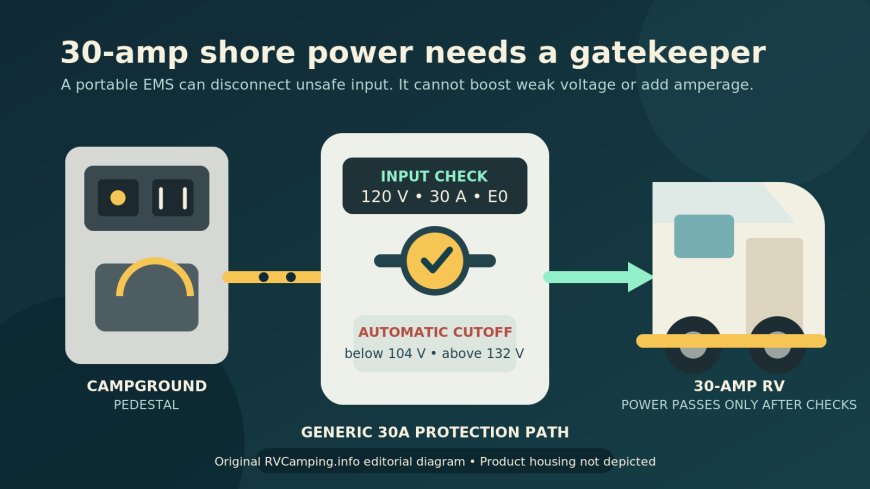
The Progressive Industries EMS-PT30X makes sense for a 30-amp RV owner who wants automatic protection from bad campground power without installing a hardwired unit. It checks the pedestal before connecting the coach, watches voltage and wiring while the RV is plugged in, and cuts power when several defined faults appear. The central tradeoff is equally clear: it can disconnect unsafe input, but it cannot improve weak voltage or give a 30-amp hookup more capacity.[1][4]
Buy it for a North American 120-volt, 30-amp RV with a TT-30 shore-power cord, especially if you move among older or unfamiliar campgrounds. Skip it if your normal connection is a native 50-amp, 120/240-volt service, you need voltage boosting, or you would rather keep the protection permanently inside the RV. A 50-amp coach can use this 30-amp EMS with the correct adapters on a smaller source, but the entire setup remains limited by the lowest-rated source, adapter, cord or RV component.[1]
This is a research-based review. RVCamping.info did not buy or physically test the EMS-PT30X.
As an Amazon Associate, RVCamping.info earns from qualifying purchases. If you buy through an Amazon link in this article, we may earn a commission at no additional cost to you.
The exact product reviewed is the Progressive Industries Electrical Management System model EMS-PT30X, rated 120V/30A. The matching US Amazon listing is ASIN B01N0W4CZ8: check the EMS-PT30X listing on Amazon.[1][2]
Its real value appears after hookup
A simple pedestal tester can catch some wiring problems before an RV is connected. A basic surge device can absorb a transient until its protection is depleted. The EMS-PT30X combines an initial wiring check with continued monitoring, which matters when a campground circuit changes after more rigs arrive and start drawing power.[1] Escapees RV Club describes that afternoon pattern: acceptable voltage at arrival can sag as additional air conditioners come online.[4]
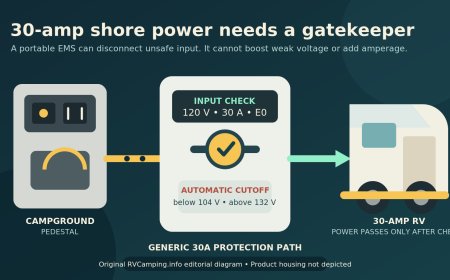
The EMS-PT30X disconnects a 30-amp RV if voltage stays below 104V for more than six seconds. Its current manual uses stepped high-voltage timing: above 132V but below 140V for more than three seconds, above 140V but below 156V for one second, and above 156V within 60 milliseconds. When acceptable power returns, the unit waits 136 seconds before reconnecting the coach, a delay intended to protect an air-conditioner compressor from a quick restart.[1]
It also blocks power for reverse polarity, open ground, open neutral, out-of-range frequency and accidental 240V input. The display cycles through incoming voltage, current, frequency, the present error and a previous-error code. That previous code is useful when power has returned before anyone walks outside to inspect the pedestal.[1]
The surge section is rated at 1,790 joules and 44,000 amps across line-to-neutral, line-to-ground and neutral-to-ground modes. One detail is easy to miss: an E10 code means the surge module has been depleted, yet the unit continues to pass power and report other errors. The manual calls for replacement at that point.[1] Owners who treat any illuminated display as proof that surge protection remains intact can miss the most important message on the case.
What the EMS does not fix
An EMS is a gate, not a power conditioner. When input falls outside its limits, it disconnects the RV. It does not raise 101V to 120V, smooth a weak generator, or negotiate with a crowded campground circuit. A separate voltage regulator addresses low voltage differently by boosting it, though that equipment brings its own ratings, heat and cost.[4]
It also does not manage ordinary overloads inside the RV. Running an air conditioner, electric water heater and microwave together can still trip the pedestal or coach breaker. The EMS display can help an owner see current draw, but the source and RV breakers remain the current-limiting devices.[1] A 30-to-50-amp adapter changes the plug arrangement; it does not turn a 30-amp source into 50-amp service.
The same boundary applies to generators. Progressive Industries says the EMS can be used with a generator and recommends a bonded neutral. It separately warns never to connect the EMS to an inverter, while distinguishing an inverter-generator as an acceptable source.[1] Those terms sound similar but describe different equipment. If an otherwise healthy generator produces an open-ground code, use the generator and EMS manufacturers' instructions rather than improvising a neutral-ground bond.
Portable convenience brings a campsite problem
The portable format is the reason many buyers choose this model. There is no panel to open and no transfer wiring to modify.[1] It can move to a replacement RV with the same shore-power format, and a failed unit is easier to swap than a hardwired EMS.
The campground pedestal is also where rain, theft and awkward cord geometry live. Progressive Industries calls the unit weather resistant, says it may be exposed to outdoor weather, and says it must remain vertical and must not be submerged.[1] That is narrower than waterproof. Keep the receptacle shield properly closed, avoid a puddle or low spot, and do not create a tightly wrapped cover that traps heat or lets water follow the cord into a connection.
A long-term Towing Home review reports using the model and its predecessor since 2012. The owners say their EMS encountered low voltage, open grounds and open neutrals, and they report operation through heat, rain and snow. They also note the practical annoyances: the bright scrolling display can draw attention at night, and short pedestals can leave the unit difficult to support upright and off the ground.[3] That is owner experience, not controlled testing, but it matches the physical tradeoff created by a portable pedestal-mounted device.
The built-in bracket accepts a separate lock. A lock deters casual removal; it does not make the cord immune to cutting or turn a poor pedestal into a safe mounting point. Buyers who camp for long stretches, dislike equipment hanging outside, or want protection every time the RV is connected may prefer the corresponding hardwired design. That choice gives up portability and usually calls for qualified installation.
Use the first connection to test the whole path
A sensible hookup begins with the RV's main breaker off and the pedestal breaker off. Inspect the pedestal receptacle, EMS blades and receptacle, and the RV cord for discoloration, looseness, contamination or heat damage. The manual says that if one side of a mating connection shows overheating, both mating parts need replacement.[1] A new EMS cannot make a worn TT-30 receptacle grip properly.
Plug the EMS into the pedestal with the RV still disconnected, turn the pedestal breaker on, and read the display.[1] An E0 code means the source passed the unit's checks.[1] Any other active error except E10 keeps power from passing; the manual directs the user to disconnect and report the fault to the park manager or a qualified technician.[1] This is the moment to ask for another site, not the moment to defeat the protection because dinner is getting late.
Turn the pedestal breaker off again before plugging the RV cord into the EMS. Seat every connector fully, restore power, and wait through the 136-second delay. Once the coach is energized, watch voltage while a large load starts. The display will not diagnose every possible hot connection, so touch-free observation still matters: smell, discoloration, a loose plug, buzzing or repeated breaker trips call for shutdown and inspection.
Progressive Industries recommends 10/3 outdoor-rated cable for a 120V/30A extension and recommends keeping that added run to no more than 25 feet.[1] More cord means more voltage drop and another pair of connections that can heat. If extra reach is unavoidable, uncoil the cable, keep connections dry and supported, and inspect them after the RV has been under load.
Who gets the best fit
The EMS-PT30X has a strong, specific job. It suits a 30-amp travel trailer, fifth wheel or motorhome whose owner wants pedestal diagnostics, automatic voltage cutoff and surge protection in one portable unit. It is especially useful for travelers who connect to many unfamiliar sites and are willing to read the error code instead of treating every shutdown as a defective accessory.
It is a weaker fit for a 50-amp RV that regularly uses full 50-amp service, for seasonal campers who want a locked indoor installation, and for anyone trying to solve chronically low campground voltage without losing power. Those needs point toward the correctly rated 50-amp EMS, a hardwired model, or a properly sized voltage regulator rather than a different adapter.
The verdict is favorable because the limitations are visible and manageable. Match the model to a 120V/30A power path, keep the portable unit upright and out of standing water, inspect every connection, and learn E0, E4 and E10 before the first trip.[1] Used that way, the EMS-PT30X is more than a surge absorber and less than a cure for bad shore power, which is exactly the distinction a buyer needs to understand.
Sources
- Progressive Industries EMS-PT30X and EMS-PT50X instruction manual (accessed 2026-10-24)
- Amazon US listing: Progressive Industries EMS-PT30X, ASIN B01N0W4CZ8 (accessed 2026-10-24)
- Towing Home: EMS-PT30X long-term owner review (accessed 2026-10-24)
- Escapees RV Club: Shore Power (accessed 2026-10-24)
What's Your Reaction?