




Anker SOLIX C1000 Gen 2 review for RVs: strong output, short endurance
Research-based Anker SOLIX C1000 Gen 2 RV review covering usable energy, whole-coach limits, fast charging, solar input and generation checks.
The Anker SOLIX C1000 Gen 2 is a good fit for an RV camper who wants a portable battery for a compressor cooler, electronics, coffee maker or brief outage backup. It weighs 24.9 pounds, can supply 2,000 watts continuously, and recharges quickly from a strong household circuit. The catch is capacity: its 1,024Wh battery is much better at running selected loads than carrying an entire RV through a long off-grid day.[1]
Buy it if portability matters and your energy plan is measured in watt-hours, not simply whether an appliance starts. Skip it if you want to run air conditioning for hours, need a 30-amp RV outlet, or expect to add an expansion battery later. This generation has ordinary 120V receptacles and cannot be expanded.[1][5]
This is a research-based review. RVCamping.info did not buy or physically test the C1000 Gen 2.
As an Amazon Associate, RVCamping.info earns from qualifying purchases. If you buy through an Amazon link in this article, we may earn a commission at no additional cost to you.
The exact US model reviewed is the standard Anker SOLIX C1000 Gen 2, model A1763, not the original C1000 or the four-outlet C1000X Gen 2. The matching Amazon listing is ASIN B0FN7MSY4L: check the C1000 Gen 2 listing on Amazon.[2][3][5]
Plan around usable energy, not the 2,000W headline
Output and endurance answer different questions. The 2,000W rating tells you which loads the inverter can operate at one moment. The 1,024Wh capacity tells you roughly how long those loads can run. An air fryer or coffee maker may stay within the output limit yet consume a large share of the battery in a short session.[1]
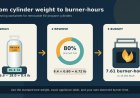
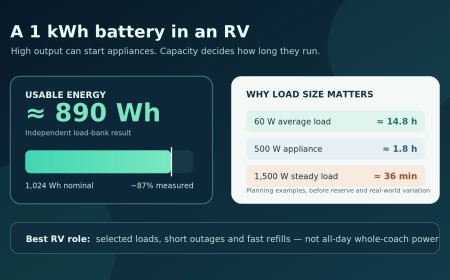
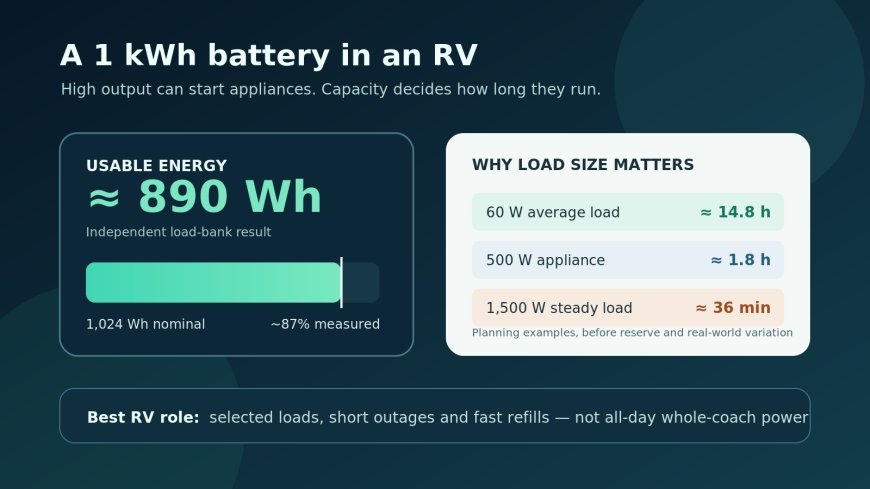
OutdoorGearLab reports 890Wh from a load-bank test, about 87% of nominal capacity.[4] That is a more useful planning number than 1,024Wh because conversion and operating losses exist.[4] It is still one test, not a guarantee for every unit or temperature. The same article's comparison table appears to carry several original-C1000 values, so this review uses its clearly stated 890Wh result rather than the inconsistent table fields.[4]
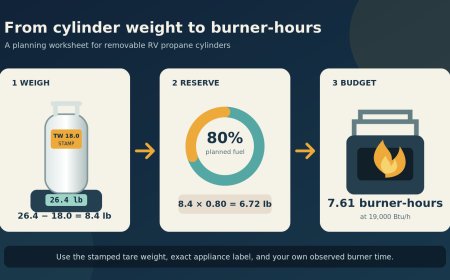
At 890Wh, a steady 60W load works out to about 14.8 hours before allowing for standby draw, startup behavior or a reserve. A 100W average load works out to 8.9 hours. A 500W appliance gets only about 1.8 hours of theoretical runtime, and a steady 1,500W load about 36 minutes. Refrigerators and coolers cycle, so their nameplate wattage alone does not predict overnight use; measure the actual energy consumed over several hours.
That arithmetic makes the best RV use case fairly clear. Let the C1000 run a cooler, CPAP with an approved power setup, laptops, phones and occasional kitchen appliances while propane or the RV battery system handles other jobs. It is less convincing as a whole-coach substitute for shore power. One rooftop air conditioner can consume the available energy quickly even if the inverter manages the startup surge.
The easy route is to power selected devices directly
For a first trip, use the C1000's outlets and USB ports rather than connecting the RV's shore cord.[1] Direct loads are easier to count, and they avoid accidentally feeding the RV converter. A converter can use the power station to charge the RV battery, adding conversion losses while hiding the real load behind the coach panel.
The standard Gen 2 has five AC outlets, three USB-C ports, one USB-A port and a 12V car socket. Two USB-C ports can deliver up to 140W each, while the 12V socket is rated at 10A/120W.[1][5] Check the device plug and its running draw rather than assuming ten ports can all deliver their individual maximum at once; the unit's overall limits still apply.
Connecting a 30-amp RV through a 15-to-30-amp adapter is possible only as a limited 120V source, not as 30-amp service. The C1000's AC output remains capped at 2,000W, and the adapter does not create more power.[1] Turn off the air conditioner, electric water heater, electric space heat and converter before trying this route, then add one known load at a time.
The manufacturer's current guide says the station uses a floating-ground design and calls for a neutral-ground plug in applications that require bonding.[2] RV electrical-management systems may otherwise report an open ground. Neutral-ground bonding is a system-safety issue, not a nuisance code to defeat. Use only the arrangement permitted by the power-station, RV and protection-device instructions, and have a qualified RV electrician review the setup if those instructions conflict.
Fast recharging is useful, but the source matters
Anker rates normal AC charging at 1,200W and its app-enabled UltraFast mode at up to 1,600W, with a claimed empty-to-full time of 49 minutes.[1] OutdoorGearLab recorded a 56-minute recharge in its test and an average charging rate of 1,097Wh per hour; Mashable also found that the fastest mode had to be enabled in the app.[4][5]
That speed is genuinely useful during a grocery stop or a short return to hookups. It also asks a lot of a campsite circuit. A 1,600W charging session leaves little margin on a 15A branch circuit once other loads are included.[1] Use the supplied AC cable, reduce the charge rate in the app when sharing a circuit, and avoid stacking charger demand on top of the RV's microwave, water heater or air conditioner.[1]
Solar input is rated to 600W through the XT60i port. Anker specifies 11–28V at up to 8.2A and 29–60V at up to 14.5A.[1][2] Panel wattage alone is not enough: the array's open-circuit voltage must remain within the station's limit in the coldest expected conditions, and connector polarity must match. Anker's roughly 1.8-hour solar claim assumes 600W under favorable conditions; shade, panel angle, heat and clouds make a slower day more likely.[1]
The battery can discharge from -4°F to 104°F, but charging is specified only from 32°F to 104°F.[1] In cold-weather RV use, warm the unit into its charging range before accepting solar or AC input. Keep it ventilated and protected from rain or standing water. "Water-resistant" marketing is not a reason to leave a high-power battery outside at a wet pedestal.[1]
Check the generation before ordering
The C1000 name now covers several products. The original C1000 has 1,056Wh, a light bar and support for an expansion battery. The standard C1000 Gen 2 drops to 1,024Wh, loses the light and expansion port, but becomes lighter, raises continuous output to 2,000W and cuts the stated UPS transfer time to 10ms.[1][5]
There is also a C1000X Gen 2. Mashable found that the X version has four AC outlets and a smaller display while the standard version has five AC outlets.[5] Those differences matter more than the nearly identical names suggest. Check A1763, the full product title and ASIN B0FN7MSY4L before paying; do not identify the unit from "C1000" alone.[2][3]
Inspect the station and cables when it arrives. Reject a damaged case, swollen enclosure, bent connector or cable that becomes hot in normal use. Leave space around the cooling vents, place the unit where it cannot slide during travel, and carry it by the handles rather than leaving appliances plugged in while moving. Test the intended appliance at home, note its startup and steady draw on the display, and record how many watt-hours the job actually consumes.
Who gets the best fit
The C1000 Gen 2 is strongest as a movable 1kWh-class supply for selective RV loads. It has enough inverter output for many kitchen appliances, tested usable energy near 890Wh, useful USB-C power and a weight that one adult can reasonably carry.[1][4] It can cover a campground outage, move outside for a picnic setup, or keep refrigeration and communications going without idling a generator.
Its weakness is not whether it can start a large appliance. It is how quickly a large appliance empties the battery. Buyers planning long air-conditioner runs, multiple off-grid days or whole-RV service need more stored energy, a properly integrated RV electrical system, or a generator where rules allow one. Buyers who need future expansion should also look elsewhere because Anker removed that option on Gen 2.[1][5]
For a weekend built around a cooler, device charging and short appliance sessions, the balance is appealing. Measure the loads, reserve energy for the night, and treat fast charging as a refill option rather than proof of long endurance. That is the difference between a portable battery that solves a real campsite problem and one that spends the trip counting down faster than expected.
Sources
- Anker SOLIX C1000 Gen 2 official product page (accessed 2026-10-25)
- Anker SOLIX C1000 Gen 2 user guide (A17630A2) (accessed 2026-10-25)
- Amazon US listing: Anker SOLIX C1000 Gen 2, ASIN B0FN7MSY4L (accessed 2026-10-25)
- OutdoorGearLab tested review of the Anker SOLIX C1000 Gen 2 (accessed 2026-10-25)
- Mashable tested review of the Anker SOLIX C1000 Gen 2 (accessed 2026-10-25)
What's Your Reaction?