





The CPAP says 90W. That is not your RV battery budget
Use the CPAP maker's exact eight-hour battery row, then subtract the RV's overnight loads before counting off-grid nights.
The CPAP says 90W. That is not your RV battery budget
A CPAP power brick or DC converter marked "90W" does not mean the machine will consume 90 watts all night. It tells you what the power hardware can deliver. For an off-grid night in an RV, the useful number is the manufacturer's eight-hour battery row for your exact machine, pressure, tube and humidifier setup.
That distinction changes the packing decision. In ResMed's published AirSense 10 table, one eight-hour night at 10 cm H2O calls for 12 amp-hours with SlimLine tubing and no humidifier, 28 Ah with the humidifier at level 4, or 46 Ah with ClimateLineAir and automatic humidification. Those figures already include ResMed's 50% safety margin.[1] A single model can therefore move from an easy overnight load to nearly half of a nominal 100 Ah bank before the RV's lights, furnace controls, water pump or refrigerator electronics enter the calculation.
This is a planning example, not a reason to change prescribed therapy settings. Keep the treatment pressure and therapy mode set by your clinician. If you are considering turning off humidification or heated tubing, ask your care team whether that is suitable for you.
Start with the correct row, not a watts sticker
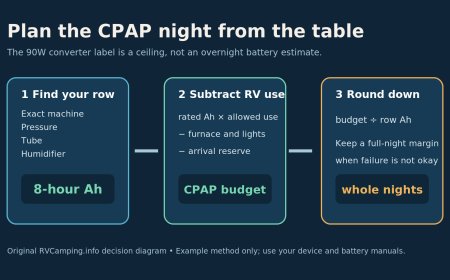
The label hunt has four parts: full machine model, treatment pressure, tube, and humidifier or climate setting. Use the current battery guide for that model. If the guide does not contain the machine, ask the equipment provider or manufacturer for a battery table rather than borrowing a row from a similar-looking device.
The Air11 converter illustrates why the accessory name can mislead a battery calculation. Its output specification is 24 V at 3.75 A, which multiplies to 90 W, but that is converter capacity, not a promise that the attached machine draws 90 W continuously. The same guide says the converter is model-specific, accepts a 12 V or 24 V source, and recommends a deep-cycle battery rather than casually relying on the starting battery.[2]
ResMed's older but unusually useful battery guide takes the direct route: select the exact device configuration, move to the treatment pressure or next higher listed pressure, and read the amp-hour requirement for eight hours. The guide assumes daily recharging and says its converter-table figures carry a 50% safety margin.[1]
One machine, three overnight budgets
| AirSense 10 example at 10 cm H2O | Published 8-hour battery size | What changes the result |
|---|---|---|
| SlimLine tubing, humidifier off | 12 Ah | Therapy device and unheated tube |
| SlimLine tubing, humidifier at 4 | 28 Ah | Heated humidification added |
| ClimateLineAir, humidifier on Auto | 46 Ah | Heated tube and automatic humidification |
These are manufacturer rows for a specific AirSense 10 configuration, not universal CPAP averages. They are also battery-size recommendations, not measured consumption from our RV.
Subtract the RV's night before counting CPAP nights
Use the bank's allowed discharge limit from its own manual or battery-management settings. Do not assume that every nominal amp-hour is available. Then reserve the overnight loads that are already spoken for.
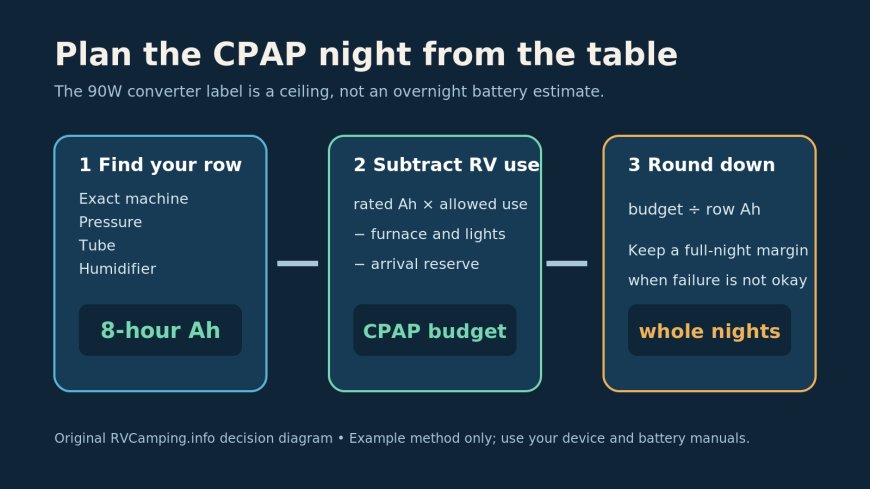
Available CPAP budget (Ah) = rated bank Ah × allowed-use fraction − other overnight Ah − arrival reserve
For an illustrative 100 Ah house bank with an allowed-use fraction of 80%, 15 Ah assigned to other overnight loads, and no separate arrival reserve, the CPAP budget is 65 Ah. Dividing that budget by the manufacturer row gives this result:
| Configuration | 8-hour row | Whole nights before recharge, using the 65 Ah example budget |
|---|---|---|
| No humidifier | 12 Ah | 5 nights |
| Humidifier at 4 | 28 Ah | 2 nights |
| ClimateLineAir + Auto | 46 Ah | 1 night |
Round down. A fraction of a night is not a workable therapy plan. If the RV's furnace fan runs longer than expected or cold weather reduces available battery capacity, the margin disappears sooner. The DOE's basic energy relationship is still useful when a device gives watt-hours instead of amp-hours: watt-hours equal amp-hours times voltage.[4] Do not mix a 24 V device-side number with a 12 V battery-bank number without accounting for the converter between them.
A downloadable copy of the arithmetic belongs in the trip notes:
- Copy the exact eight-hour Ah figure from the machine maker's table.
- Enter the battery bank's rated Ah and the allowed-use fraction from its documentation.
- Subtract the RV loads expected between quiet hours and morning.
- Divide by the machine's eight-hour figure and round down.
- Hold one full-night margin if missing therapy is not an acceptable failure mode.
DC-to-DC usually buys a cleaner calculation
When a manufacturer offers a model-specific DC converter, it avoids converting battery DC to 120 V AC and then back to the machine's DC input. ResMed explicitly recommends its DC-to-DC route over an inverter for the devices covered by its battery guide.[1]
An inverter is not free even when the CPAP load is modest. One current Victron family lists maximum efficiency from 87% to 92%, depending on model, plus zero-load consumption from 4.2 W to 12 W.[3] "Maximum" efficiency is not a guarantee at a small overnight load, and the idle draw can matter across eight hours. If AC power is the only supported route for your machine, use the machine maker's inverter guidance and measure the complete overnight draw at the battery rather than inserting a generic efficiency guess.
The practical comparison is short:
| Power path | Best planning source | Main trap |
|---|---|---|
| Model-specific DC-to-DC converter | Manufacturer's converter battery table | Treating converter wattage as nightly consumption |
| RV inverter plus factory AC brick | Manufacturer's inverter guidance, then a battery-side measurement | Ignoring inverter losses and idle draw |
| Vehicle starting battery | Do not make this the default overnight bank | Waking up with too little reserve to start |
ResMed warns that using a non-operating vehicle battery can leave inadequate starting reserve, and its Air11 converter guide points users toward a deep-cycle battery.[1][2] In an RV, that means confirming which receptacle is connected to the house bank. A dashboard socket may be on the chassis battery even when it is physically close to the bed.
Run one driveway night before the campsite night
A paper calculation is the screening test. The driveway run is the acceptance test.
Charge the house bank fully, leave the CPAP in the exact planned configuration, and run the RV's normal overnight loads. Record battery state at lights-out and on waking with the RV's shunt-based monitor if one is installed. Repeat if the first night includes unusual furnace runtime or a different humidifier setting. The result measures the whole system: converter, wiring, socket, battery condition and competing loads.
Also test the failure path. Confirm the converter stays ventilated, the cable cannot be pulled loose, the battery monitor's low-state alarm is audible, and the morning state leaves the reserve you planned. Carry the factory AC supply for shore-power nights and keep the clinician or equipment provider's contact information available. A spare cable is only useful if it is approved for the exact machine.
The decision comes down to one line in the correct table. Once that row is known, the RV arithmetic is ordinary subtraction. Without it, a 90W label is just a large ceiling pretending to be an overnight estimate.
Sources
What's Your Reaction?