




How long will your RV propane last? Weigh the cylinder and count burner-hours
Weigh a removable RV propane cylinder, subtract its stamped tare weight, and turn exact appliance ratings into a reserve-aware burner-hour estimate.
How long will your RV propane last? Weigh the cylinder and count burner-hours
By Romana | Information checked 2026-10-27 UTC
A dashboard gauge or the word “full” does not tell you how many cold nights remain. For an RV with removable propane cylinders, the useful estimate starts with two readings: the cylinder’s gross weight today and its stamped tare weight. Then the appliance label, not the size of the RV, sets the burn rate.
This is a planning estimate, not permission to run a cylinder empty. Keep a reserve, follow every appliance and RV manual, and refill before the calculation becomes a field experiment.
Start with pounds you can account for
PERC’s cylinder guide defines TW as the empty cylinder’s weight and gives a common example: a cylinder with 47.8 pounds of water capacity holds 20 pounds of propane. Its comparison table lists that 20-pound cylinder at 430,270 Btu when full.[1] The U.S. Energy Information Administration separately lists propane at approximately 91,452 Btu per gallon.[2]
For a removable cylinder that your RV manual allows you to remove, weigh it with an adequate scale and subtract the stamped tare weight:
propane remaining (lb) = current gross weight (lb) - stamped TW (lb)
Do not substitute a catalog tare weight. Collars, valves and cylinders differ, and an aftermarket gauge or cover can add weight. If the result is negative or plainly impossible, stop and check the scale, units and stamp rather than forcing the number to work.
This method is for removable DOT cylinders. A permanently mounted ASME tank is not a scale project. Use its installed level indication as a rough check and have the tank filled through the normal service procedure.
Turn the labels into a fuel budget
Find the identity or rating label for every propane appliance you expect to use. Suburban says the furnace identity label carries unit specifications and safety notices.[4] Record the complete model and the gas input in Btu per hour. Do not use the heat output rating or a number copied from a similar-looking furnace.
The burner-hour worksheet is:
planned fuel energy = propane remaining × reserve factor × Btu per pound
appliance burner-hours = planned fuel energy ÷ appliance input Btu/h
Using PERC’s 430,270-Btu figure for a full 20-pound cylinder gives a planning factor of 21,513.5 Btu per pound.[1] That is an editorial conversion for this worksheet, not a fill specification.
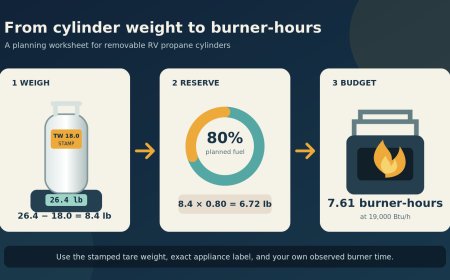
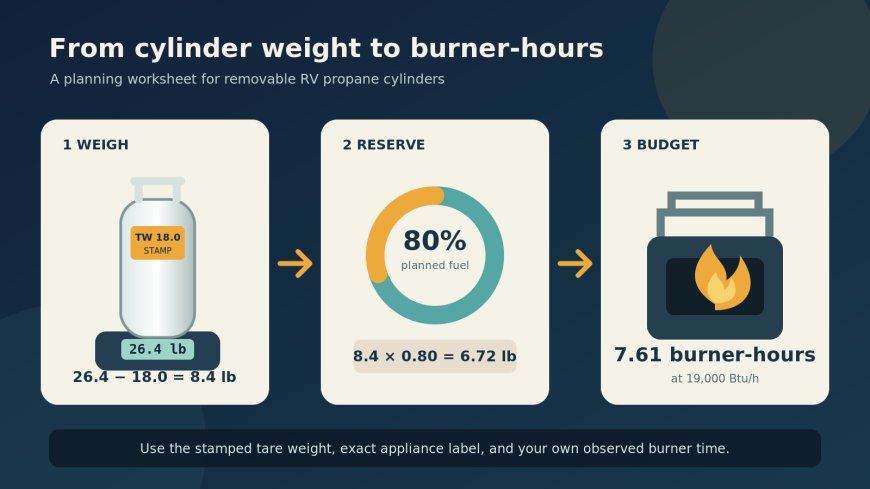
Here is an illustrative calculation. A removable cylinder weighs 26.4 pounds, and its collar is stamped TW 18.0:
- Propane on the scale:
26.4 - 18.0 = 8.4 lb - Fuel after holding back a 20% planning reserve:
8.4 × 0.80 = 6.72 lb - Planned energy:
6.72 × 21,513.5 = 144,571 Btu
A Suburban specification sheet lists 19,000 Btu/h of gas input for one NT-SEQ furnace model.[3] If that exact rating were on the installed furnace, the sample cylinder would provide:
144,571 ÷ 19,000 = 7.61 burner-hours
That does not mean 7.61 hours on the clock. A thermostat cycles the burner. If you time the burner for three representative hours and record 72 minutes of flame time, the observed duty fraction is 72 ÷ 180 = 0.40. The same fuel budget then represents about 7.61 ÷ 0.40 = 19.0 clock-hours under those observed conditions.
Weather can wreck that estimate. Wind, temperature, thermostat setting, insulation, open doors and altitude can change cycling. Measure during conditions similar to the trip, and treat one mild-afternoon observation as poor evidence for a freezing night.
Add the loads that share the same cylinder
The furnace is rarely alone. A propane refrigerator, water heater, range or generator may draw from the same supply. For each appliance, multiply its label input by the time its burner actually runs, then add the results:
daily propane demand = Σ (input Btu/h × burner-hours per day)
Use observed burner time where practical. For cooking, a written estimate by burner and minutes is more honest than assuming the range runs continuously. For a water heater or refrigerator, operating mode and controls matter. If the label or manual does not supply a usable input figure, leave that appliance out of the arithmetic and increase the reserve rather than inventing a number.
A two-cylinder automatic-changeover system also needs a physical check. The worksheet only describes fuel quantity; it does not prove that both valves are open, the regulator is working or the indicator changed as expected. Keep the service cylinder and reserve cylinder identifiable, and reset the record after a refill or exchange.
Know when the worksheet no longer applies
A fuel budget is useless when the propane system is unsafe. Do not continue calculating through an odor, hissing, soot, damaged cylinder, recurring ignition failure or an alarm. Suburban’s furnace guide says to evacuate the vehicle, shut off gas at the source when it is safe to do so, avoid switches, phones, engines and generators in the vehicle, and contact the gas supplier, service technician or fire department if gas is smelled.[4]
The same guide directs owners to stop after three failed ignition attempts and seek service rather than continuing to cycle the thermostat.[4] Installation, regulator work, leak diagnosis and appliance repair belong with qualified personnel.
The trip decision is simpler than the formula. Refill when the calculated burner-hours, minus a deliberate reserve, do not cover the expected cold period and other propane loads. Recalculate when weather, appliances or cylinder status changes. A scale reading and three lines of arithmetic give you a defensible estimate; they do not replace a safe system or a nearby refill plan.
Source credit: RVCamping.info reviewed the linked U.S. Energy Information Administration, Propane Education & Research Council and Suburban manufacturer materials on 2026-10-27. The reserve-and-burner-hour worksheet and worked example are original editorial analysis.
Sources
- PERC: Measurements and Calculations with Propane (accessed 2026-10-27)
- EIA: British thermal units and fuel conversion factors (accessed 2026-10-27)
- Suburban NT-SEQ Series furnace specifications (accessed 2026-10-27)
- Suburban gas furnace operation guide (accessed 2026-10-27)
What's Your Reaction?