










NOCO GENIUS10 review for RV batteries: useful backup, slow for big banks
Research-based NOCO GENIUS10 review covering RV battery compatibility, charging time, lithium limits, safe setup and backup-charger tradeoffs.

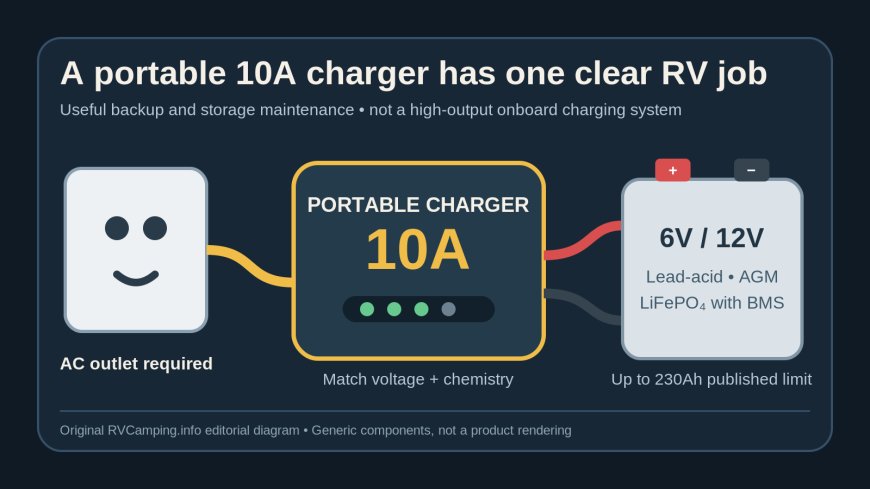
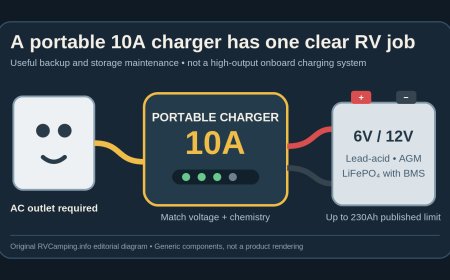
The NOCO GENIUS10 is a sensible portable charger and maintainer for RV owners who want one tool for a 6- or 12-volt starting battery, a modest 12-volt house bank, or winter storage. Its 10-amp output is enough to recover an ordinary single battery overnight in many cases, and NOCO rates it for charging batteries up to 230 amp-hours.[1][2]
Buy it if you can identify the battery voltage and chemistry, have access to a suitable AC outlet, and want a charger that can move between the RV, tow vehicle and other 6- or 12-volt equipment. Skip it for 24-, 36- or 48-volt banks, lithium batteries without a compatible battery-management system, or a large house bank that needs fast recovery after every off-grid stay.[1]
The tradeoff is time. Ten amps is substantial for a portable maintainer, but small beside a typical RV converter/charger or inverter/charger. NOCO's own table estimates about 7 hours for a normally discharged 100Ah battery and 17.3 hours for a 230Ah battery, based on a 50% depth of discharge.[1] That makes the GENIUS10 a practical spare and storage charger, not a replacement for a properly sized onboard charging system.
This is a research-based review. RVCamping.info did not buy or physically test the charger.
As an Amazon Associate, RVCamping.info earns from qualifying purchases. If you buy through an Amazon link in this article, we may earn a commission at no additional cost to you.
The exact product reviewed is the NOCO GENIUS10, model GENIUS10, UPC 046221190052. The matching US Amazon listing is ASIN B07W3QT226: check the NOCO GENIUS10 listing on Amazon.[2][3] The current Amazon Canada page provides a useful identity cross-check because its product data pairs that ASIN with item model GENIUS10.[3]
The best RV use is a portable second charger
Picture an RV returning to storage with a low chassis battery and a house battery that the onboard converter will maintain once shore power is restored. The GENIUS10 can handle either job, one compatible battery or bank at a time, without becoming a permanent part of the RV's electrical system.
That portability is its strongest case. The included clamps have integrated eyelets, and NOCO lists roughly 77 inches of DC cable. The unit accepts 100-240V AC, weighs 3.33 pounds and carries an IP65 housing rating, although its manual still says to operate and store it dry and to stop using it if it becomes wet.[1][2] IP65 is not permission to leave an energized charger in rain or a wet battery compartment.
The mode choices cover common RV batteries: conventional 12V lead-acid, 12V AGM, 12V lithium, standard 6V lead-acid and 6V AGM. All charge modes are rated at 10 amps, with different peak voltages for the selected chemistry.[1] That flexibility helps a household with a travel trailer, tow vehicle and golf-cart-style 6V batteries, but only if the user deliberately chooses the right mode.
An independent demonstration from High-Tech Battery Solutions walked through the controls on a real unit and confirmed that the 6V modes retain the 10-amp rate. The presenter also showed the stiff single mode button, diagnostic lights, Supply mode and the manual Force function.[4] The demonstrator sells battery equipment, so this is useful operational evidence rather than a neutral laboratory comparison.
Check the bank before connecting the clamps
The 230Ah figure needs context. It is a manufacturer charging limit, not a promise that every 230Ah RV bank will recharge quickly.[1][2] Two 100Ah 12V batteries wired in parallel form a 200Ah 12V bank and fall within that published capacity ceiling, provided the batteries form a healthy, matched bank and the battery maker accepts a 10-amp charging rate. A pair of 6V batteries wired in series forms a 12V bank, so the charger sees the bank's 12V output; that setup calls for the correct 12V mode, not the 6V mode.
Do not infer the wiring from the battery labels. Trace the interconnects or use the RV's documentation. A 24V bank is outside the GENIUS10's compatibility even if it consists of individual 12V batteries.[1] Owners with multiple banks also need to know which disconnects, combiners, solar controllers and onboard chargers remain connected. The safest plan comes from the RV and battery manufacturers, not from treating a portable charger as electrically isolated when it is still attached to the coach.
Lithium deserves a separate pause. NOCO says its 12V Lithium mode is for lithium-ion batteries, including LiFePO4, with a built-in battery-management system. The manual tells users to check the battery maker's recommended voltage and charge rate before charging.[1] A Lithium button does not prove that a cold battery will block charging, nor does the charger's ambient-temperature compensation replace the battery's own low-temperature protection.
The GENIUS10 is also not a jump starter. It needs AC input and charges over time. NOCO's Force mode can begin charging a battery below the charger's normal 1V detection threshold, but that mode temporarily disables safety protections and leaves live power at the connectors.[1] A battery that is frozen, visibly damaged, leaking, hot or of uncertain chemistry is a stop-and-diagnose situation, not a reason to force current into it.
A setup route that fits an RV campsite or storage bay
Start with the label and wiring, not the charger button. Identify whether the target is 6V or 12V, lead-acid or lithium, and whether several batteries make up one bank.[1] Confirm the battery maker permits the GENIUS10's charge voltage and 10-amp rate.[1] Inspect the case, terminals, cables and charger leads before energizing anything.[5]
Location matters more than the charger's compact size suggests. NOCO calls for ventilation, a dry operating area and cable routing away from doors, fan blades, belts and other moving parts. It says not to place the charger directly on a battery.[1] Interstate Batteries independently advises eye, face and hand protection, ventilation, no sparks or flames, and no charging of a frozen or visibly damaged lead-acid battery.[5]
For a battery installed in a negative-ground vehicle, NOCO's sequence puts the red clamp on the positive post and the black clamp on a substantial grounded metal part of the chassis or engine, separated from the battery; AC power comes last. Disconnection happens in reverse.[1] An RV house bank may not match a tow vehicle's under-hood layout, so follow the battery and RV manufacturer's connection instructions when they differ. Do not guess at a frame point inside a compartment full of electronics or propane equipment.
Once the clamps are secure, choose the mode that matches the battery. The charger remembers its previous mode, which is convenient until the unit moves from an AGM tow-vehicle battery to a flooded or lithium house battery.[1] Reading the illuminated mode before every session is a small habit that prevents a large mistake.
The charge lights report broad progress rather than a precise state of charge. A solid green light means charging is complete and the unit has entered maintenance behavior, but it does not measure usable battery capacity under load.[1] A tired battery can accept a charge and still fail quickly. NOCO's bad-battery indication or repeated inability to hold charge calls for professional testing, not repeated Repair cycles.
Repair and Supply modes are specialist tools
The ordinary charge modes are the reason to buy this product. Repair and Supply modes are secondary capabilities with sharper edges.
Repair mode can raise voltage as high as 16.5V and is only for 12V lead-acid batteries. NOCO warns that sensitive vehicle electronics may not tolerate that voltage and recommends disconnecting the battery before using the mode.[1] It is not a lithium desulfation setting, and it cannot restore every sulfated or damaged battery.
Supply mode outputs 13.6V at 10A, with a 12A maximum overload point. In that mode, live power is present at the connectors and several protections are disabled.[1] It can support a modest 12V device or preserve vehicle memory during battery replacement, but it is not an RV converter upgrade and cannot support loads that exceed its output.
These modes are valuable when the user understands the circuit and follows the manual. For routine RV storage, the normal chemistry-specific charge mode is the calmer choice. NOCO says the charger can remain connected for ongoing maintenance after the battery reaches full charge.[1] Keep the area dry and ventilated, protect the cables from damage, and check the battery and connections periodically rather than abandoning the setup for a season.
Who should buy the GENIUS10
The GENIUS10 fits an RV owner who wants a portable charger for seasonal maintenance, a low chassis battery, or a 6/12V house bank up to the published 230Ah charging limit. It is more versatile than a tiny maintainer and easier to move between vehicles than an installed converter.
It is less appealing when a large bank needs to recover quickly, when the RV already has a healthy multistage charger matched to the battery chemistry, or when shore power is unavailable. Solar or generator charging solves a different problem. The GENIUS10 cannot create AC power, and its 10A output remains the bottleneck no matter how large the battery bank is.
The verdict is favorable, with a narrow job description: this is a capable portable second charger, not the center of an RV electrical system. Verify voltage, chemistry, bank wiring and the battery maker's limits first.[1] If those match, the GENIUS10 offers enough current to be genuinely useful while remaining small enough to carry as backup gear.
Sources
- NOCO GENIUS10 user guide and warranty, revision 4.9.2024A (accessed 2026-10-23)
- NOCO GENIUS10 technical specifications (accessed 2026-10-23)
- Amazon listing for NOCO GENIUS10, ASIN B07W3QT226 (accessed 2026-10-23)
- High-Tech Battery Solutions: NOCO GENIUS10 review and demonstration (accessed 2026-10-23)
- Interstate Batteries 2025 application guide: charging safety (accessed 2026-10-23)
What's Your Reaction?