









A 420-pound mobility carrier can add 579 pounds to an RV's rear axle
Use a static axle-load screen, exact RV ratings and a before-and-after scale test before adding a hitch-mounted wheelchair or scooter carrier.
A hitch-mounted carrier looks like a simple cargo problem: add the carrier, power chair or scooter, then compare the total with the receiver's vertical-load rating. On a motorhome, that shortcut misses the lever behind the rear axle.
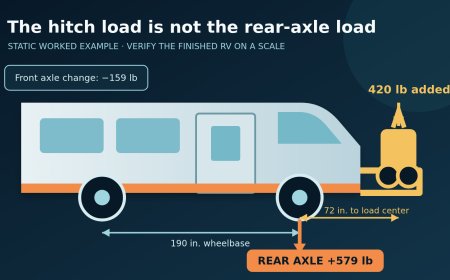
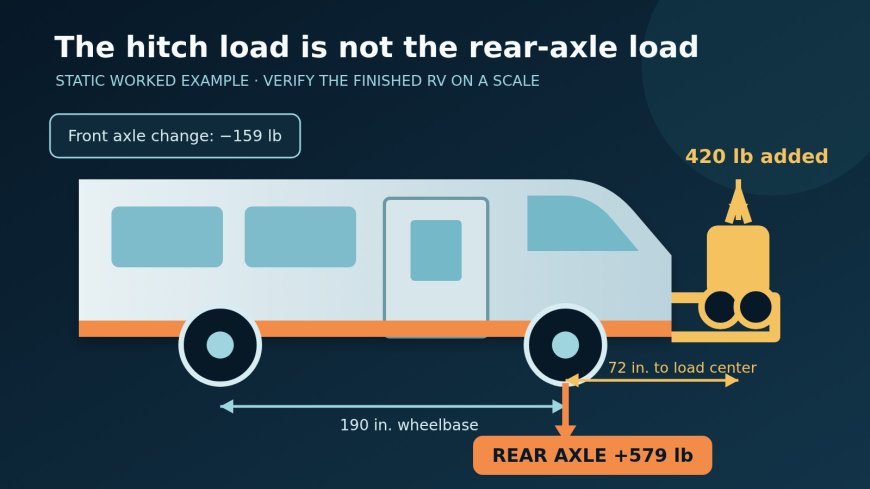
Put 420 pounds with its combined center of gravity 72 inches behind the rear axle of a 190-inch-wheelbase motorhome. A static calculation predicts about 579 pounds added to the rear axle and 159 pounds removed from the front. The RV's total weight still rises by 420 pounds. The axle loads do not change by 420 and zero.
This matters before anyone orders hardware. A carrier can fit the receiver's published limit while using more rear-axle capacity than its own scale weight suggests. The screen below finds that mismatch. It cannot approve an installation.
Start with a real scale ticket
Load the motorhome as it normally travels, including occupants, fuel, water, mobility equipment, food and trip gear, but without the proposed rear carrier. Get separate front- and rear-axle readings on a scale suitable for the vehicle. Record the loading state with the ticket.
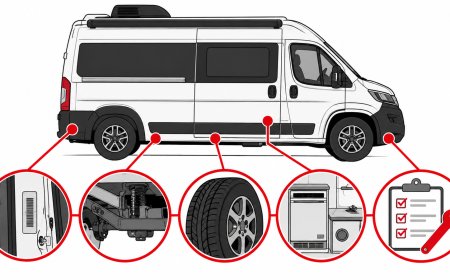
Then photograph the certification and occupant-and-cargo labels on the exact RV. Federal rules require motorhomes at or below 10,000 pounds GVWR and those above 10,000 pounds to carry occupant-and-cargo information tied to GVWR; both versions state that the combined weight of occupants and cargo should never exceed the labeled amount.[1][2] That yellow label is the starting allowance from the completed RV's original configuration, not proof that a concentrated load far behind the axle will fit.
Collect five more numbers before doing any arithmetic:
- front GAWR, rear GAWR and GVWR from the motorhome's labels;
- wheelbase, measured from the front-axle centerline to the rear-axle centerline;
- the carrier's installed weight, including ramps, swing-away hardware and fasteners;
- the mobility device's travel weight, including its battery, cover and anything left attached; and
- the horizontal distance from the rear-axle centerline to the combined center of gravity of everything added.
Do not substitute overall carrier length for that last distance. Ask the carrier installer or manufacturer for the loaded center-of-gravity location and measurement method. If nobody can support that input for the proposed combination, the calculator cannot rescue the proposal.
Run the rear-axle lever screen
For a level, stationary, two-axle motorhome, let:
W= total added carrier and mobility-device weight;L= wheelbase; andd= distance from the rear axle to the added load's combined center of gravity.
Use the same units for L and d.
front-axle change = -W × d / L
rear-axle change = W × (L + d) / L
The rear increase is greater than W because the load behind the axle also transfers weight off the front axle. As a check, add the two changes: they must equal W.
Here is the documented example:
| Input or result | Illustrative value |
|---|---|
| Current front / rear scale readings | 4,200 / 7,400 lb |
| Front / rear GAWR | 5,000 / 8,000 lb |
| GVWR | 12,500 lb |
Wheelbase L |
190 in. |
Load center behind rear axle d |
72 in. |
Carrier + device + attached gear W |
420 lb |
| Receiver vertical-load limit | 500 lb |
| Predicted front change | -159.2 lb |
| Predicted rear change | +579.2 lb |
| Predicted front / rear loads | 4,040.8 / 7,979.2 lb |
| Predicted gross | 12,020 lb |
| Predicted rear-GAWR margin | 20.8 lb |
The illustrative hitch check passes by 80 pounds. The rear axle is left with only 20.8 pounds of predicted margin. That is a hold, not a comfortable pass: measurement uncertainty, ordinary load changes and the model's static limits are larger than the apparent cushion.
The package's worksheet and command-line calculator repeat the arithmetic and report four separate gates: front GAWR, rear GAWR, GVWR and the receiver's vertical-load limit. A negative margin on any gate stops the proposal. A positive result means only that this first screen did not find an overload.
The legal camera exemption is not an installation approval
A rear transporter may cover the original backup camera. Federal disability-modification rules include a narrow exemption for a personal mobility device transporter temporarily installed through a trailer hitch when it affects specified rear-visibility requirements.[3] The rule applies to qualifying work by covered modifiers; it does not turn every owner-installed carrier into a compliant adaptation or waive unrelated standards.
The same regulation requires a modifier using the exemption to label and document affected standards. If the completed modification reduces load-carrying capacity by more than 220 pounds, the modifier's document must identify the reduction and say whether the user's wheelchair weight is included.[3] Ask for that paperwork when it applies, and keep it with the RV.
NHTSA's final rule explains the practical camera problem: a rear-mounted transporter or the device on it can obstruct a low, center-mounted camera. The agency limited the exemption to specified field-of-view and image-size requirements for temporary installations and encouraged modifiers to consider a supplemental camera.[4] Camera coverage is only one line on the fit check. The loaded device must not hide required lamps, reflectors or the license plate, and any solution needs written confirmation from the qualified installer for the exact RV.
Turn the estimate into a testable workflow
Take a proposal forward only after the motorhome manufacturer or responsible final-stage manufacturer and the hitch/carrier parties confirm the exact combination in writing. A receiver label alone does not certify an RV frame extension, adapter, swing-away joint or carrier. The lowest applicable limit controls.
Before installation:
- Photograph the RV's labels and receiver markings. Save model and serial numbers for the RV, chassis, hitch, carrier and mobility device.
- Weigh the travel-loaded RV by axle. Do not build the screen from brochure or empty weights.
- Obtain supported values for installed weight and loaded center of gravity. Run the worksheet with no rounding until the final display.
- Mark HOLD if front GAWR, rear GAWR, GVWR or the controlling hitch limit has no positive margin. Also hold if any required rating, approval or center-of-gravity input is missing.
- Have a qualified mobility-equipment installer check attachment, frame extension, device securement, ground clearance, departure angle, rear doors, exhaust clearance, lamps, plate and rear visibility. Confirm the carrier's rated device fit by dimensions as well as weight.
After installation, load the RV in the same travel condition and reweigh both axles. Compare the new ticket with the prediction and every rating. Inspect the secured device through the full carrier movement, including stow, loading and unloading. Check the rear view from the driver's seat and camera display. Repeat the axle weigh whenever the mobility device, carrier hardware, batteries or normal trip load changes materially.
The calculation earns its keep by rejecting a false shortcut. Four hundred twenty pounds on the hitch is not necessarily 420 pounds on the rear axle. The finished scale ticket, exact ratings and written installation approval decide whether the carrier travels.
Sources
- 49 CFR 571.110: tire selection, rims and RV load-carrying-capacity information for vehicles at or below 10,000 pounds GVWR — current eCFR text, retrieved October 28, 2026.
- 49 CFR 571.120: tire selection, rims and RV load-carrying-capacity information for vehicles over 10,000 pounds GVWR — current eCFR text, retrieved October 28, 2026.
- 49 CFR 595.7: requirements for vehicle modifications to accommodate people with disabilities — current eCFR text, retrieved October 28, 2026.
- NHTSA final rule: Make Inoperative Exemptions, Vehicle Modifications To Accommodate People With Disabilities — 87 FR 14406, March 15, 2022.
What's Your Reaction?