









RV house-battery storage between trips: disconnect, charge, and check the manual
A manual-first RV house-battery storage plan covering disconnect boundaries, charging, temperature, flooded and AGM checks, and model-specific lithium instructions.

By Romana | September 24, 2026
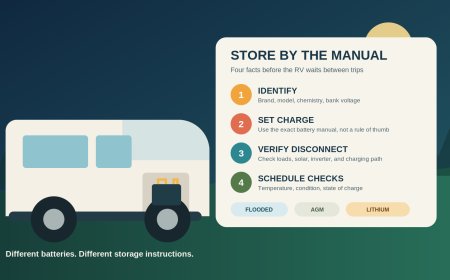
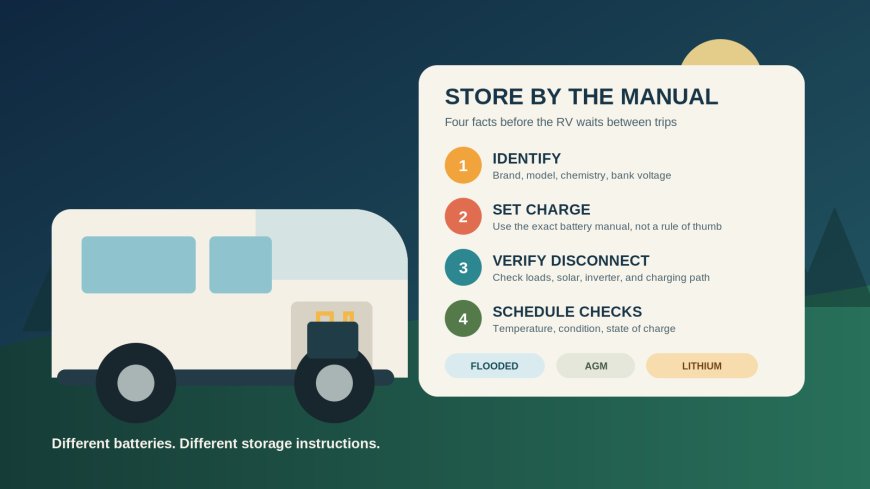
Storing an RV house battery is a four-part decision: identify the exact battery, choose whether the bank will be isolated or maintained by an approved charger, keep it within the battery maker's storage conditions, and schedule the checks named in that battery's manual. There is no chemistry-wide state-of-charge percentage or inspection interval that is safe to copy onto every flooded, AGM, or lithium battery.
The practical rule is simple: build the storage plan from the labels and manuals for the installed battery, RV, converter or inverter/charger, and solar controller. A dashboard switch marked "battery disconnect" does not prove that every load and every charging path has been isolated.
Start with a one-page battery record
Before changing a switch, photograph the battery label and write down:
- brand, model and serial number;
- chemistry stated on the label;
- bank voltage and number of batteries;
- series or parallel arrangement;
- converter or inverter/charger model;
- solar controller model and whether solar remains active;
- location of every battery switch, fuse and breaker identified in the manuals;
- storage state of charge, temperature range and check interval from the battery manual; and
- any separate instructions for a heater, Bluetooth module or battery-management system.
Do not infer chemistry from case shape. A battery that fits a familiar group-size tray may use different chemistry and different charging limits. If the label is missing or the wiring is unfamiliar, have an RV electrical technician identify the bank before storage.
House and chassis batteries are separate systems. A coach disconnect may not isolate the starting battery, and a motorhome manual may assign different maintenance to each one.
Decide whether the plan is isolate or maintain
An isolation plan removes charging sources and loads to the extent required by the manuals. A maintenance plan leaves the bank connected to a compatible, approved charging source. Neither is automatically right for every RV.
The 2026 Winnebago Solis manual illustrates why the switch boundary must be checked on the exact coach. Its house-battery switch is intended to disconnect the house bank from the 12-volt system during storage, but its converter charges that bank from shore power only while the switch is on.[1] On that model, turning the switch off and plugging in shore power would not be the same as maintaining the house batteries.
Solar creates another boundary. A panel can remain energized in daylight even when cabin controls look dead. Follow the RV and controller shutdown order. Do not open solar wiring, battery enclosures, inverter compartments, or 120-volt panels unless the maker identifies them as owner-serviceable.
After the selected switches are set, verify the result by the method approved for the RV. Check which safety devices, monitors and direct-to-battery accessories remain powered. An alarm going dark is not a storage success if the RV will be occupied. An illuminated switch is not proof of battery condition or charging current.
Lead-acid storage: flooded and AGM are not identical
Trojan's current guidance for its lead-acid products says to charge fully before storage, keep the battery cool and dry, and monitor specific gravity for flooded batteries or voltage for the applicable battery. It calls for a boost charge at 70% state of charge or lower and says self-discharge speeds up above 80°F (26.6°C).[2] Those are Trojan instructions, not universal lead-acid thresholds.
For a flooded battery, the manual may also require electrolyte inspection, safe watering practices, ventilation, and specific-gravity measurements. AGM batteries are sealed and do not get the flooded-battery watering routine. The Solis manual, for example, identifies its installed house batteries as AGM and says owners do not inspect or top up their fluid.[1]
Cold changes the risk rather than eliminating it. The Solis manual warns that insufficiently charged lead-acid electrolyte can freeze, and it directs owners of that model to check and recharge at least monthly during long storage.[1] Another RV or battery can specify a different threshold and schedule. Record the controlling instruction instead of carrying over the Solis numbers.
Use only a charger profile approved for the exact battery. A generic trickle charger, an old converter, or a solar controller set for another chemistry is not automatically a safe maintainer. If the RV manual and battery manual disagree about leaving shore power connected, ask the manufacturers or a qualified service facility to resolve the conflict.
Lithium storage: the model number changes the answer
"Lithium" does not supply a storage percentage. Two current LiFePO4 manuals give different instructions.
Battle Born's July 2026 manual for the BB10012 and BB10012H tells owners to bring those batteries to 100% state of charge and disconnect the load for storage. Its stated storage limits run from -10°F to 140°F, equivalent to -23°C through 60°C, and it says capacity loss can increase in extreme conditions.[3]
Renogy's manual for the RBT12300LFPSH Core Series battery instead calls for 30% to 50% state of charge, disconnection from the system, a storage area between -13°F and 149°F (-25°C to 65°C), and charging at least once every three to six months.[4]
Those instructions cannot be blended into one compromise percentage. Use the manual for the exact model and revision. Check whether a Bluetooth module, heater, remote switch, shunt or inverter remains connected. Battle Born's same manual identifies a continuing Bluetooth draw on the covered model, which is one reason a physical disconnect boundary matters.[3]
Storage temperature and charging temperature are also different specifications. A battery may be allowed to sit at a temperature where charging is restricted. Before reconnecting shore power, solar or an alternator after a cold soak, confirm the charging-temperature rule and heater behavior for the exact pack.
A battery-management system is a protective device, not a substitute for a storage plan. Do not rely on low-voltage shutdown as the normal end point. Renogy's manual says a severely overdischarged battery caused by self-discharge or parasitic loads should be taken out of use until the fault is corrected and the battery can be charged.[4]
Build the between-trip routine
At the end of the trip
- Park where the battery can stay within its documented storage environment.
- Turn off loads in the order specified by the RV and component manuals.
- Inspect the accessible battery case, hold-down, terminals, cables and protective covers without disturbing damaged parts.
- Bring the battery to the exact storage state of charge required by its manual.
- Choose isolation or approved maintenance charging. Set the coach disconnect, inverter, solar and other controls according to their own instructions.
- Confirm what remains powered and whether the chosen charger can actually reach the bank in that switch configuration.
- Record date, state of charge, temperature, switch positions and the next check date.
During storage
Use the manual's method, not a casual monitor-panel glance. Depending on the model, the check may be open-circuit voltage after a rest period, specific gravity for a serviceable flooded battery, a state-of-charge reading from an approved monitor, or a documented recharge interval.
Check for water intrusion, corrosion, a loose hold-down, cable damage, swelling, heat, odor or a battery-management fault. Do not touch or charge a swollen, cracked, leaking, unusually hot, smoking or hissing battery. Keep ignition sources away and obtain professional help.
Temperature deserves its own log entry. A closed RV compartment can move well beyond the outdoor forecast. If the stored location will exceed the battery's documented range, change the location or have a qualified installer assess a suitable storage arrangement.
Before the next trip
Restore the system in the manual's order. Inspect before energizing. Confirm that the battery is within its allowed charging temperature, then charge or balance only as the manufacturer directs. Test alarms after power is restored, confirm the converter, inverter and solar controller have the right chemistry profile, and investigate any unexpected voltage drop or fault before departure.
When the job belongs to a technician
Stop and use a qualified RV electrical technician or the battery maker's service channel when:
- the battery chemistry, model or wiring cannot be identified;
- applicable manuals conflict;
- the bank uses unfamiliar series wiring, high voltage, or a proprietary energy system;
- access requires working under the RV or lifting a heavy battery;
- a cable, terminal, fuse, busbar or enclosure shows heat damage;
- the battery is swollen, cracked, leaking, hot, hissing, smoking or faulted;
- charging equipment cannot be confirmed compatible with the battery;
- the disconnect does not isolate the loads the manual says it should; or
- the battery will not hold the documented storage condition.
Winnebago specifically tells Solis owners not to remove the under-coach batteries and to use a dealer or service center because of their weight and access location.[1] That restriction is model-specific, but it shows why a general storage checklist cannot override the coach manual.
A good storage record ends with five facts: exact battery identity, chosen state of charge, verified disconnect or maintenance-charge boundary, allowed temperature range, and next manual-required check. If one of those fields is blank, the storage setup is not finished.
Source note: This RVCamping.info guide compares current RV and battery-manufacturer instructions. Product-specific values are examples only and do not replace the manuals and labels for the installed RV, battery and charging equipment.
Sources
- 2026 Winnebago Solis Operator Manual Winnebago Industries
- Trojan Battery Maintenance Trojan Battery Company
- Battle Born 100Ah 12V Lithium Battery Manual, Rev. 37 Battle Born Batteries
- Renogy Core Series 12.8V 300Ah Battery User Manual Renogy
What's Your Reaction?