


Skidaway Island or Fort McAllister? Pick the Savannah RV base by the trip
Skidaway Island cuts the drive to Savannah; Fort McAllister makes the campground, fort and tidal creek the destination. This worksheet helps RV travelers choose, then verify the exact site's hookups and fit.
By Romana
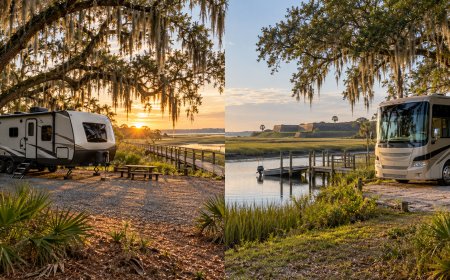
Two Georgia state parks can anchor an RV stay near Savannah, but they solve different trips. Skidaway Island State Park is the better default when the historic district will fill several days. Fort McAllister State Park is the stronger choice when you want the RV parked near a tidal creek, boat ramp and historic fort, with Savannah as one outing rather than the daily center.
That conclusion came from checking the parks, sample reservable sites and the drive to Savannah's historic district. It is not a ranking of scenery. The useful choice is about where you expect to spend your time and what the exact campsite must provide.
Start with the drive you will repeat
Georgia describes Skidaway Island as being near historic Savannah. Its trails cross maritime forest and salt marsh, and the park lists 87 tent, trailer and RV campsites. The park also says some RV sites have sewer hookups.[1]
Fort McAllister sits south of Savannah on the Ogeechee River. Its 67-site campground borders tidal Redbird Creek, with boat access, a fishing dock and a nature trail nearby; the park's Civil War earthworks and museum are part of the same destination.[2]
For a consistent comparison, RVCamping.info routed each park to the same point, the Savannah Historic District, on October 27, 2026. The OpenStreetMap/Nominatim and OSRM snapshot returned about 13.9 miles and 27 minutes one way from Skidaway, versus 28.8 miles and 43 minutes from Fort McAllister.[8][9] Traffic, road work and the chosen downtown parking area can change those figures, so they are planning estimates rather than promises.
The difference looks modest on a one-way map. Repeat it on three sightseeing days and it becomes roughly 83 miles of driving from Skidaway versus 173 miles from Fort McAllister. That is about 90 extra miles before any detours or parking search. If everyone wants breakfast and evening walks in Savannah, paying attention to that repetition is more useful than comparing campground acreage.
Fort McAllister's longer city run is not wasted distance if the fort and waterfront are the point of the stay. The park publishes separate historic-site admission, including $9.75 for adults ages 18–61, in addition to the parking requirement.[2] Build that visit into a campground day instead of treating the park as only a place to sleep.
Eliminate the wrong sites before scoring the parks
A park-level amenity is not an exact-site promise. The reservation listings make the distinction plain.
At Skidaway, premium campsite 01 is listed with 50/30-amp electricity, water and sewer, a pull-through driveway and a 50-foot maximum vehicle length.[3] Standard campsite 85 has 50/30-amp electricity and water, but its listing does not include sewer; it is a back-in site with a 70-foot maximum vehicle length.[4]
Fort McAllister shows the same need for site-level reading. Premium campsite 06 lists 50-amp electricity, water, sewer, a pull-through driveway and a 50-foot maximum vehicle length.[5] Standard campsite 34 lists 30-amp electricity and water without sewer, also as a 50-foot pull-through.[6]
Those four sites are examples, not a claim about every pad in either campground. Use them to set three hard gates before comparing the destination:
- Enter the full vehicle length requested by the reservation listing, then open the exact site page. Do not transfer a neighboring site's 50- or 70-foot number to your choice.
- Match the electrical listing to the RV and your adapter plan. A 30-amp site and a 50-amp site are different power budgets.
- Treat sewer as site-specific. If you need it, the word "sewer" must appear on the selected site's details.
If a candidate fails any hard gate, remove it. A beautiful park with the wrong pad is the wrong reservation.
There is one current complication at Skidaway: the park says a partial campground renovation began February 2, 2026, and is scheduled to last one year.[1] That does not mean the entire campground is closed. It does mean the available loop and exact-site inventory deserve a fresh check for your dates, even if an old map or trip report shows something else.
Use the Savannah-base worksheet
After the hard gates, score the trip rather than the parks in the abstract. Give each priority a weight from 0 to 3: 0 means irrelevant, 1 means nice, 2 means important and 3 means trip-defining. Multiply that weight by each park's fit score below, then add the columns.
| Priority | Your weight (0–3) | Skidaway fit | Fort McAllister fit |
|---|---|---|---|
| Several days in Savannah's historic district | 2 | 0 | |
| Maritime-forest and salt-marsh walks at camp | 2 | 1 | |
| Fort, museum, tidal-creek fishing or boat access | 0 | 2 | |
| Shorter approach from I-95 matters | 0 | 2 | |
| Avoid a campground with an active renovation notice | 0 | 2 | |
| Need a sewer site | hard gate | exact site only | exact site only |
| Need a specific rig length or electrical service | hard gate | exact site only | exact site only |
The fit scores reflect the published park features and the October 27 route snapshot, not a quality judgment. Fort McAllister's official description calls it close to I-95, while Skidaway's advantage is the shorter repeated run to central Savannah.[1][2]
Here is how the model changes the answer. A four-night stay with three city days puts a weight of 3 on Savannah access; Skidaway earns six points before anything else is counted. A fishing-and-history weekend with one lunch in town puts the weight on Fort McAllister's creek, ramps and historic site instead. Fort McAllister then wins without pretending its longer city drive disappeared.
The downloadable CSV in this article package uses the same model and leaves the weights blank. The numbers are deliberately small. They force the group to name the trip it is actually booking instead of letting one flashy amenity decide everything.
Check the booking terms once, not after checkout
Georgia allows campsite reservations up to 13 months ahead, or 14 months for Georgia residents. A ParkPass is required for every vehicle and is not included in the reservation fee; overnight guests pay one parking fee per vehicle for the stay. The statewide policy permits campsite arrivals from 1 p.m. through 10 p.m., requires departure before noon, and notes that most park gates lock at 10 p.m.[7]
The same policy limits a campsite to six people and 14 consecutive nights, with defined combinations of RVs, automobiles and tents.[7] A boat trailer may be allowed when the site is large enough, but that condition matters at Fort McAllister: booking a waterfront-oriented trip does not prove the chosen pad can hold the RV, tow vehicle and boat trailer.
Before paying, save the exact-site page or screenshot with these fields visible:
- site number and loop;
- back-in or pull-through;
- maximum vehicle length;
- 30- or 50-amp service;
- water and sewer entries;
- number of vehicles; and
- the current renovation or closure notice.
Then call the park if the listing leaves a geometry question unanswered. "Maximum vehicle length" does not tell you where slides, awnings, trees, picnic furniture and an extra trailer will land.
The practical choice
Choose Skidaway Island when Savannah is the daily plan, then verify that the exact reservable site survives the renovation schedule and carries the hookups and length you need. Choose Fort McAllister when the campground's creek, fishing, boating and historic site will occupy a meaningful part of the stay, or when an I-95-oriented approach matters more than repeated downtown drives.
Do not break a tie with the park name. Break it with the itinerary, then let the exact site approve or reject the reservation.
Sources
What's Your Reaction?