


At Shenandoah River, the closest roofed bed to an RV may not be the yurt you expect
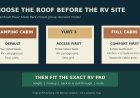
Compare Shenandoah River camping cabins, Yurt 3 and full cabins, then reserve the least replaceable roofed unit before matching an RV site.

At Shenandoah River, the closest roofed bed to an RV may not be the yurt you expect
By Romana
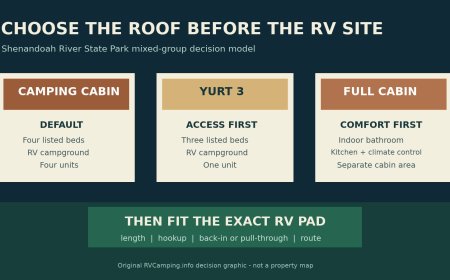
Shenandoah River State Park gives a mixed group three plausible roofed choices: four camping cabins, three yurts and ten full cabins. Only two choices put the non-RV sleepers inside the RV campground: the camping cabins and Yurt 3.[1][4]
That location changes the booking decision. Yurts 1 and 2 are in the walk-in River Right campground, with parking about 100 yards away.[1] They may be attractive for river access, but they do not solve the basic mixed-group problem of keeping the roofed party near the RVs. For a trip organized around shared campground time, start with a camping cabin. Move Yurt 3 to the top only when its access features matter and its three listed sleeping places work for the party.[1]
The park has one close yurt, not three
The word "yurt" looks like one reservation category until the map and unit notes are read together. Yurts 1 and 2 sit in River Right, a 12-site walk-in, tent-only campground.[1] Their shared parking is about 100 yards from the yurts, with wagons available for gear.[1] Overflow parking is several hundred yards away.[1]
Yurt 3 is different. It is in the RV campground, uses the RV bathhouse, has parking for two vehicles and is the park's universally accessible yurt.[1] The official park map also separates the Yurt 1 and 2 area from the RV campground and labels Yurt 3 inside the RV camping area.[4]
The four camping cabins are in the RV campground too. They use the same campground bathhouse and each has parking for two cars.[1]
The park does not promise that a particular cabin and RV site are side by side, so the map settles the campground choice, not the walking distance between exact units.[1][4]
For this trip, "same campground" is the first gate.[1][4] It removes Yurts 1 and 2 unless the group deliberately prefers the river setting over routine contact with the RV party.[1]
Camping cabin or Yurt 3?
Neither option is a climate-controlled cottage.[1] Both require guests to bring linens, both have a two-night minimum, and neither has a private bathroom.[1][2] The differences that can change the choice are narrower and more useful.
| Decision | Camping cabin | Yurt 3 |
|---|---|---|
| Location | RV campground | RV campground |
| Inventory | Four units | One unit |
| Listed sleeping setup | Two bunk-bed sets; sleeps up to four | Queen bed plus twin trundle; maximum occupancy four but listed beds sleep three |
| Temperature control | No heat or air conditioning; ceiling fan | No heat or air conditioning |
| Bathroom | RV campground bathhouse | RV campground bathhouse |
| Access designation | No camping cabin is identified as universally accessible on the park page | Universally accessible yurt |
| Pets | Park page applies cabin pet-fee policy to camping cabins | No pets in yurts |
| Cooking | No kitchen; outdoor grill and fire ring | No cooking inside; outdoor grill and fire ring |
The bed count on Yurt 3 deserves a pause. The official page says maximum occupancy is four, then lists a queen and a twin trundle and says the yurt sleeps three.[1] Do not turn the occupancy ceiling into a fourth bed. A party of four should either confirm an approved fourth sleeping arrangement with the park or choose a camping cabin.[1]
For a traveler who needs the features attached to the accessible-yurt designation, Yurt 3 is the obvious unit to investigate first.[1] The label still does not answer an individual's questions about the parking surface, deck ramp, doorway, bed-transfer space or route to the bathhouse. Ask about those features before treating the reservation as suitable.
A camping cabin is the better default for four sleepers, a pet-owning household or a group that wants more than one possible roofed unit.[1] It is still a rustic stay. There is electricity and a ceiling fan, but no heat, air conditioning, kitchen or bathroom inside.[1]
When a full cabin is worth leaving the campground cluster
The park's ten regular cabins are in a separate cabin area on the official map. They add a kitchen, bathroom, climate control and a fireplace.[1][4]
Most two-bedroom cabins accommodate up to six; the larger Cabin 5 accommodates up to eight. Guests still bring linens.[1]
That comfort can matter more than proximity.[1] Choose a full cabin when someone needs an indoor bathroom, the forecast makes an unheated roofed unit a poor fit, or the cabin household needs a real kitchen. The group should then plan scheduled gathering time rather than expecting the RV and cabin doors to function as one campsite.
The stay rules also differ. Between Memorial Day weekend and Labor Day, regular cabins begin with a six-night minimum on assigned start days.[1] The requirement drops to four nights three months out; during the final month before the trip, it falls again to two nights.[1] Camping cabins explicitly do not require a week-long prime-season stay, and yurts carry a two-night minimum.[1]
For a two- or three-night summer RV weekend, that can eliminate the full cabin long before amenities are compared.[1]
Use a roof-first reservation order
The RV campground has 31 water-and-electric sites, while the in-campground roofed inventory consists of four camping cabins and Yurt 3.[1] That is not a live availability count, but it shows the substitution problem: there are 7.75 listed RV sites for each camping cabin and 31 RV sites for the only in-campground yurt.[1] The roofed requirement is the tighter filter.[1]
Virginia accepts reservations up to 11 months ahead.[2][3]
Campsites are site-specific and can be reserved until 2 p.m. on arrival day, while cabin reservations should be made before midnight the day before arrival.[2][3] Payment is due in full, and changes or cancellations may reduce the refund.[3]
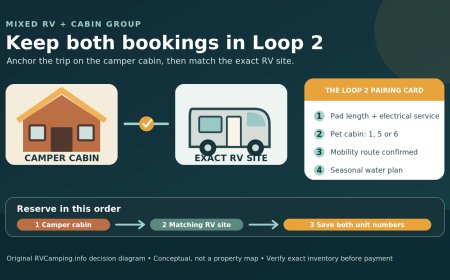
Use this order:
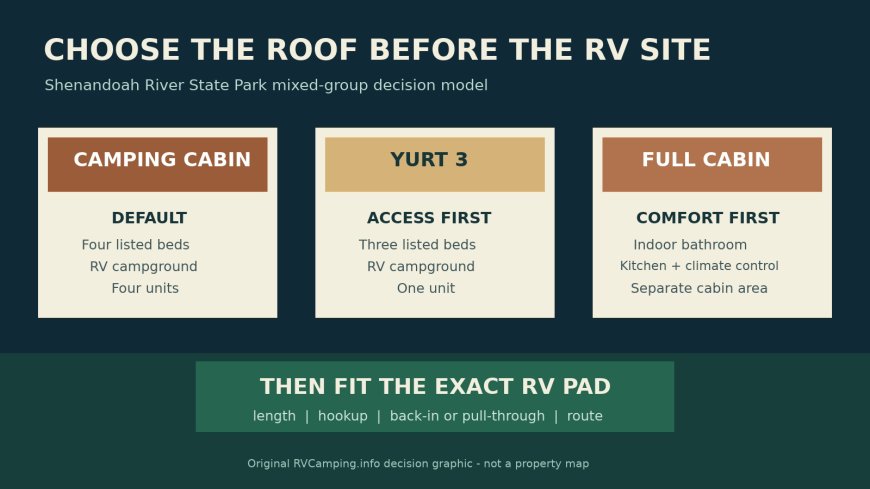
- Choose the roofed class by non-negotiable need: Yurt 3 for its access designation, a camping cabin for campground proximity and four listed beds, or a full cabin for indoor plumbing, climate control or a kitchen.
- Search the exact roofed unit for the real dates. If Yurt 3 is required, do not book an RV site while hoping that another yurt will work the same way.
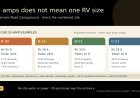
- Open the site-specific RV inventory and match the rig to an exact pad.[2] The park lists water and electric service with 20-, 30- and 50-amp outlets, but the exact record must settle equipment length, back-in or pull-through layout and fit.[1]
- Ask the park to describe the route between the proposed roofed unit and RV site. Record road crossings, grade, lighting and bathhouse access if those details matter to the group.
- Complete both reservations in one session, then save both confirmation numbers and the cancellation terms shown at checkout.
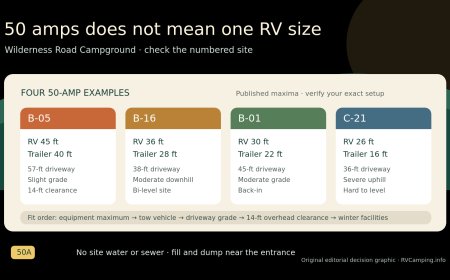
Do not use the park-wide 60-foot RV maximum as a promise for every pad.[1] The campground has 26 back-in and five pull-through sites, and Virginia tells campers to reserve specific sites.[1][2] Fit the actual rig to the actual listing.
The practical choice
For most mixed RV-and-roofed groups at Shenandoah River, a camping cabin is the first search.[1] It keeps the group in the RV campground, supplies four listed sleeping places and leaves four possible units rather than one.[1]
Yurt 3 is the more selective choice. It belongs at the top when its access designation fits the traveler, the pet ban is acceptable and no one invents a fourth bed from a four-person occupancy limit.[1]
Yurts 1 and 2 suit a group that wants the walk-in river setting enough to accept separation from the RV campground.[1][4] A full cabin wins when indoor comfort matters more than the cluster and the stay length works.[1]
The reservation should follow that hierarchy. Fix the least replaceable roofed bed first, then fit the RV around it.
Source credit: RVCamping.info reviewed current Virginia State Parks pages and the official park map on 2026-10-28. The roof-first comparison and inventory-ratio reservation model are original editorial analysis. The reporting does not include an on-site visit.
Sources
What's Your Reaction?