





Full-hookup RV site? Keep the waste valves closed and set a dump day
Use a two-tank valve-state card and simple capacity calculation to plan attended black-then-gray dumps at a full-hookup campsite.
Full-hookup RV site? Keep the waste valves closed and set a dump day
By Romana
A sewer connection beside the RV can look like permission to turn the holding tanks into straight-through plumbing. It is not. Keystone's current owner guidance says to keep the termination valves closed even at a full-hookup site, wait until a tank warrants dumping, and avoid the solids, clog and odor problems associated with leaving the valves open.[1]
The useful campground decision is not "open or closed forever." It is which valve opens, for how long, and on what day. A small valve-state card and one capacity calculation can settle that before the first shower.
Source credit: This RVCamping.info workflow combines current manufacturer guidance with a second manufacturer setup example and a state public-health rule for lawful wastewater disposal.
Full hookup does not bypass the holding tanks
The black tank receives toilet waste; the gray tank receives sink and shower water. Both have termination valves.[1] At a full-hookup site, the hose changes where the tanks can be emptied. It does not change the tanks into household drainpipes.
Keystone's direction is broad: leave the termination valves closed, including with full hookups, and dump when the level warrants it.[1] A Winnebago owner setup guide describes the same operating pattern in practice: open black to empty, close it, open gray to empty, then close gray and reopen only as needed.[2]
That gives the stay a defensible default:
| Stay state | Black valve | Gray valve | Why |
|---|---|---|---|
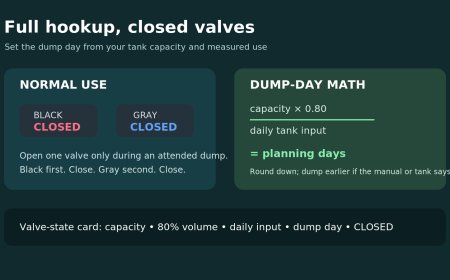
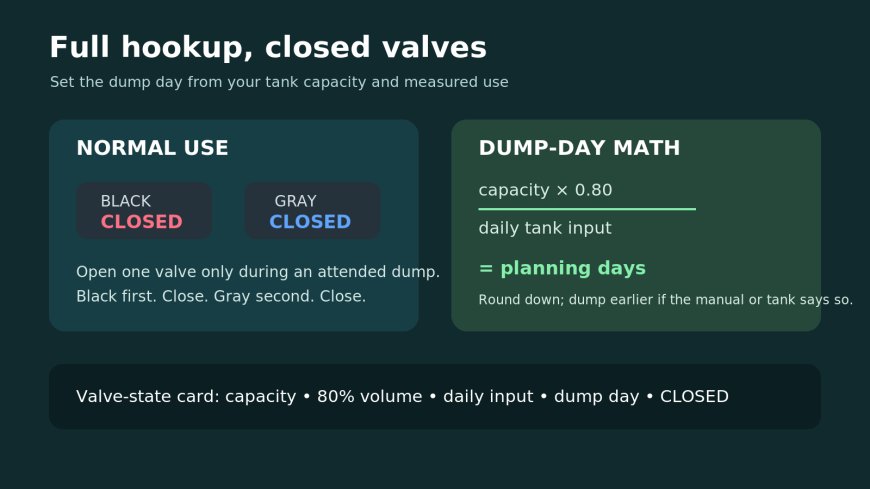
| Normal use | Closed | Closed | Tanks collect a dumpable volume; Keystone warns that open valves can contribute to solids, clogs and odors.[1] |
| Black-tank dump | Open only while actively dumping | Closed | Keeps the dump sequence controlled |
| Gray-tank rinse of hose | Closed | Open only while actively dumping | Sends the less contaminated tank after black; Winnebago documents this order.[2] |
| After flow ends | Closed | Closed | Restores the normal-use state before the rig is left unattended |
This is a planning model, not a substitute for the manual for a macerator, cassette toilet, composting system or unusually plumbed RV. Those systems may have different controls and steps.
Put the dump day on the calendar
Tank monitors commonly report in coarse fractions, and Keystone notes that dirty probes can produce false readings.[1] A calendar estimate is useful as a cross-check, not as permission to overfill.
Use this worksheet for each waste tank:
- Find the tank's capacity in the exact RV manual.
- Reserve 20 percent for uncertainty and changing use. The usable planning volume is capacity multiplied by 0.80.
- Measure or estimate one normal day's contribution to that tank.
- Divide usable planning volume by daily contribution, then round down to a whole day.
- Schedule the dump before that day ends, and move it earlier if the monitor, drain behavior or manual says to.
For a 40-gallon gray tank using an estimated 10 gallons per day, the planning volume is 32 gallons. Dividing 32 by 10 gives 3.2, so day 3 is the latest planned dump day. For a 40-gallon black tank accumulating about 5 gallons per day, the same calculation gives 6.4 days, so day 6 is the calculated ceiling.
Those figures are examples, not universal consumption rates. A navy shower and a residential-style shower do not belong in the same estimate. Measure the first day's fresh-water use when practical, separate likely gray and black contributions, and revise the card.
The two-tank card
Write this near the monitor panel:
| Tank | Manual capacity | 80% planning volume | Estimated daily input | Planned dump day | Valve now |
|---|---|---|---|---|---|
| Gray | ___ gal | ___ gal | ___ gal/day | Day ___ | Closed |
| Black | ___ gal | ___ gal | ___ gal/day | Day ___ | Closed |
The "valve now" column is deliberately boring. Outside an attended dump, both entries should return to closed. That makes a quick pre-departure check possible without relying on memory.
If the gray tank will reach its planned limit too early, change water use before changing the valve rule. Use the campground shower, shorten showers, or move dishwashing practices within campground rules. An open gray valve may seem convenient, but Keystone's current guidance does not make a gray-tank exception.[1]
Connect for containment, not convenience
A full-hookup site still requires a secure route from RV to sewer. The Winnebago setup example checks the bayonet fittings, uses a supported downhill run and watches flow at a clear elbow.[2] Those details support a contained dump; they do not justify leaving a questionable connection active all week.
Before opening either valve:
- confirm the hose and fittings are rated for the system and free of visible damage;
- lock the RV-end connection and secure the campground end as the campground requires;
- support the hose so it does not hold a low pocket or strain a fitting;
- keep the fresh-water hose and fittings out of the sewer-work area;
- stay with the dump and close each valve when its tank finishes.
Law and campground rules still control disposal. Minnesota's public-health summary, for example, requires sewage and wastewater to enter an approved municipal or onsite treatment system and requires sanitary dump facilities for campgrounds serving self-contained RVs.[3] It is one state's rule, not a nationwide code, but it shows why a nearby drain or patch of ground is not an alternative.
Dump black, then gray, then verify closed
The repeatable sequence is short:
- Put on appropriate protective gear and inspect both connections.
- Verify the gray valve is closed.
- Open the black valve and stay with the hose until flow ends.
- Close black completely.
- Open gray to empty that tank and rinse the common hose path.[2]
- Close gray completely.
- Follow the RV and campground instructions for rinsing, disconnecting or leaving the hose connected between dumps.
- Wash hands with soap and water and mark the dump on the card.
Do not start a black-tank flush from a generic checklist. Use the exact RV or component manual, keep the waste outlet configured as instructed, and never walk away from a flush. Keystone specifically warns against leaving the RV unattended during these processes and notes that overfilling the black tank can cause serious damage.[1]
The decision in one line
At a conventional full-hookup RV site, connect the sewer hose securely, keep both termination valves closed during normal use, and open one valve at a time only for an attended dump. The capacity worksheet decides when. The black-then-gray sequence decides how.
Sources
- Keystone RV — Complete guide to RV holding tanks (manufacturer guidance captured October 27, 2026)
- Winnebago — Newbie checklist for setting up an RV campsite (manufacturer-hosted owner setup example)
- Minnesota Department of Health — General requirements for recreational camping areas (public-health disposal requirements)
What's Your Reaction?