



Teton Pass now requires Safe Pass for RVs: certify or budget the 62-mile detour
RV and trailer drivers now need Wyoming's annual Safe Pass certificate for Teton Pass. Use this four-gate check or budget the 62-mile US 26 detour.
Teton Pass now requires Safe Pass for RVs: certify or budget the 62-mile detour
Driving an RV or towing any trailer over Teton Pass now requires paperwork before the climb. Since October 1, 2026, the driver must complete Wyoming's free Safe Pass self-certification. The rule also covers vehicles with a GVW, GVWR, or GCWR of at least 10,000 pounds.[1][2]
The certificate gets a driver to the first gate, not through the pass. WYDOT's current route listing also posts a 60,000-pound gross-vehicle-weight limit, and temporary weather or road restrictions can still close WY 22 to a rig that otherwise qualifies.[2][3]
Clear every gate before leaving, or build the US 26 route through Swan Valley and Alpine into the day from the start.
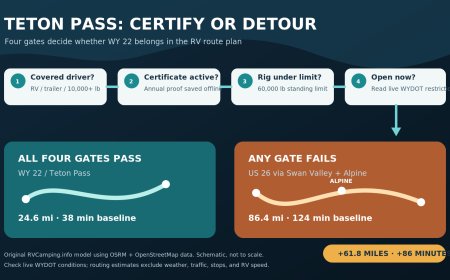
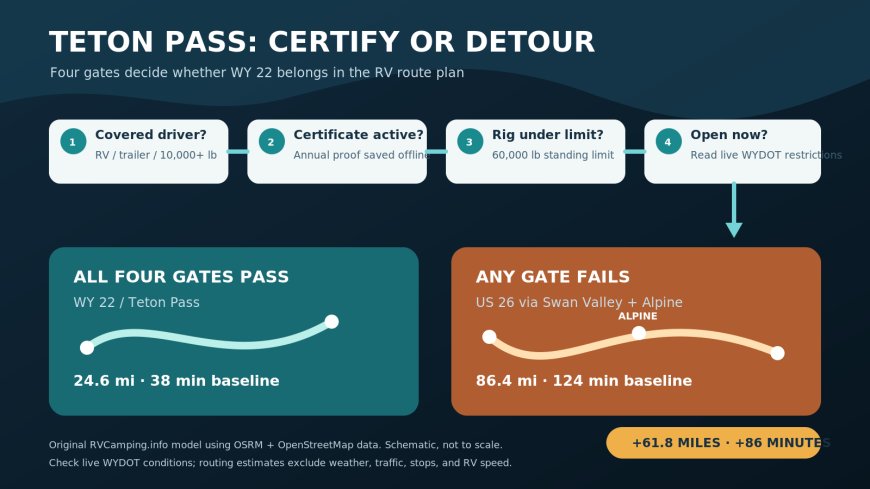
The pass decision has four gates
Treat the certificate as permission to evaluate the route, not proof that the route suits the driver or RV.
- Does the rule cover this driver? It does if the vehicle is an RV, if it is towing any trailer, or if GVW, GVWR, or GCWR reaches 10,000 pounds. A rental RV is not exempt.[1]
- Is the annual certificate active and available? The online program is free. It requires an account, at least three minutes with the education material, acknowledgements, and a downloadable certificate. WYDOT says proof may be shown electronically or on paper; one driver's certification covers the vehicles that person drives.[1]
- Is the rig legal for the standing restriction? WYDOT's route report lists a 60,000-pound GVW ceiling from milepost 6.000 to 17.490.[3]
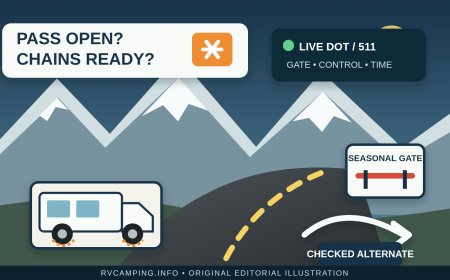
- Is WY 22 open to this rig now? Check the live WYDOT route report close to departure. Safe Pass does not override temporary closures, chain controls, wind restrictions, or other posted conditions.[2][3]
A "no" at any gate moves the trip to the alternate route. It is not a reason to improvise at the foot of the grade.
What the alternate costs between Victor and Jackson
For covered drivers bypassing Teton Pass, WYDOT directs Idaho-to-Jackson traffic south on US 26 through Swan Valley and Alpine.[1]
To put a planning number on that choice, RVCamping.info routed the same endpoints, central Victor and central Jackson, two ways with OSRM over OpenStreetMap road data: directly over WY 22, and south through Alpine. The baseline result was 24.6 miles and 38 minutes direct, versus 86.4 miles and 124 minutes through Alpine.[4][5]
That makes the alternate 61.8 miles and 86 minutes longer, or about 3.5 times the direct distance. These are reproducible routing estimates, not RV travel-time promises. They exclude weather, traffic, fuel stops, slower RV speeds, and any road restriction that changes the available route.
For planning, add the 62 miles before choosing the fuel stop and arrival deadline. Do not bolt the detour onto an already tight check-in day. If the campground has a hard arrival cutoff, move departure earlier or choose an overnight stop that leaves the pass decision for daylight.
A certificate does not settle vehicle readiness
The self-certification material covers gear selection, brake-fade protocols, pre-trip inspection, and trailer and weight restrictions. WYDOT describes grades of 10 percent and tells drivers who finish the material but remain unsure about themselves or the vehicle to use the alternate route.[1]
The direct route may save roughly an hour and a half in the baseline model. That number says nothing about brake condition, transmission operation, towing experience, weather, or whether a rental driver understands the controls. Check the exact vehicle's manuals and limits; a generic downhill-driving tip is no substitute.
Drivers who cannot complete the online process have offline options at WYDOT's Jackson office, the Highway Patrol's Alpine port of entry, and specified eastbound pullouts on the Idaho side. Building certification into the planning day avoids relying on those stops while towing.[1]
The departure card
Before committing an RV trip to Teton Pass, record five items on the route sheet:
- the driver's certificate expiration date and a saved offline copy;
- actual GVW when known, plus the vehicle's GVWR and combination's GCWR from the correct labels or manuals;
- the 60,000-pound standing limit and any lower temporary restriction;
- the latest WYDOT 511 condition for the Jackson-to-state-line segment; and
- the US 26 via Alpine route, with at least 62 extra miles in the trip budget.
Recheck WYDOT rather than reusing a screenshot from an earlier trip. The route page is the live source for current advisories and restrictions.[3]
Safe Pass is paperwork, not a verdict on the rig or driver. Finish the certificate, check the standing limit and live road status, then make the readiness call. If any part fails, the US 26 route belongs in the itinerary before departure.
Sources
- WYDOT: Safe Pass Program FAQ — eligibility, certification workflow, proof, alternate route, and safety scope; accessed October 28, 2026.
- WYDOT: New Teton Pass safe driving program launches Oct. 1 — September 21, 2026 launch notice and continuing restrictions; accessed October 28, 2026.
- WYDOT 511: WY 22 route conditions — standing weight and Safe Pass restrictions; route snapshot saved October 28, 2026 (page report time October 27, 2026).
- Project OSRM — routing engine used for the original endpoint comparison; route responses saved with the package.
- OpenStreetMap copyright and license — road-data source and attribution for the route calculation.
What's Your Reaction?