


Duxtop 9600LS review for RVs: strong on shore power, hungry on battery
Research-based Duxtop 9600LS RV review with shore-power load checks and an original battery-use model for real meal profiles.
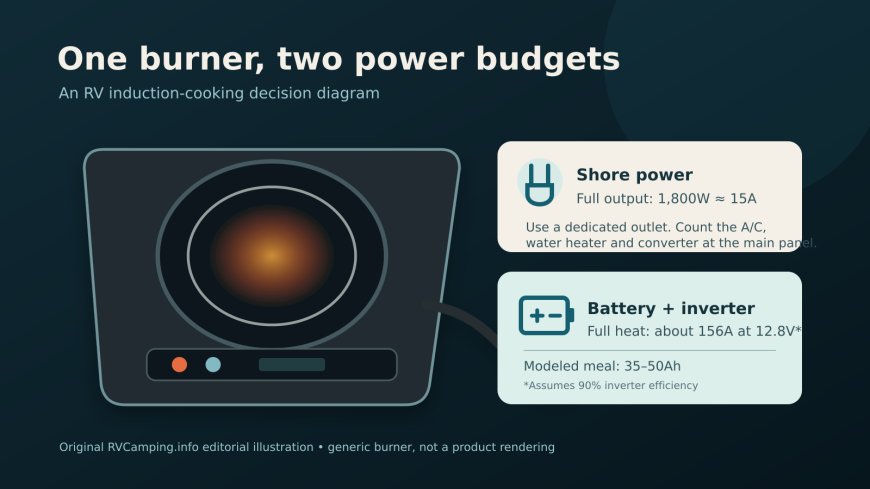
The Duxtop 9600LS is a good portable induction burner for an RV with dependable shore power or a properly engineered inverter system. Its wide power range and unusually gentle low-setting behavior make it more useful than a burner built only to boil fast. The catch is electrical, not culinary: at full output it can occupy the whole 15A circuit, and even a short meal can take 35–50Ah from a 12.8V battery after inverter losses.
Buy it if you want one compact indoor burner, have magnetic cookware, and can give it a dedicated 120V outlet while managing the RV's other heavy loads. Skip it if your inverter, battery, wiring, or campsite power cannot comfortably support an 1,800W appliance, or if you expect the temperature buttons to work like a probe-controlled thermostat.
This is a research-based review. RVCamping.info did not buy, cook on, or physically test the Duxtop 9600LS. Independent observations are identified as such, and the RV energy examples below are calculations rather than measured product tests.
As an Amazon Associate, RVCamping.info earns from qualifying purchases. If you buy through an Amazon link in this article, we may earn a commission at no additional cost to you.
The exact US model covered here is the silver Duxtop 9600LS, also identified as BT-200DZ, ASIN B01FLR0ET8.[1][3] The manufacturer page and Amazon listing both connect those identifiers: check the Duxtop 9600LS listing on Amazon.[1][3] Do not substitute the 230V international version or assume a similarly named double burner has the same electrical requirements.
It cooks well enough to justify the load
Secura specifies 20 power settings, a 100–1,800W range on the current product page, 20 temperature selections from 100°F to 460°F, a ten-hour timer, and a five-foot cord.[1] The burner needs flat magnetic cookware with at least a five-inch base.[1][2] It weighs 5 pounds 12 ounces and measures 11.4 by 14 by 2.5 inches, small enough to store in many RV kitchens.[1][2] Those are useful specifications, but the low end is what separates this model from a cheap hot plate. CenturyLife timed the 9600LS cycling at lower settings and reported short pulses with longer rests at the minimum setting, then continuous output around the middle of the scale.[4] The reviewer found that behavior gentler for pancakes, potstickers, and simmering than the coarser Duxtop 9100MC, while also noting fan noise and limits in the under-glass temperature sensing.[4] That evidence supports a selective verdict. The 9600LS is a strong fit for boiling, sautéing, reheating, and ordinary one-pot RV meals. Temperature mode is better treated as a repeatable control setting than as the true temperature of the food.[4] Pan material, base thickness, batch size, and sensor lag still change the result.[4] For frying or food-safety decisions, use the thermometer the recipe requires rather than trusting the number on the cooktop.
There is also a small documentation conflict worth preserving. Secura's current product page and Amazon listing describe a 100W minimum, while the older manufacturer manual's specification table says 200W even though its operating section lists level 0.5.[1][2][3] The independent cycling observations show why the label needs context: low settings are average heat delivered through on-and-off pulses, not a continuous 100W trickle.[4]
The RV decision starts at the breaker
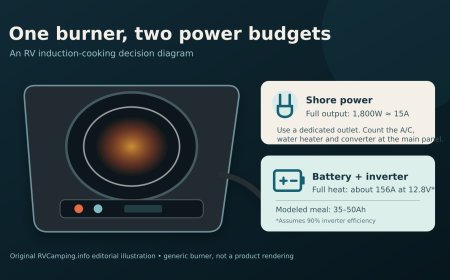
The manual calls for a dedicated 120V, 15A outlet and says not to share that outlet with another electrical item.[2] It also requires a dry, stable, nonmetallic and noncombustible surface with at least four inches around the unit for airflow.[2] At the 1,800W maximum, the simple nameplate calculation is 1,800W ÷ 120V = 15A.[1][2] There is no spare capacity on that nominal circuit for a coffee maker, toaster, or other countertop appliance.
A dedicated outlet does not mean the rest of a 30A RV can be ignored. The branch circuit protects the burner connection, while the coach's 30A main service still sees the combined load. This illustrative collision check uses typical round numbers rather than ratings for a particular RV:
| Loads operating together | Assumed watts | Approximate current at 120V | Planning result |
|---|---|---|---|
| Duxtop at full output | 1,800W | 15.0A | Uses the burner's whole 15A branch allowance |
| Duxtop plus 400W converter load | 2,200W | 18.3A | Usually manageable on 30A service if other loads stay low |
| Duxtop plus 1,500W air conditioner | 3,300W | 27.5A | Little margin remains for the converter or water heater |
| Duxtop, air conditioner, and 1,400W water heater | 4,700W | 39.2A | Exceeds a 30A service before startup surges |
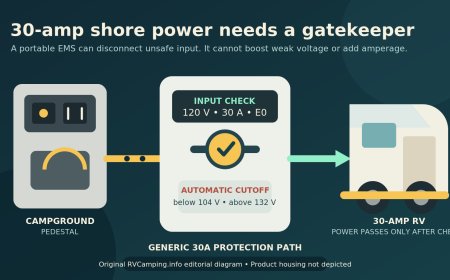
The exact answer depends on measured loads and the RV's energy-management system. The practical routine is simple: identify the outlet's breaker, learn what else that branch serves, and shed the water heater or other large load before cooking when the main service is tight. A power strip does not create another circuit. The US Fire Administration advises against overloading outlets and says major appliances should plug directly into a wall outlet rather than an extension cord.[5] The same logic applies at a weak campsite pedestal. Turning down the cooktop can reduce average load, but it does not repair low voltage, a loose receptacle, or an overheating connection. Stop if a plug or outlet becomes abnormally hot, if the cooktop reports a voltage error, or if the breaker repeatedly trips.
Battery cooking is possible, but the meal matters
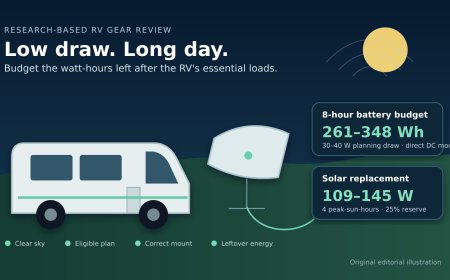
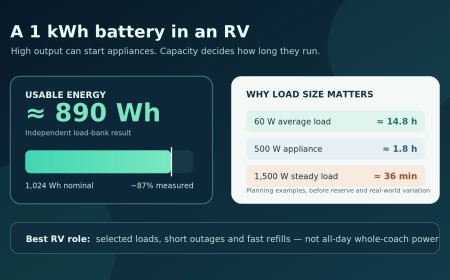
An inverter label larger than 1,800W is only the first check. The inverter must support the cooktop's sustained load, while the battery bank, BMS, fuse, disconnects, cabling, and connections must carry the DC current without excessive voltage drop. At 1,800W and an assumed 90% inverter efficiency, the battery side supplies about 2,000W, or roughly 156A at 12.8V. That is a system-design load, not something to improvise with an accessory socket.
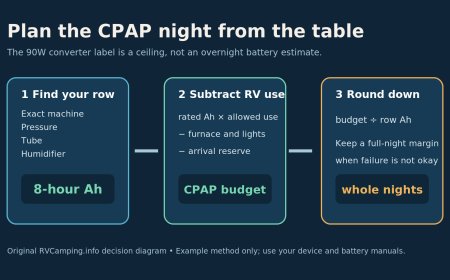
Daily energy depends on the cooking profile. These examples use the selected power setting as average input, then add a 10% inverter loss. Real consumption will vary as the burner cycles and the cook changes settings.
| Illustrative meal | Cooking profile | AC energy | Battery energy at 90% inverter efficiency | 12.8V battery use |
|---|---|---|---|---|
| Quick skillet meal | 1,200W for 15 min, then 600W for 10 min | 400Wh | 444Wh | 34.7Ah |
| Pasta and sauce | 1,800W for 10 min, then 800W for 20 min | 567Wh | 630Wh | 49.2Ah |
| Long simmer | 1,800W for 8 min, then 500W for 52 min | 673Wh | 748Wh | 58.4Ah |
This model is the article's main contribution: size induction cooking by the meal, not the 1,800W badge alone. A burner may run for only half an hour yet consume a large share of a 100Ah battery's usable energy. Conversely, a short lower-power meal can fit a capable lithium system without making induction an all-day load.
Owners who cook mostly on shore power get the easier version of this product. Boondockers need both instantaneous-current capacity and enough watt-hours left after refrigeration, lights, the water pump, furnace blower, laptops, and reserve. If that arithmetic feels tight before dinner, the 9600LS is better kept as a shore-power burner than treated as a propane replacement.
Give it a real counter, not a temporary perch
The four-inch ventilation rule matters in a small galley.[2] Do not wedge the burner against a wall, operate it on another appliance, or place it on a metal surface.[2] Keep the fan openings clear, route the cord away from the hot pan, and make sure a five-pound appliance plus cookware cannot slide during use.[2] The manufacturer limits weight on the cooktop to 25 pounds.[2] A refrigerator lid, sink cover, loose board, or narrow flip-up shelf may look convenient without being stable, heat-safe, or large enough for the unit and pan. Measure the working area with the intended cookware in place. Store the burner only after the cooling fan stops and the glass has cooled, then secure it for travel rather than leaving it on the counter.
Cookware needs its own trial before a trip. A magnet test screens for induction compatibility, but a flat base and useful contact area still affect performance.[1][2] Large pans can physically overhang the glass even though only the area above the induction coil heats directly.[4] That can create a hot center and cooler edges, especially with thin cookware.[4]
Who gets the best fit
The Duxtop 9600LS earns its place in an RV when one burner is enough and electrical capacity is known. It offers finer low-power control than many inexpensive portable units, packs into a small footprint, and avoids an open flame.[1][4] On shore power, those strengths make it a practical second burner or a primary cooker for compact rigs.
The buyer who should pass is not necessarily someone who dislikes induction. It is the owner whose 15A branch is shared, whose 30A coach is already load-constrained, or whose off-grid system cannot sustain roughly 156A at 12.8V during full-power operation. The same goes for anyone unwilling to use magnetic cookware or provide a dry, stable surface with the required airflow.
The decisive tradeoff is clear: the 9600LS gives an RV kitchen good heat control without much storage penalty, but it moves cooking into the electrical budget. Give it a dedicated outlet on shore power, or prove the complete inverter-and-battery path before trying to cook off-grid. Then estimate watt-hours from the meal you actually make.
Sources
- Secura Duxtop 9600LS product page (accessed October 27, 2026)
- Duxtop 9600LS user manual (accessed October 27, 2026)
- Amazon US Duxtop 9600LS listing, ASIN B01FLR0ET8 (accessed October 27, 2026)
- CenturyLife Duxtop 9600LS measured low-power cycling review (accessed October 27, 2026)
- US Fire Administration electrical and appliance fire safety (accessed October 27, 2026)
What's Your Reaction?