














Frozen RV sewer hose or dump valve: stop before you force it
A manual-first response plan for a frozen RV sewer hose, dump valve or macerator, including when to stop, what not to heat or add, and how to prevent a repeat freeze.

Frozen RV sewer hose or dump valve: stop before you force it
By Romana | September 27, 2026
A dump-valve handle that will not move on a freezing morning is not a cue to pull harder. Neither is a rigid, bulging sewer hose a cue to twist off a fitting. Ice can block the discharge path while liquid waste remains behind it. Forcing the valve, flexing a cold hose or separating a loaded connection can turn a freeze problem into broken plastic and a sewage spill.
The safe first move is to stop using the wastewater system, identify what is frozen and check the instructions for the exact RV, valve, hose, heater or macerator. Jayco's North Point manual, for example, requires cold-weather preparation for both fresh-water and drainage systems and says to check frozen exterior parts before operating them to avoid damage.[1] That is a model-specific reminder of a broader boundary: a generic thawing trick does not override the installed equipment manuals.
The short answer
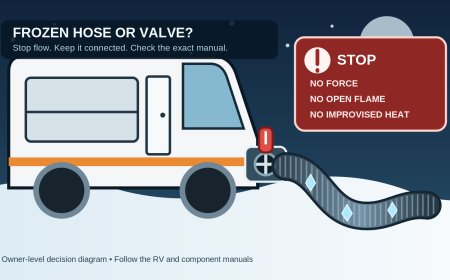
If flow stops or a dump valve will not move in freezing weather:
- Stop adding wastewater. Do not run faucets, shower, washer, toilet rinse or black-tank flush.
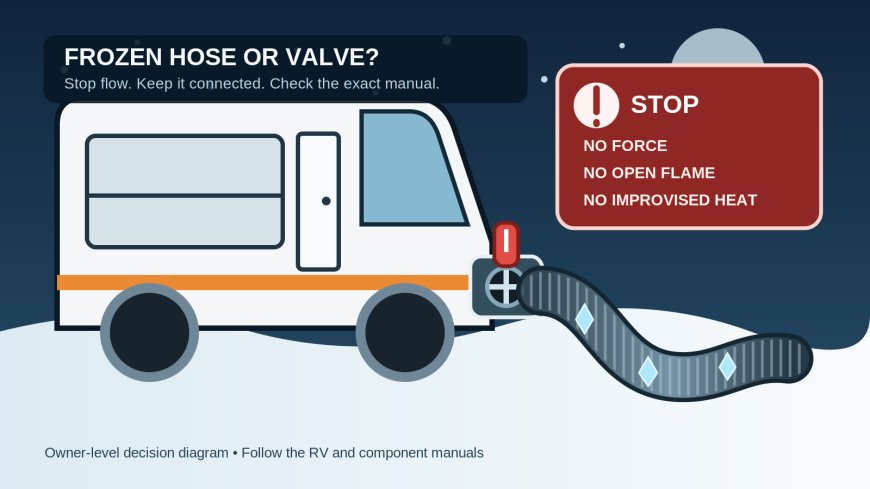
- Leave a closed valve closed. Do not yank, pry, hammer or extend the handle for leverage.
- If a valve is open and the hose is blocked, do not disconnect either end. Keep people and pets away from the hose and sewer inlet.
- Shut off a macerator or waste pump when flow stops. The Thetford Sani-Con Turbo 700 manual directs the operator to switch its pump off when discharge pressure stops or drops sharply, then check for an obstruction; continuing against a blockage can damage the pump.[4]
- Look without dismantling: Is the hose visibly full, flattened, kinked or bulged? Is the valve body frosted? Is the final rigid drain pipe exposed? Does the RV have a documented factory or installed heater for that exact component?
- Use only the recovery method authorized by the exact manuals. If there is no documented owner procedure, call campground staff and an RV service technician. Wait for a controlled ambient thaw or qualified service rather than inventing a heat source.
Stop immediately for a leak, cracking sound, split hose, displaced fitting, sewage odor inside the RV, tank level near full, electrical damage, smoke, melting plastic or a heater that cannot be matched to its instructions.
First decide where the ice is
"The sewer froze" can describe several different failures. The response depends on which part is blocked.
- Hose low point: A sag retains liquid, which freezes into a plug. The hose may be rigid or locally swollen.
- Termination or dump valve: The handle will not move normally, or the cable or electric actuator moves without opening the gate.
- Rigid pipe between tank and valve: A heated tank can remain liquid while an exposed drain run freezes.
- Fitting or sewer elbow: Water left at a joint freezes even when most of the hose drained.
- Macerator hose or pump: The motor runs but flow stops, or discharge pressure changes sharply.
- Campground sewer riser: The site's inlet or connection is frozen. That belongs to campground staff, not the guest.
Do not prove the location by opening more valves. A second open valve can put more liquid behind the blockage. Do not remove a termination cap to "check" if a closed upstream valve may have leaked; the cap can be holding contaminated liquid.
Closed valve, open valve and powered pump are different emergencies
The valve is frozen closed
This is usually a containment problem rather than an immediate spill, provided the tanks have room and nothing is leaking. Stop wastewater use and verify tank levels without treating an imprecise monitor panel as proof of spare capacity. Do not force the handle. A bent stem, torn seal or cracked valve body can remain hidden until the system thaws.
A purpose-built gate-valve heater is not generic permission to add heat. UltraHeat's instructions cover its own installed gate-valve panel: switch it on, allow roughly five to seven minutes or until the valve moves freely, then switch it off. The maker calls the panel a short-term, manually operated product for compatible smooth-sided gate-valve bodies.[3] Those instructions apply only when that exact equipment is installed correctly and can be positively identified. They do not authorize a loose heat tape, heat gun, hair dryer, lamp, portable heater or improvised wiring around a waste connection.
The valve is open but the hose is blocked
Treat the hose as loaded. Stop every drain and toilet use. Do not lift, squeeze, stomp, strike or sharply bend it. Do not loosen the RV fitting or sewer elbow. Protect the area from people, pets and vehicles, then notify campground staff because the site connection and any spill response fall under campground rules.
If the blockage releases, the hose may move suddenly and discharge at full flow. A person should not stand over a joint or hold a fitting by hand while pressure is released. A technician may decide that controlled warming, containment equipment or pump-out service is required. That decision needs the hose material, fitting design, ambient conditions and site rules, none of which a universal article can establish.
A macerator or powered waste system stops flowing
Turn the pump off. Do not keep cycling it to grind through ice. The Sani-Con Turbo 700 troubleshooting table says to switch the pump off after a sharp pressure or flow loss, check the hose for an obstruction and inspect through the provided access point as directed. It warns that failure to clear a clog can damage the pump and void the warranty.[4]
Use that product's manual, not a gravity-hose routine. Some powered systems have manual overrides, winterization steps and service-access limits. Do not open a pump housing or remove a cover when the instructions require containment, replacement seals or service parts.
Heating stops at the manual boundary
Waste equipment combines plastic, rubber seals, sewage, water and sometimes 12- or 120-volt power. Localized heat can soften a hose before the ice releases, overheat a valve seal, damage a heater, ignite nearby material or put an electrical device in a wet area.
Do not use:
- an open flame, torch, charcoal device or fuel-fired heater;
- a heat gun, unattended portable heater or bare incandescent lamp;
- boiling or very hot water poured over plastic or into a blocked tank;
- automotive antifreeze, windshield-washer fluid, salt, alcohol, drain opener or a chemical cocktail;
- unlisted heat tape, a household heating pad, damaged extension cords or any electrical appliance in standing water;
- a tank heater, pipe heater or valve heater whose identity, installation or operating limits are unknown.
Even a documented heater has operating conditions. UltraHeat says its tank system requires liquid in the tank, connected pipes and elbows while it operates. Its pipe and elbow heaters are not sensor-controlled and must be switched off when the pipe is empty or temperatures remain above freezing.[3] A tank-pad switch therefore does not prove that the outlet pipe, gate valve, cap or sewer hose is heated. Nor should an owner energize an unknown pad on the assumption that more heat is safer.
Do not pour extra holding-tank chemicals into a blocked system as a thawing experiment. EPA warns that mixing chemicals with holding-tank waste can create toxic fumes, corrode tanks and piping, and harm soil or groundwater after disposal.[5] Any additive must be permitted by the RV and component manuals, compatible with the receiving campground or dump station, and used only at its labeled amount. This guide does not recommend an additive as a freeze cure.
Spill, leak and capacity stop conditions
Call campground staff at once if wastewater escapes the hose, fitting, valve, sewer inlet or ground connection. Keep people and pets away. Do not wash a spill toward soil, a storm drain, snowbank or neighboring site. The receiving facility controls cleanup and disposal.
Suspend RV plumbing use and seek qualified help when:
- a hose or rigid drain is cracked, bulged, flattened or leaking;
- a fitting has shifted or the valve body is distorted;
- the termination cap is under pressure or holds unexpected liquid;
- the black or gray tank is near its usable limit;
- the monitor reading conflicts with recent water use;
- a cable, electric actuator or macerator does not respond normally;
- the only available thaw method is not named in the equipment instructions;
- the campground sewer connection is frozen, damaged or backing up;
- a heater trips a breaker, damages wiring or produces odor, smoke or melted plastic.
Do not tow merely to find a dump station without checking the RV's weight and travel limits. Jayco warns against traveling with full black or gray tanks because the weight can affect ratings, suspension and handling.[1] If capacity is becoming urgent, ask the campground about an approved mobile pump-out, another functioning sewer connection or local emergency sanitation arrangements. Stop using the fixtures until there is verified capacity.
Prevent the next freeze without leaving an open path
The simplest prevention for a conventional gravity system is to keep wastewater in the protected holding tanks, then connect or use the hose only for a complete dump when conditions and manuals allow. Keystone tells owners to keep the black termination valve closed between dumps, route the sewer hose on a downward slope, then close the valves, rinse the hose and store it after draining.[2]
For cold-weather operation:
- Read the RV manual and every installed heater, valve, hose and macerator manual before the forecast drops.
- Keep both waste valves closed unless the exact dumping procedure requires one open.
- Support a connected hose in a continuous downhill run with no sag that can retain liquid.
- After dumping, let the hose drain completely, disconnect it only when the valves are closed and the hose is no longer loaded, cap it and store it according to its instructions.
- Verify exactly what each heater protects. A holding-tank pad may not protect the outlet pipe or valve.
- Maintain the power and fuel that the documented freeze-protection system requires, and know what happens during an outage.
- If the RV cannot keep the complete waste path within its documented operating conditions, reduce water use, winterize by the exact manual or move before roads and plumbing freeze.
A sewer connection must remain a controlled, sanitary path to an approved disposal point. Keystone's dumping sequence starts with closed valves, a secured hose and an approved dump connection.[2] EPA likewise warns against illegal disposal and chemical practices that can damage wastewater systems.[5] Cold weather does not loosen those boundaries.
A campsite decision card
Hose empty and flexible, valves closed: Drain, cap and stow it before the freeze.
Valve will not move: Stop wastewater use. Do not force it. Use only the exact installed heater or recovery procedure named in its manual.
Valve open, hose blocked: Treat the hose as full. Do not disconnect. Keep the area clear and call campground staff and RV service.
Macerator flow stops: Switch the pump off. Follow that pump's obstruction and service procedure.
Leak, split, smoke, electrical fault or tank near full: Stop all plumbing use and escalate. The job has moved beyond owner-level recovery.
Source credit: This owner-level response framework was developed from RV manufacturer manuals, component operating instructions and U.S. EPA wastewater guidance. It is not a repair procedure and does not replace the manuals for the exact RV and installed equipment.
Sources
- Jayco 2023 North Point Fifth Wheel Owner's Manual (cold-weather, drainage and holding-tank operating boundaries; accessed September 27, 2026).
- Keystone RV: Essential Guide to RV Black and Gray Tanks (valve position, hose slope, approved disposal and storage sequence; accessed September 27, 2026).
- UltraHeat: Tank, Gate Valve, Pipe and Elbow Heater Operating Instructions (product-specific heater conditions and limits; accessed September 27, 2026).
- Thetford Sani-Con Turbo 700 Owner's Manual (pump stop, obstruction and winterization instructions; accessed September 27, 2026).
- U.S. EPA: Safe Wastewater Disposal for RV, Boat and Mobile Home Owners and Park Operators (chemical and disposal hazards; accessed September 27, 2026).
What's Your Reaction?