





Plan an RV route around mountain-pass closures and chain rules
A state-aware checkpoint for verifying a seasonal mountain-pass gate, translating the live traction order to a motorhome or tow combination, and diverting before the last safe junction.

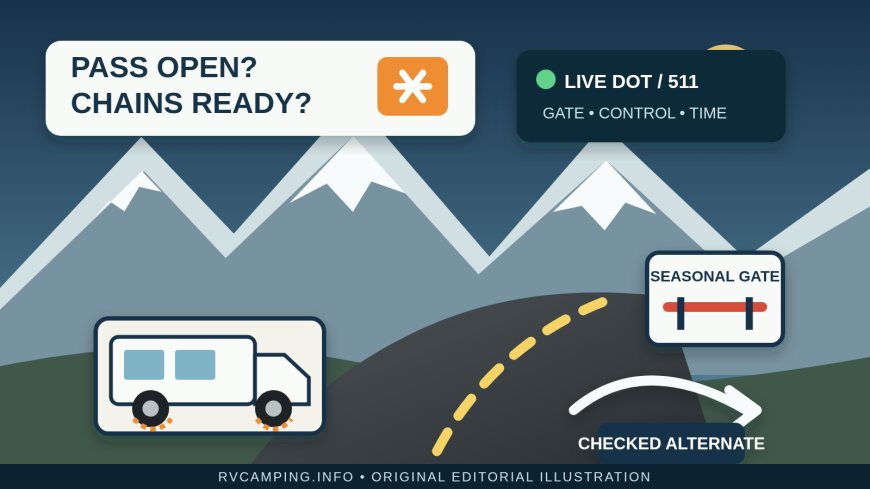
Plan an RV route around mountain-pass closures and chain rules
By Romana
Source note: This guide uses official Washington, Oregon, California, Colorado and Utah transportation sources retrieved September 19, 2026. A saved rule page is not a live road report. Posted signs, gates and on-scene instructions control.
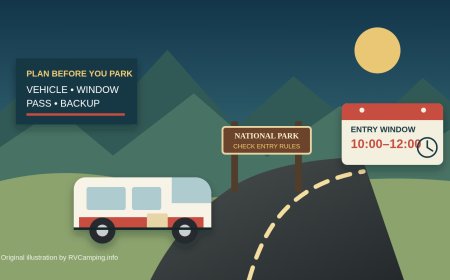
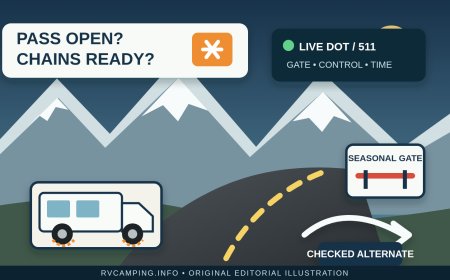
A fall RV route over a mountain pass needs two independent answers: Will the road be open when you arrive, and can your exact RV combination satisfy the traction order in effect? A seasonal reopening does not prevent chain control later. The pavement can also be bare at a lower junction while a winter gate remains locked farther up.
Build the route around a closure-and-chain checkpoint, not an opening-date guess. Record the seasonal status, the live control level, the rule for the motorhome or tow combination, the equipment aboard, and the last safe place to divert. If one field is unknown, the pass is not a committed route.
Treat the calendar and the pavement as separate systems
Seasonal closures are calendar-shaped but weather-controlled. WSDOT maintains a history page for the closing and opening dates of Chinook, Cayuse and North Cascades passes.[1] UDOT says nine listed state routes typically close from November until May or June, depending on weather, and directs travelers to its traffic site for current status.[5] Those pages help identify roads that require a gate check. They do not forecast your travel day.
Traction controls operate on a different clock. A pass that remains seasonally open can move from no restriction to a carry requirement, chain installation or closure during one storm. Caltrans warns that control areas may change quickly from one place to another.[3] A navigation app showing an open highway therefore answers neither question completely.
Use two rows in the trip plan:
| Route test | What counts as proof | Failure response |
|---|---|---|
| Seasonal gate | Current DOT/511 status for the named route segment | Use the checked alternate before the last major junction |
| Traction control | Current DOT/511 control plus roadside signs at arrival | Install the required devices in a legal chain-up area, or turn back before entering |
Do not merge those rows into “pass open.” The wording is too vague to drive a decision.
Identify the RV by rule-relevant facts
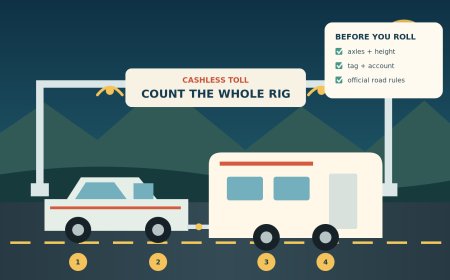
State notices use terms such as gross vehicle weight, gross vehicle weight rating, passenger vehicle, four-wheel drive, towing, drive axle and braked trailer. The correct answer may change when a car is attached behind a motorhome or when a travel trailer is connected to an AWD pickup.
Make a rig card before searching 511:
- motorhome or tow vehicle year, make and model;
- GVWR from the certification label, not a scale estimate;
- drive type: 2WD, 4WD or AWD;
- tire markings on every axle and measured tread depth;
- trailer type and whether each trailer axle has brakes;
- chain or approved alternative device part number, tire size and quantity;
- axles and tires the manufacturer permits you to chain;
- a photo of the chain-placement diagram for the exact combination.
GVWR and current scale weight are not interchangeable. If a rule says a vehicle is “rated” above a threshold, use the rating shown on its label. If the notice classifies commercial vehicles separately, do not assume private RV use settles every question; registration and use can matter. Ask the responsible agency or enforcement authority before the trip when the classification is unclear.
Read the state rule for the whole combination
The fastest way to make a bad call is to read only the tow vehicle line. These official examples show why the trailer must stay in the analysis.
Oregon: towing removes the usual traction-tire substitute
Oregon permits traction tires instead of chains in typical winter conditions only for vehicles rated at 10,000 pounds GVW or less that are not towing or being towed.[2] Its chain-law page says a vehicle at or below that rating must use chains when towing, and it points users to separate minimum-placement requirements for the trailer or towed vehicle.[2]
For an RV crew, “the truck has snow tires” is not a completed Oregon check. Write down the tow vehicle rating, confirm that the current sign applies to the route, then use ODOT’s placement diagram to count devices for both the powered vehicle and any braked trailer axle. Oregon can also impose a conditional closure whose terms are stricter than the ordinary chain categories.[2]
California: R-1 already changes the answer for trailers
Under California’s R-1 description, a tow vehicle needs chains on a powered axle; if the trailer has brakes, one trailer axle also must be chained.[3] R-2 generally requires chains or traction devices. The exception is a 4WD or AWD vehicle fitted with qualifying snow-tread rubber at every wheel, though it still must carry traction devices inside a control area.[3] At R-3, every vehicle must use chains or traction devices, without exception.[3]
That means AWD does not erase the trailer requirement at R-1, and a four-wheel-drive exemption at R-2 is conditional. Caltrans also says posted signs and Caltrans or CHP instructions at the checkpoint take priority over a broadcast report.[3]
Colorado: separate a traction law from a chain law
Colorado alerts motorists through signs, COtrip.org and road-condition notices when a traction or chain law is active.[4] The state’s passenger-vehicle traction-law page lists qualifying AWD/4WD tire configurations with 3/16-inch tread depth or chains/approved alternatives. When the passenger-vehicle chain law is active, every vehicle needs chains or an approved alternative traction device.[4]
Do not reduce both notices to “winter tires required.” Record the actual law shown for the segment. A traction-law-compliant setup and a chain-law-compliant setup are different answers.
These examples are not a nationwide matrix. They are a warning against carrying one state’s vocabulary across a border. Open the destination state’s rule page every time the route changes jurisdictions.
Build an equipment decision before departure
A box of chains is useful only if it fits, is permitted and covers the required tires. Complete this check at home:
- Match the device package to the exact tire-size code on the sidewall. Front and rear sizes can differ.
- Read the chassis, tow vehicle and trailer manuals for clearance limits and prohibited placements.
- Compare the state’s axle diagram with the rig card. Count drive-axle devices and trailer-axle devices separately.
- Lay out every device and identify its inside and outside faces, tensioners and repair links.
- Practice installing and removing it on the RV combination while parked on dry, level ground.
- Repack wet-weather gloves, a kneeling pad, reflective outerwear, a light and the manufacturer’s instructions with the devices.
If the vehicle manual limits conventional chains, that is a planning problem to resolve before entering chain country. Find out whether the state recognizes an alternative device and whether the vehicle manufacturer permits that exact product. “Chains do not fit” is not an exemption from a posted order.
Carry only equipment you can map to a required wheel position. A single pair may be enough for one passenger-car rule and inadequate for a tow vehicle plus braked trailer.
Put three checkpoints on the route
A live check at breakfast is too early for a pass reached after lunch. Place these checkpoints in the itinerary:
1. Reservation checkpoint
Check the seasonal-road page when booking. Mark any weather-dependent gate and build a lower-elevation alternate that reaches the campground without using the same closed segment. Estimate the alternate’s fuel, time and arrival effect now, while reservations can still be changed.
2. Departure checkpoint
On the travel day, open the official DOT or 511 map. Save the route number, named pass, control wording, direction and update time. Compare the notice with the rig card. A screenshot helps in a weak-signal area, but label it with its time; it is evidence of an earlier check, not permission to continue later.
3. Last-diversion checkpoint
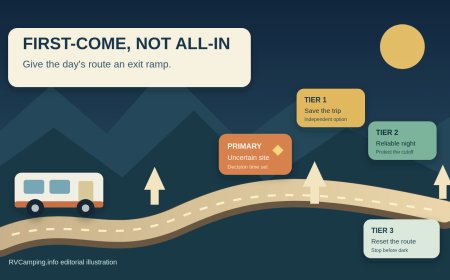
Stop before the final junction where the RV can still take the alternate without backing or making a risky roadside turn. Refresh the official status while parked. If signs at the approach are stricter than the saved report, follow the signs. If the status is unclear or the legal chain-up area is already full, take the alternate rather than joining a shoulder queue.
Set the diversion rule in advance: “If the seasonal gate, control level or equipment match is unresolved at Junction X by 2 p.m., use Route Y.” A named place and time leave less room for wishful improvisation.
Use a one-page pass-and-chain card
Keep this where the navigator can read it:
| Field | Trip entry |
|---|---|
| Pass, route and direction | ____________________ |
| Planned crossing window | ____________________ |
| Seasonal status source and update time | ____________________ |
| Live traction level and update time | ____________________ |
| Tow vehicle/motorhome GVWR and drive type | ____________________ |
| Tire markings and measured tread | ____________________ |
| Trailer present; braked axles | ____________________ |
| Required chain positions | ____________________ |
| Devices aboard, size checked, quantity | ____________________ |
| Legal chain-up location | ____________________ |
| Last safe diversion junction | ____________________ |
| Audited alternate | ____________________ |
| Go/no-go decision time | ____________________ |
The navigator should be able to point from the live notice to a line on this card and then to the correct bag of devices. If that chain breaks, the route is not ready.
Decide with explicit stop conditions
Use the pass only when all of these are true:
- the official current status shows the seasonal segment open;
- the current traction order is identified for your direction of travel;
- the complete RV combination meets that order;
- the required devices fit, are allowed, and are aboard in sufficient quantity;
- the driver can install them before the control point in a legal area;
- the checked alternate remains available before the last diversion point.
Choose the alternate when the gate status is uncertain, a device cannot be mapped to the required axle, the trailer requirement is unresolved, the chain-up area cannot be reached safely, or conditions exceed the driver’s comfort even though the route is technically open.
An official “open” icon is the start of the decision. The finished decision says: open segment, identified control, compliant combination, fitted equipment and a reachable alternate.
Sources
What's Your Reaction?