











How to Confirm a Corps of Engineers RV Campsite Before You Book
Confirm the exact Army Corps RV campsite by checking rig length, electric and water service, the facility booking window, and current operating notices.

How to confirm a Corps of Engineers RV campsite before you book
By Romana
A campground summary can tell you that a U.S. Army Corps of Engineers park has electric sites, drinking water and room for RVs. It cannot tell you that the specific site in your cart fits your rig, supplies the hookup you need or will operate normally on your dates.
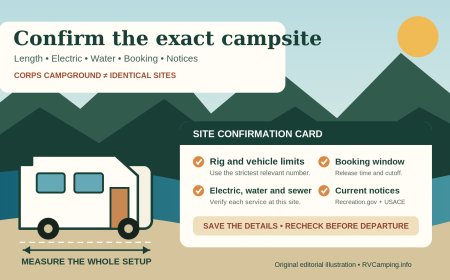
That distinction matters because Recreation.gov separates facility information from campsite details. The safest booking method is a three-page check: read the campground page, open the exact campsite record, then look for current notices from Recreation.gov and the local USACE project or district. Save the result after booking. A reservation confirmation is proof of a transaction, not a promise that floods, repairs, fire restrictions or utility outages will leave every service unchanged.
Start with your real parking requirement
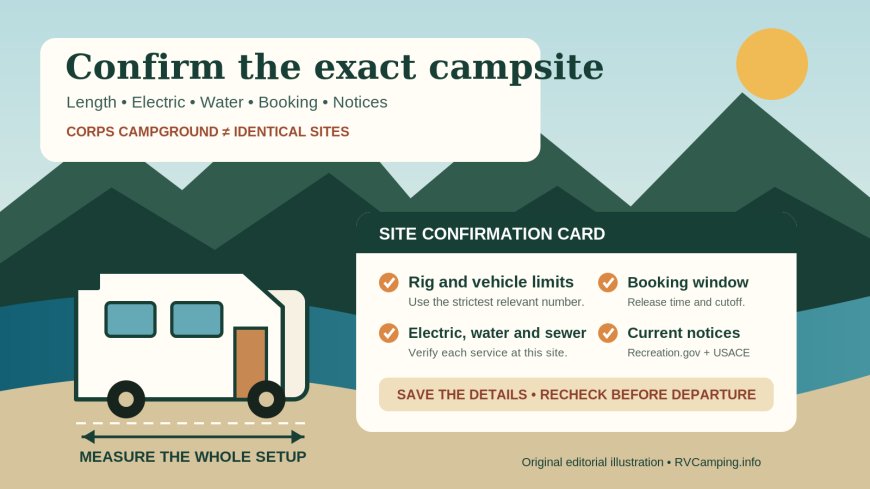
Write down four numbers before searching: the RV body length, the total hitched length, the width with slides deployed and the height at the tallest fixed point. Add the number of other vehicles and trailers you plan to park. A boat trailer, toad or tow vehicle can be the detail that makes an otherwise long pad unusable.
Do not treat every length on a campsite page as interchangeable. Recreation.gov may show a permitted equipment length, maximum vehicle length, driveway length and site length. Those fields can describe different constraints.
Site 023 at R. Shaefer Heard Campground on West Point Lake is a useful example. Its record lists a 93-foot paved driveway, yet RVs, trailers, fifth-wheels and camper vans are limited to 30 feet. It also lists a maximum vehicle length of 30 feet, a moderate grade and four vehicles. The long driveway does not erase the published 30-foot equipment limit.[3]
South Marcum site 106 at Rend Lake works differently. Its page lists a 63-foot site and maximum vehicle length, a paved back-in pad 10 feet wide and a +4.5 percent slope. The equipment list accepts RVs, trailers, fifth-wheels and other camping units without displaying a separate equipment-length figure.[2] For this site, 63 feet is useful, but it still does not answer every fit question. A long trailer and tow vehicle must share the paved space unless staff confirms other legal parking, and a narrow pad can complicate steps or slide deployment.
Use the strictest relevant number, not the largest number on the page. If the listing is internally unclear, call the facility before paying. Give staff your RV length, total combination length, slide side, number of vehicles and any boat or utility trailer. Ask which number controls the exact site.
Read electric and water as separate attributes
"Electric campground" is not the same as "electric at every site." The Hazelton Recreation Area page, for example, describes 12 sites with 50-amp hookups and 18 primitive sites.[4] Choosing the campground name alone does not choose power.
The exact campsite record should state the electrical service. South Marcum site 106 lists 50/30-amp electric.[2] R. Shaefer Heard site 023 lists 50-amp electric and a water hookup.[3] These examples also show why water needs its own check. Site 106's details list electric service but do not list a water hookup; its photo alt text even describes it as "electric only." That is enough reason to plan as though water is not at the pad unless the facility confirms otherwise.[2]
Separate these four questions:
- Is electricity installed at this exact site, and which amperage is listed?
- Is a potable-water connection assigned to the site, or is water only available from shared hydrants?
- Is sewer available at the site, or is there only a dump station?
- Will those services be operating on the travel dates?
A shared drinking-water amenity may be across the loop and may prohibit a continuous hose connection. An RV with a 50-amp plug can often use lower-amperage service with appropriate equipment and reduced loads, but a listing or local rule may restrict adapters. Never infer permission from the pedestal shape alone.
The booking window belongs to the facility
There is no universal "Corps campground booking day." Recreation.gov defines a booking window as the period before an arrival date when a reservation can be made. The platform says individual facilities set their own windows and directs travelers to the facility's Seasons & Booking tab.[1]
Hazelton gives a concrete counterexample to the familiar six-month assumption. Its notice says all campsites are reservable with a zero-day booking window, meaning a traveler may reserve through the intended arrival day. The same notice warns that arriving without first reserving can still mean finding a full campground.[4] Zero-day availability means same-day booking is allowed. It does not mean a site is held for walk-ins.
For any other Corps park, check the live facility page rather than carrying Hazelton's rule over. Confirm:
- the first date your intended arrival becomes reservable;
- the release time and time zone;
- whether individual and group sites use different windows;
- whether part of the inventory releases later;
- the latest cutoff for same-day or next-day booking; and
- whether the campground requires a reservation before occupying an empty site.
Take a screenshot of the Seasons & Booking panel before the sale opens. Recheck it the day before, since agencies can alter operating seasons or release dates.
Treat notices as part of the reservation
Read the Notifications and Alerts area before selecting a site, again before the cancellation deadline and once more before departure. Then open the official page for the USACE lake, project office or district. The two channels do different jobs: Recreation.gov carries transaction and facility notices, while USACE may publish flood recovery, construction and reopening details.
Littcarr Campground at Carr Creek Lake shows how quickly the operating model can change. USACE reported that it reopened April 27, 2026 after flood damage, initially used first-come, first-served camping, and began accepting Recreation.gov reservations on May 15. Restoration work was still visible after reopening.[5] An older trip note saying "first come" would have been wrong within weeks.
Utility notices deserve the same attention. The LePage Park facility page normally describes electric sites, drinking water, showers and a dump station, while its current indexed notice warns of a temporary water outage and separate fire restrictions.[6] A facility can remain open while one of the services that shaped your booking decision is unavailable.
A notice may affect only a swim beach, boat ramp, loop, restroom or water system. Do not turn a partial closure into a claim that the whole campground is closed. Record exactly what the agency says, the date checked and the contact number supplied for questions.
A five-minute confirmation routine
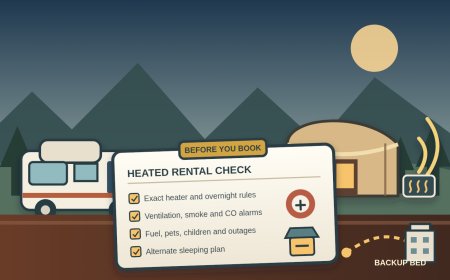
Before payment, open the exact campsite in a separate tab and work down this list:
- Match the site number and loop to the map and cart.
- Compare every length field with both the RV and the full combination.
- Check entry type, grade, surface, width, vehicle count and parking instructions.
- Confirm electric amperage, site water and sewer separately.
- Read Need to Know, Notifications and Alerts, and the Seasons & Booking panel.
- Check the local USACE project or district page for closures, flood recovery, fire rules or reduced services.
- Save screenshots or a PDF with the date, site number and displayed attributes.
Repeat the notice check shortly before travel. If water, power or access is essential, call the listed facility number and note who answered and when. Ask a narrow question: "For site 023 on October 18, is the 50-amp and water hookup expected to be on, and does the 30-foot maximum apply to the RV body or the full combination?" Specific questions are easier to answer than "Will my rig fit?"
The rule to carry between Corps campgrounds
Do not assume Corps parks use identical site measurements, utilities, release calendars or operating rules. Even two campgrounds at the same lake can have different loops, managers and seasonal service levels.
Book only when three records agree with your plan: the facility page says the campground is operating, the exact site page fits the rig and lists the required hookups, and current notices do not remove the service or access you need. If one record is silent, treat the feature as unconfirmed. A phone call before payment is cheaper than arriving with a 38-foot fifth-wheel for a site whose 93-foot driveway still carries a 30-foot equipment limit.
Sources
- Recreation.gov FAQ: booking windows and facility policies
- Site 106, South Marcum Campground at Rend Lake - Recreation.gov
- Site 023, R. Shaefer Heard at West Point Lake - Recreation.gov
- Hazelton Recreation Area at Lake Oahe - Recreation.gov
- LittCarr Campground reopens after historic flooding - U.S. Army Corps of Engineers
- LePage Park at John Day Lock and Dam - Recreation.gov
What's Your Reaction?