




Carolina Beach camper cabins and RV sites: pair availability with rig fit
Pair a Carolina Beach State Park camper cabin with an RV site by matching live availability to exact rig limits and hookup needs.

Carolina Beach camper cabins and RV sites: pair availability with rig fit
By Romana | Official park and reservation information checked October 22, 2026
Carolina Beach State Park solves one problem that trips up many mixed groups: its six camper cabins and 79 campsites are in the same family campground. It does not solve the next problem for you. Dry sites and full-hookup sites sit near the cabin cluster, but they have very different rig limits and do not share the same availability.
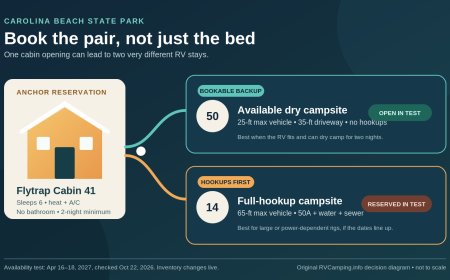
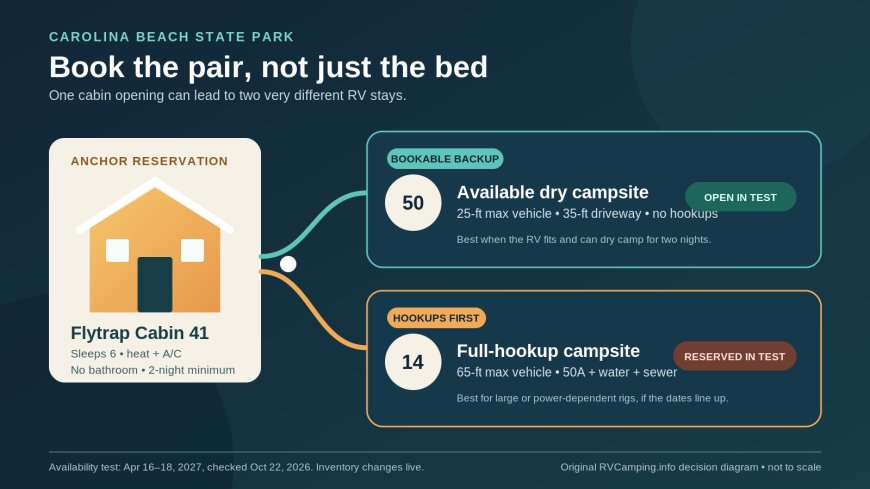
That tradeoff is visible in a real reservation check. For a two-night arrival on April 16, 2027, the official booking pages showed Flytrap Cabin 41 and non-electric site 50 available. Nearby site 14 had the larger pad and full hookups, but it was already reserved for those dates when checked on October 22, 2026.[6][7][8] Inventory can change at any moment, but the test exposes the useful question: will the group accept a dry site that fits, or change dates to keep the hookup requirement?
One campground, two very different pairings
The park has 69 campsites without hookups and 10 with water, electric and sewer. Its six cabins sit inside the family campground rather than in a remote lodge area.[1] That makes Carolina Beach a workable choice for grandparents, friends or children who want a solid roof while the RV household keeps its own bed and galley.
The official map labels the cabins as sites 39 through 44: Longleaf, Yaupon, Flytrap, Centennial, Coquina and Live Oak. Non-electric sites 45 through 50 wrap around the cabin area. The map's electrical-site symbols appear farther down the same loop at sites 14 and 15, with additional electrical sites continuing toward the entrance.[2]
This is close enough to coordinate, but "same campground" is not the same as "next door." A group that starts by filtering for full hookups can miss the dry sites beside the cabins. A group that starts with the map can pick a nearby pad that is too short for its RV.
Site 50 is a good example. It is a back-in, non-electric site in the cabin half of the campground, but its reservation record lists a 35-foot driveway and a 25-foot maximum vehicle length.[7] Site 14 is a different proposition: a level, 70-foot back-in driveway, a 65-foot maximum vehicle length, 50-amp electric, water and sewer.[8] The full-hookup site gives a larger rig much more room. On the tested weekend, the shorter dry site was the bookable fallback.
The map should narrow the search, not make the booking decision. Open every candidate's site-detail page and use its stated maximum vehicle length, driveway entry, grade and hookup fields.
What the cabin household is actually booking
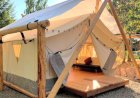
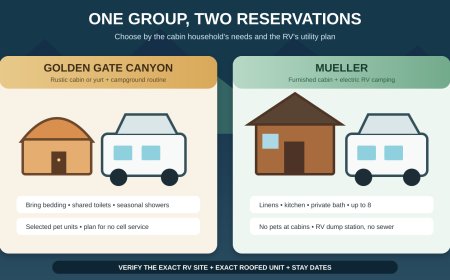
These are camper cabins, not vacation cottages. Each cabin sleeps six in two rooms, with one queen bed and two sets of twin bunk beds. Heat, air conditioning and electrical outlets are provided, but linens and pillows are not. There is no bathroom or running water inside; cabin guests use campground spigots and the shared bathhouse.[1]
Each cabin has a picnic table, charcoal grill, fire ring and two vehicle spaces. Cooking, smoking and open flame are prohibited indoors. Pets may stay at RV campsites, but cabin guests cannot bring them into the cabins or the surrounding cabin area, apart from service animals.[1] A pet-owning household cannot solve that mismatch by putting the dog in the cabin at night.
Centennial Cabin 42 is the accessible cabin. The park also identifies campsites 37 and 59 as accessible and site 8 as an accessible full-hookup site.[1] Those designations do not establish the route between a particular cabin and a particular RV pad. If someone needs an accessible connection between the two, call the park with the exact site numbers before paying.
The cabin has a two-night minimum, and cabin cancellations need to be made at least 14 days before arrival to preserve a refund under the park's stated policy.[1][4] That makes the cabin the harder half of the pair to replace. Treat it as the anchor reservation.
The April booking test
The reservation system's six-month window was open through April 21, 2027 when checked on October 22, 2026.[5] I tested a Friday-to-Sunday stay beginning April 16 rather than relying on a generic availability badge.
The first pairing was Flytrap Cabin 41 plus site 50. Both date matrices showed the requested nights as available. Flytrap sleeps six and has a two-night minimum; site 50 allows six people and two vehicles, accepts pets, and has no electric hookup.[6][7]
The second pairing kept Flytrap Cabin but replaced site 50 with site 14. Site 14 solves the utility and rig-length problem, but its date matrix showed the requested nights reserved.[8] On that weekend, closeness and availability lined up; hookups did not.
This is a snapshot, not a promise of inventory. Its value is procedural. Search the cabin and RV site for the same arrival and stay length, then read the letters on both date matrices. Do not assume that finding one available unit means the other half of the trip can be added later.
Decide which compromise your RV can tolerate
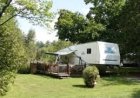
Choose a nearby dry site if the RV fits the exact vehicle limit and can comfortably handle two nights without a pedestal or sewer connection. Site 50's 25-foot vehicle limit makes it plausible for a camper van, truck camper or compact motorhome, but not for every trailer combination.[7] Check how the reservation system defines the vehicle field for your equipment and do not use the 35-foot driveway as permission to exceed the listed 25-foot maximum.
Choose a full-hookup site if the RV needs air-conditioning power, has limited battery capacity, carries a larger mobility setup, or simply cannot fit the short dry pads near the cabins. Site 14's record supports a 65-foot maximum vehicle length and full hookups.[8] On the tested weekend, that requirement meant changing the site or the dates because site 14 was unavailable.
The park allows generators at campsites outside quiet hours, according to the site-detail rules, but that is a poor substitute for an honest power budget when the group expects air conditioning. If electricity is non-negotiable, filter for it first and accept that the cabin may not be beside the RV.
Pets create the opposite priority. Since pets are barred from the cabin vicinity, the pet-owning household should remain at the RV site and plan gatherings at the campsite or another permitted outdoor area. Cabin guests should not become the default dog sitters.[1]
Price the pair, not each bed
North Carolina's published rate card lists camper cabins at $78 per night, full-hookup RV sites at $45, and no-hookup tent/trailer/RV sites at $30. The listed prices include the state's $3 reservation service fee when applicable, while checkout can still add taxes or other charges.[3]
For two nights, the simple rate-card comparison is:
- cabin plus nearby dry site: $216;
- cabin plus full-hookup site: $246.
The $30 difference is small compared with booking a site that does not fit the rig or asking a power-dependent RV to dry camp. Price becomes decisive only after placement, dimensions and utilities work.
Book the pair without losing one half
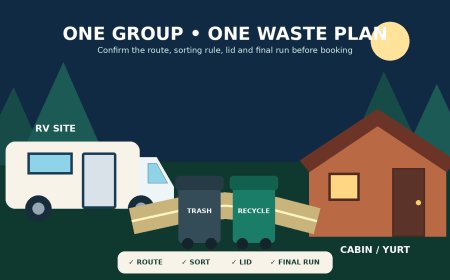
Start with one date range and one rig measurement sheet. Search the six cabins first because there are fewer of them and their two-night minimum is firm. Once a cabin is open, use the campground map to identify two nearby RV candidates and one utility-first fallback.
Open the exact details for all three RV sites before placing anything in the cart. North Carolina State Parks warns that amenities vary by site and directs guests to confirm availability, price, notes, photos, restrooms, water, hookups and driveway details on each listing.[4]
Then move quickly. The reservation guide says the shopping-cart hold expires after 15 minutes of inactivity, though the timer resets when the shopper moves to a new page.[4] Have one person handle both reservations in the same account if possible. If two people book separately, stay on a call, agree which reservation is the anchor and do not let both shoppers assume the other has completed checkout.
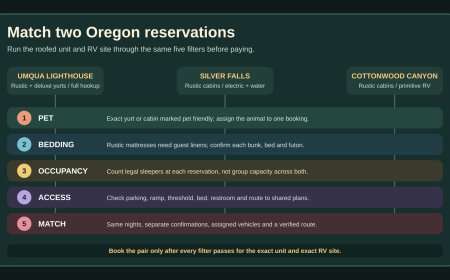
Before paying, read back five fields:
- the cabin name and number;
- the RV site number and maximum vehicle length;
- the arrival date and two-night stay length;
- the RV site's hookup type;
- the pet and vehicle assignments.
Carolina Beach works best when the group chooses its compromise deliberately. A compact, self-contained RV had a bookable dry-site fallback in the tested search. A larger or power-hungry rig may need different dates to secure site 14 or another full-hookup pad. Book the roofed bed first, but do not call the trip coordinated until the exact RV site passes its own fit test.
Sources
- Carolina Beach: Camping (accessed October 22, 2026)
- Carolina Beach State Park campground map (accessed October 22, 2026)
- State Parks reservation rates and activity fees (accessed October 22, 2026)
- Reserving campsites in North Carolina State Parks (accessed October 22, 2026)
- Carolina Beach State Park reservations overview (accessed October 22, 2026)
- Flytrap Cabin 41: April 16, 2027 availability and site details (accessed October 22, 2026)
- Campsite 050: April 16, 2027 availability and site details (accessed October 22, 2026)
- Full-hookup campsite 014: April 16, 2027 availability and site details (accessed October 22, 2026)
What's Your Reaction?