
















Can an RV stay overnight at a highway rest area? Build a state-by-state verification plan
Highway rest-area rules vary by state, facility, vehicle class, and posted zone. Use this primary-source workflow to verify parking, sleeping, camping, time limits, live status, and a safe fallback before relying on an overnight stop.

Can an RV stay overnight at a highway rest area? Build a state-by-state verification plan
By Romana

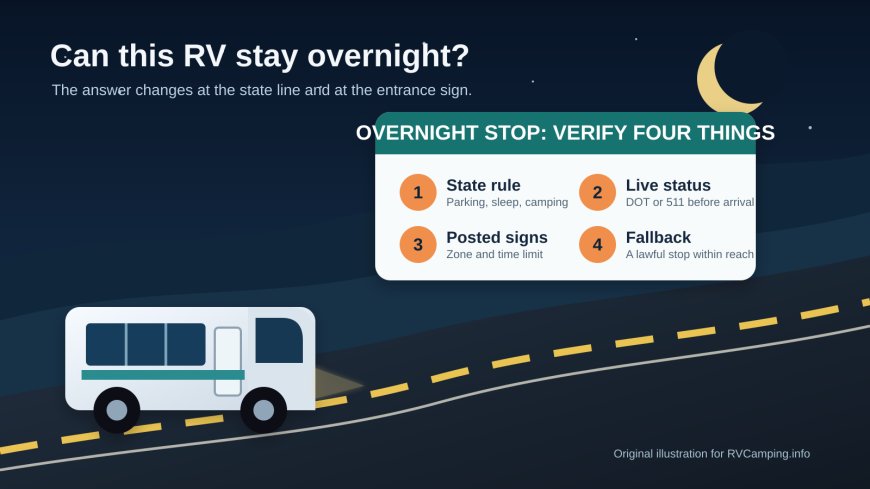
A rest area can be a sensible fatigue stop, but it is a poor place to improvise a night's itinerary. The answer to "Can I stay overnight?" changes by state, by facility, and sometimes by the sign at the entrance. It also depends on what "stay" means. Parking for six hours, sleeping inside a parked RV, and setting up camp are not the same activity.
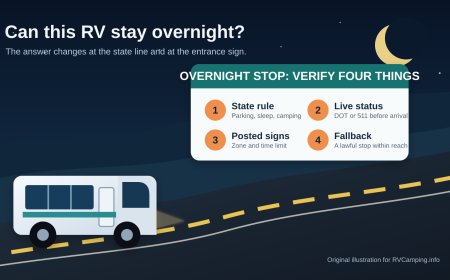
The safest answer is conditional: use a highway rest area only after checking the state rule, the live status of that exact facility, and the signs on arrival. Keep a legal fallback within your remaining safe driving range. That takes more work than reading a crowd-sourced map pin, but much less work than being awakened and told to move when you are already exhausted.
The federal government does not give RVers one overnight rule
Interstate highways are national infrastructure, but states operate their rest areas. FHWA says MAP-21 left day-to-day Interstate rest-area management with state DOTs.[1] FHWA also treats whether a rest-area parking site remains available as an operational decision for the state, made site by site.[2]
That split explains why a rule found for one state does not travel with you across the border. Federal provisions affect matters such as Interstate access and commercial activity. They do not create a nationwide permission for an RV to sleep overnight.
There is another practical wrinkle: "open 24 hours" describes access, not necessarily permission to occupy a parking space all night. A restroom can remain open around the clock while parking has an eight-hour cap, a shorter posted limit, or an outright ban on staying overnight.
Parking permission is not camping permission
Before checking a state, separate four questions:
- May the RV enter and park in the marked RV or long-vehicle area?
- How long may the vehicle remain during a rolling 24-hour period?
- May occupants sleep inside the vehicle during that parked interval?
- What conduct turns a fatigue stop into prohibited camping?
Washington shows why the wording matters. Its statute generally limits parking in a safety rest area to eight hours in a 24-hour period, allows shorter limits in designated zones, and separately prohibits camping or maintaining a camp, tent, or other sleeping accommodation.[4] An eight-hour parking allowance is therefore not an eight-hour campsite reservation. The statute's two clauses need to be read together, and the posted zone may be stricter.
Oregon draws a different line. Its posted DOT regulations cap a person's presence at 12 hours in each 24-hour window and separately bar camping, tents, and other structures.[5] The same rules prohibit parking outside designated spaces and violating posted parking controls. An RV that stays self-contained, occupies one marked space, and leaves before the limit presents a different fact pattern from an RV with slides, chairs, a grill, leveling equipment, or waste discharge outside.
North Carolina is clearer and more restrictive. NCDOT's rest-area publication says that camping and staying overnight are prohibited.[6] A driver should not convert the fact that the facility is open into permission to make an overnight stop.
What a time limit does and does not tell you
TxDOT lists a 24-hour maximum stay and points readers to Transportation Code 545.411.[3] That is unusually direct evidence about duration, but it still is not a promise that every space will be available or that every campsite-like activity is allowed. The maximum is a ceiling, not an entitlement to occupy the lot regardless of closure, posted instructions, or an officer's direction.
California illustrates another trap. Caltrans says its safety roadside rest areas give travelers a place to stop, stretch, and take a nap, among other short-break uses.[7] Its highway design manual calls for an "8 Hour Parking" sign for automobile areas and a separate "10 Hour Parking Commercial Motor Vehicles" sign for long-vehicle areas.[8] An RV owner should not assume the commercial-vehicle limit applies merely because the rig is long. Read the sign for the lane and space actually used.
These examples are not a national rules list. They are a test set. They prove that state wording can distinguish among a maximum stay, an overnight ban, a sleeping-accommodation ban, and a posted limit tied to a parking zone.
Build one verification row for every state on the route
Do this during route planning, not while pulling onto an exit ramp. Create one row per state, then complete these fields:
| Field | What to record | Why it matters |
|---|---|---|
| State and route | State, highway, direction, milepost | Rest areas are often directional and cannot be reached safely from the opposite carriageway. |
| Official rule source | DOT page, statute, or administrative rule | A facility directory alone may not answer the sleeping or camping question. |
| Parking limit | Exact number of hours and measurement period | "8 hours" may mean eight hours within any 24-hour period, not eight hours per visit. |
| Sleep wording | Allowed, prohibited, unclear, or not addressed | Silence is not permission. Mark it for confirmation. |
| Camping wording | Specific banned conduct | Tents, awnings, slides, chairs, fires, and sanitation activity may be treated differently. |
| Vehicle class | Passenger/RV/long vehicle/commercial | A truck rule may not cover a private motorhome or trailer. |
| Facility status | Open, closed, seasonal, services limited | Rules cannot make a closed lot usable. |
| Posted override | What the entrance and parking-zone signs say | Site signs can impose a shorter limit or designate where an RV belongs. |
| Checked at | Date, time, and source URL | Pages, closures, and operating conditions change. |
| Fallback | Campground, truck stop with permission, or other lawful lot | A full, closed, or uncomfortable rest area should not leave you stranded. |
Use four status labels in the row: "verified yes," "verified no," "conditional," and "unresolved." Do not turn "unresolved" into yes because a review says someone stayed there last year.
A five-step state-by-state research method
1. Start with the official state DOT rest-area page
Search the DOT site for "rest areas," then open the page for locations and facility status. Confirm that the page belongs to the agency, not a copied rules blog. Record direction, milepost, services, and closures.
WSDOT's directory, for example, reports each facility's location, status, and amenities, and it may show an RV dump station as open at one site and closed at another.[9] That is useful operational evidence. It does not replace Washington's statute on length of stay and camping.
2. Find the rule behind the directory
Search the same official domain and the state legislature or administrative-code site for terms such as "rest area," "parking," "camping," "sleeping accommodation," and "overnight." Save the controlling language, not just a search snippet. If the DOT page and code appear to conflict, do not choose the answer you prefer. Record the conflict and ask the DOT or highway patrol.
3. Check the exact facility on 511 shortly before arrival
A static rules page cannot tell you that tonight's stop is closed for maintenance, weather, construction, or an incident. State 511 systems can fill that gap. Florida 511, for example, provides map layers for closures and truck parking availability.[10] Treat truck-space data as capacity information for the class it names, not automatic permission for a private RV.
Check once while planning and again before committing to the stop. A passenger can do that while the RV is moving; the driver should wait until safely parked.
4. Read every sign on arrival
The sign at the entrance or parking zone is the last check. Photograph it for your own trip record if the wording is complex. Follow the shortest applicable time limit. Park only in the marked area that fits the RV, and never on a ramp, shoulder, gore, fire lane, or striped buffer because the proper spaces are full.
Keep the stop visibly a rest stop. Unless the official rule and signs clearly allow otherwise, leave the awning in, keep slides retracted where possible, skip outdoor furniture and grills, do not deploy a tent, and never discharge gray or black water. If leveling is necessary for a safety reason, it may be better to use a campground designed for that purpose.
5. Leave yourself a usable fallback
A legal stop can still be a bad stop. Lighting may be poor, the lot may be crowded, weather may change, or another person may make you uncomfortable. Before arrival, identify at least one staffed campground or other lawful overnight option and note its latest check-in process. If considering a business lot, obtain current permission from that location rather than relying on a chain-wide rumor.
Plan the decision point while you still have fuel and enough alertness to reach the fallback. Rest-area parking is first-come, not a reservation. Never press on merely because the planned lot is full. If fatigue becomes acute, prioritize immediate safety, contact authorities if needed, and avoid stopping in an unprotected travel lane or ramp.
A practical decision rule at the entrance
Use the stop only when all six statements are true:
- The facility is officially open.
- Your RV is allowed in the available marked space.
- The state rule permits the intended duration.
- Sleeping in the vehicle is permitted or has been confirmed, rather than guessed from a parking limit.
- Your behavior will remain a parking/rest stop, not prohibited camping.
- You have a fallback if the lot is full, posted more restrictively, or feels unsafe.
If any answer is no, move to the fallback. If an answer is unresolved, call the DOT, 511 traveler-information service, highway patrol, or the facility contact before building the night's plan around it.
The bottom line
An RV can stay overnight at some highway rest areas, but "some" is doing all the work. Texas publishes a stay limit of up to 24 hours. Washington pairs an eight-hour parking ceiling with a separate prohibition on camping and sleeping accommodations. Oregon bars camping and remaining longer than 12 hours. North Carolina says staying overnight is prohibited. California expressly supports naps while posting time limits by parking area.
A careful RVer does not memorize a colorful 50-state chart and hope it remains current. Build a state row from primary sources, check the exact facility on DOT or 511, obey the signs in front of you, and keep another lawful stop within reach. That method takes account of both the written rule and the conditions that can change before sunset.
Sources
- FHWA: Rest Areas (MAP-21 Section 1539) questions and answers
- FHWA: Interstate rest-area operations and abandonment guidance
- TxDOT safety rest areas and visitor length of stay
- Washington RCW 47.38.020: Limitations on use of rest areas
- Oregon DOT rest area regulations, OAR 734-030
- NCDOT Rest Area System map and rules
- Caltrans safety roadside rest areas
- Caltrans Highway Design Manual Chapter 910: Roadside sites
- WSDOT rest-area locations, status and amenities
- Florida 511 live traffic, closures and truck parking map
What's Your Reaction?