











Generator quiet hours are not an energy plan: budget RV battery use before a no-generator night
A measurement-first worksheet for budgeting required RV battery loads, charging limits and a documented morning margin before campground generator hours end.

Generator quiet hours are not an energy plan: budget RV battery use before a no-generator night
By Romana | RV Camping | October 11, 2026
A posted generator schedule tells you when an engine must be off. It does not tell you whether the house battery can carry the furnace blower, refrigerator controls, alarms, water pump, lights and chargers until morning.
Joshua Tree National Park makes the distinction easy to see: quiet hours run from 10 p.m. to 6 a.m., while generator use is limited to 7–9 a.m., noon–2 p.m. and 5–7 p.m.[1] In that example, the overnight battery interval begins at 7 p.m., three hours before quiet hours. A camper who plans only for “quiet time” has already missed part of the load.
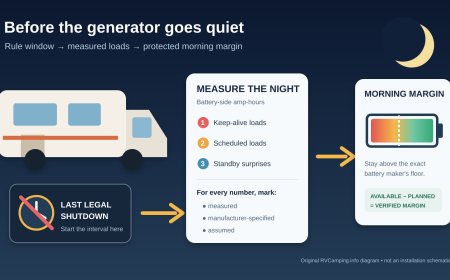
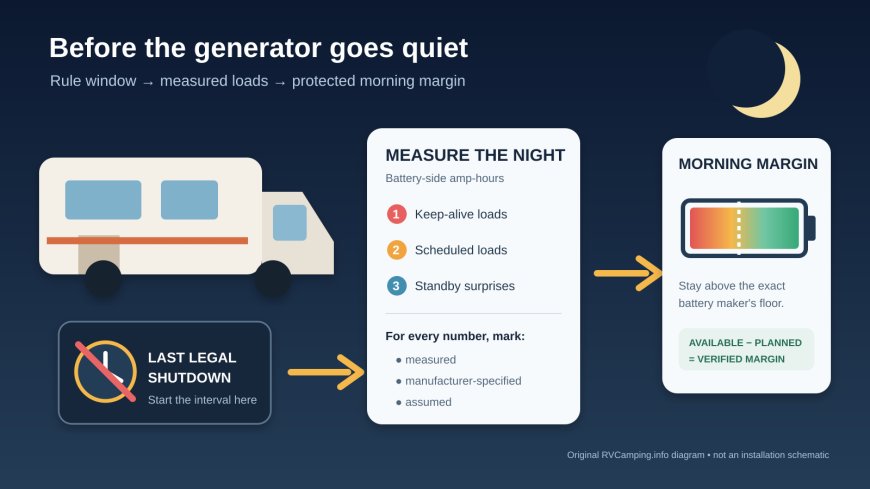
The defensible way to prepare is measurement-first: identify the exact no-generator interval, record what the installed battery monitor says the RV actually consumes, protect a manufacturer-supported discharge floor, and test the same setup before the trip. A generic appliance chart can start a worksheet, but it cannot certify your runtime.
First, draw the real overnight boundary
Copy the rule for the exact campground, loop, site and dates. Do not use Joshua Tree’s times as a national template; they are one official example. Your booking may have different windows, a generator-free loop, a seasonal restriction or a prohibition that includes vehicle idling.
Write down four times:
- Last legal generator shutdown.
- The time you expect to finish high-use evening tasks.
- The coldest or highest-demand part of the night.
- The next time charging is both legal and realistically planned.
The interval runs from item 1 to item 4—not merely from “bedtime” to breakfast. If the next generator window opens at 7 a.m. but you will not start it until 8:30, budget through 8:30.
Progressive Dynamics’ RV load calculator describes the same operating condition in electrical terms: when there is no shore or generator power, the converter is off and the 12-volt items draw from the battery bank.[2] That is the boundary to model.
Inventory loads in three passes
A useful audit separates loads by what you can do about them.
Pass 1: keep-alive loads
These are the loads that remain even when everyone is asleep:
- LP-gas and carbon-monoxide alarms;
- refrigerator electronics or a 12-volt compressor refrigerator;
- furnace controls and blower when heat calls;
- water-system or tank-heater controls, if required;
- battery monitor, networking and control panels; and
- any medically necessary equipment with its own verified backup plan.
Do not remove required alarms to make the spreadsheet work. Do not call a propane appliance “zero electric.” Dometic’s current DF Series furnace manual lists model-specific 12-volt current values, and the values differ across models; its small models alone are listed at 2.4, 3.4 or 4.8 amps.[5] Use the label and manual for the furnace actually installed, then measure its real cycling over comparable weather.
Pass 2: scheduled loads
These have a known event or duration: lights during dinner, water-pump runs, a vent fan, device charging, an electric bed system, or a brief inverter session. Record each separately. Scheduled loads are the easiest place to move work into a legal charging window—for example, finish laptop charging before generator shutdown rather than leaving an inverter awake all night.
Pass 3: surprise and standby loads
Turn everything “off,” then read battery-side current. If the draw is larger than expected, find the reason before assigning it to a vague reserve. Common discoveries include an inverter left enabled, entertainment electronics, heated tanks, antenna equipment, chargers and refrigerator mode changes.
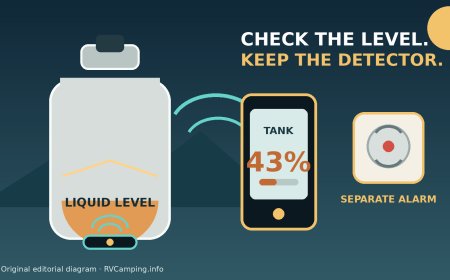
A shunt-based monitor is especially useful because it measures current into and out of the bank. Victron’s BMV manual explains that consumed amp-hours are integrated from current over time; its example is a 12-amp load for three hours registering 36 amp-hours removed.[4] The same manual warns that state of charge must synchronize regularly with the true full-charge state to prevent drift.[4] A percentage on an unconfigured or unsynchronized display is not proof of capacity.
Build the worksheet from measured amp-hours
For a nominal 12-volt house system, keep the primary worksheet in amp-hours when your shunt reports amp-hours. That avoids inventing an inverter-efficiency figure or assuming the battery stays at exactly 12 volts.
For a steady DC load:
amp-hours used = measured amps × hours
For a cycling load, use the monitor’s change in consumed amp-hours during a representative test interval. Do not multiply the furnace’s maximum label current by the whole night unless you are intentionally creating a worst-case bound. Do not guess a duty cycle and present it as measured.
| Overnight item | Basis: monitor / manual / estimate | Test interval | Ah used | Confidence note |
|---|---|---|---|---|
| Always-on baseline | ______ | ______ h | ______ | ______ |
| Furnace and controls | ______ | ______ h | ______ | Weather: ______ |
| Refrigerator | ______ | ______ h | ______ | Mode: ______ |
| Lights and water pump | ______ | ______ h | ______ | ______ |
| Devices and accessibility equipment | ______ | ______ h | ______ | Backup: ______ |
| Inverter idle plus AC loads | ______ | ______ h | ______ | ______ |
| Other | ______ | ______ h | ______ | ______ |
| Measured or documented subtotal | ______ Ah | |||
| Owner-selected uncertainty reserve | Assumption: ______% or ______ Ah | ______ Ah | Reason: ______ | |
| Planned overnight withdrawal | ______ Ah |
The reserve is a planning choice, not a universal electrical constant. Label it as an assumption and explain what it covers: colder weather, a longer wake period, battery aging, an unscheduled fan or uncertainty in a nameplate-only load.
If an AC appliance runs through an inverter, the clean input is battery-side amp-hours measured while the complete inverter-and-appliance combination operates. If measurement is not available, use the inverter manual’s idle draw and efficiency information with the appliance’s verified consumption, state every assumption, and have the result checked when the load is critical. Dividing AC watts by 12 and ignoring losses is not a publication-grade runtime claim.
Establish an allowed floor, not a folk rule
The bank’s large advertised amp-hour number is not automatically the amount available tonight. Record:
- exact battery manufacturer and model;
- chemistry and number of batteries;
- series/parallel arrangement;
- manufacturer-rated capacity and rating conditions;
- manufacturer-recommended discharge floor or low-voltage boundary;
- current state of charge after charging;
- age, temperature and known test results; and
- monitor settings and last valid synchronization.
Use the installed battery maker’s current documentation. Do not apply “50 percent” to every lead-acid bank or “100 percent usable” to every lithium battery. Those shortcuts erase chemistry, model, temperature, discharge rate, BMS behavior and service-life goals.
Your decision line is:
available Ah above the documented floor − planned overnight withdrawal = morning margin
Each input must be labeled measured, manufacturer-specified or assumed. If the margin depends on an assumption you cannot defend, the plan has not passed.
Charging time is not converter amperage divided into missing amp-hours
A short legal generator window does not guarantee a full battery. Progressive Dynamics says recharge time depends on battery size, converter output, other 12-volt loads and how deeply the battery is discharged.[3] It also says one of its converters can reach maximum rated output only when other 12-volt systems are not consuming that output and the battery is discharged enough to accept it.[3]
That means a “60-amp converter” is not evidence that 60 amp-hours will enter the bank every hour. Charge current can be shared with operating loads and can taper as the battery accepts less. Generator output, converter model and mode, wiring voltage drop, temperature and battery chemistry also matter.
During a legal daytime window, record battery-side current and state of charge at the start and end. If the bank does not reach the monitor’s valid synchronization conditions, do not manually declare it full just because the generator ran for two hours.
Run a dress rehearsal
Test before relying on the plan at a campground:
- Charge the bank using the approved equipment and verify the monitor is correctly configured and synchronized.
- Disconnect shore power at the same time the campground generator window will close.
- Use the actual refrigerator mode, thermostat setting, inverter policy, lights and chargers.
- Record state of charge, voltage, current and consumed amp-hours at shutdown, bedtime and the planned morning endpoint.
- Note outdoor temperature and furnace behavior.
- Repeat if the first test does not represent the forecast or if any major load changes.
- Stop at the manufacturer’s documented floor; do not test by forcing a damaging deep discharge.
The rehearsal is also a fault check. A furnace can have propane and still fail when 12-volt power is inadequate; Dometic’s troubleshooting guidance specifically directs users to check RV system voltage when 12-volt power is low.[5]
Set decision points before dark
Define three checkpoints:
- At generator shutdown: charging is complete enough, all essential loads are confirmed, and the projected margin is positive.
- At bedtime: live consumed amp-hours are near the tested curve. If not, find the load while options remain.
- At the morning floor: discretionary loads are already off, and the bank remains above its documented boundary until the next legal charge.
If the numbers fail, the remedies are operational—not rhetorical. Choose hookups, change sites or loops, reduce discretionary use, repair an unexplained draw, add properly engineered storage, or alter the trip conditions. Solar can contribute during daylight, but an unverified solar forecast is not stored overnight energy.
Continuous medical equipment, powered mobility needs, extreme-temperature protection and any life-safety load require a manufacturer- and clinician-supported backup plan. A campground generator schedule and a blog worksheet are not emergency power systems.
Generator hours answer a rules question. An overnight battery plan answers a measurement question: what the RV draws, what the bank can safely deliver, and how much verified margin remains. Make those three lines agree before the engine goes quiet.
Sources
- National Park Service, Camping Regulations — Joshua Tree National Park (official quiet-hours and generator-use windows; accessed October 11, 2026).
- Progressive Dynamics, Support — Battery Size Calculators (manufacturer load-planning guidance for periods without shore or generator power; accessed October 11, 2026).
- Progressive Dynamics, FAQs About Power Converters/Chargers (manufacturer explanation of converter charging-rate and recharge-time limits; accessed October 11, 2026).
- Victron Energy, BMV-700 Manual: Operation (manufacturer guidance on consumed amp-hours, state of charge and synchronization; accessed October 11, 2026).
- Dometic, DF Series Furnace Installation Manual (Rev. B, September 18, 2025; model-specific 12-volt current and low-voltage troubleshooting; accessed October 11, 2026).
What's Your Reaction?