



















White Sands Has No Campground: Where RVers Can Stay and What to Verify
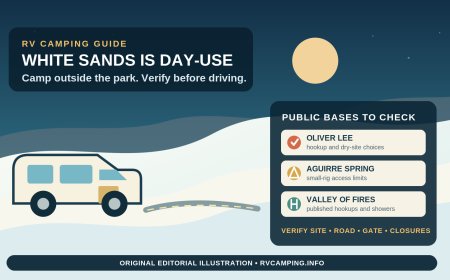
White Sands has no in-park campground. Compare Oliver Lee, Aguirre Spring, and Valley of Fires, then verify RV fit, utilities, roads, gates, and park closures.

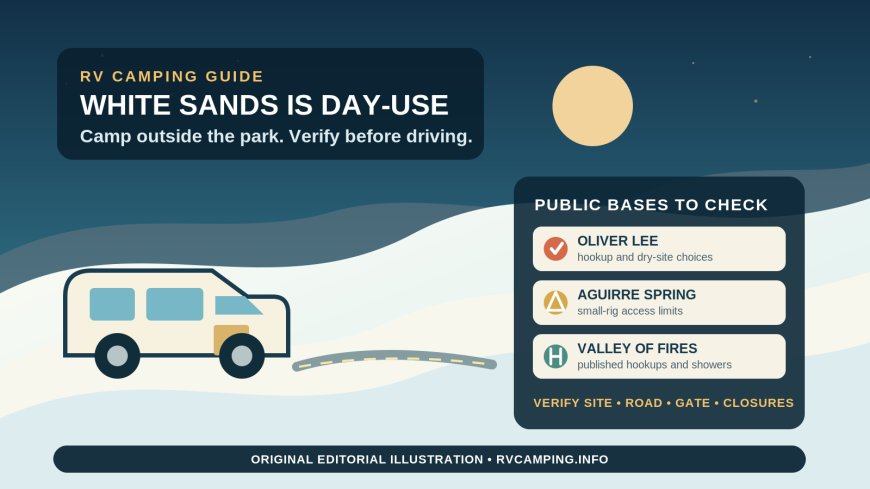
White Sands National Park is an RV-friendly day visit, not a place to spend the night. These three public campgrounds solve different problems: proximity, a small-rig dry-camping setting, or hookups and services.
The first planning fact is blunt: you cannot camp inside White Sands National Park right now. The former backcountry option is closed while the National Park Service assesses whether camping is safe and feasible, no reopening date has been set, and overnight stays are not permitted anywhere in the park.[1] White Sands also says it has no RV/car campground or other sleeping option inside the park.[2][3]
That does not mean an RV must stay at the campground all day. NPS says Dunes Drive is suitable for recreational vehicles and buses. The first five miles are paved; the final three miles are hard-packed gypsum that can develop washboard, potholes, and sand drifts.[6] In other words, an RV can make the day-use drive, but the campsite must be somewhere else.
For a public-land base, three realistic choices are Oliver Lee Memorial State Park, Aguirre Spring Recreation Area, and Valley of Fires Recreation Area. NPS lists them at 24, 39, and 76 miles from White Sands, respectively.[2] Those are the park's published mileages, not promised travel times. Weather, road work, a long vehicle, and missile testing can change the day.
The short decision matrix
Every entry below comes from the current NPS, New Mexico State Parks, or BLM pages cited in the row. “Not listed” means the cited facility page does not promise that amenity; it does not mean a traveler should assume the opposite.
| RV base | NPS-listed distance from White Sands | Campsite access | RV utilities and services listed by operator | Road or operating rule that may decide it | Best fit based on those published facts |
|---|---|---|---|---|---|
| Oliver Lee Memorial State Park | 24 miles[2] | Reservation sites are listed year-round.[7] | 15 water/electric sites at 30 amp, one ADA water/electric site at 50 amp, developed dry sites, restrooms with water, and showers. The dump station is currently closed during entrance construction.[7] | Entrance work is expected through December 2026; general camping remains open, but delays are possible.[7] | RVers who want the closest of these three NPS-listed public bases and a choice between hookups and dry sites. |
| Aguirre Spring Recreation Area | 39 miles[2] | 55 individual sites, first come, first served.[8] | Water is available only near the host site at the entrance. BLM promises a covered shelter for shade, a picnic table, a grill, and a tent pad at every site; it does not list electric hookups or a dump station.[8] | The 5.5-mile campground road becomes narrow and winding, the recommended RV maximum is 23 feet, and the road becomes a steep one-way loop at mile 4.[8] | A dry-camping-capable rig no longer than the published recommendation, with a driver comfortable accepting the access-road limits. |
| Valley of Fires Recreation Area | 76 miles[2] | Some sites can be reserved online; the BLM page also identifies at least one accessible site as first come, first served.[9] | Thirteen sites have 30- and 50-amp electricity plus water hookups. The campground has showers, flush and vault toilets, water spigots, and a dump station.[9] | Open year-round; the published stay limit is 14 days before a required relocation of at least 25 miles.[9] | RVers willing to use the farthest of these three NPS-listed bases in exchange for the broadest published utility and bathhouse set. |
The “best fit” column is intentionally narrow. It does not score scenery, cellular service, site levelness, shade, generator noise, or a maximum rig length that the operator has not published on the cited page. Check the exact reservable site or call the managing office before treating any of those as known.
Oliver Lee: the practical close-in public base
Oliver Lee is the uncomplicated first place to check for a conventional RV setup. New Mexico State Parks lists water-and-electric sites, developed dry sites, wet restrooms, and showers.[7] It also links to reservations and describes reservation sites as available year-round. The state page lists 30-amp service at 15 water/electric sites and a single ADA water/electric site with 50-amp service.[7]
There is one important 2026 catch. Entrance construction is expected to continue through December, and the dump station and group area are closed even though general camping remains open. The park says alternate dump locations are available on request and warns of possible entrance delays.[7] A directory entry that merely says “dump station” is stale for this trip unless the park confirms reopening.
Before reserving, open the individual campsite record rather than relying on the campground-wide amenity list. Verify the pad length, back-in or pull-through layout, electrical pedestal, water connection, number of vehicles, and whether a towed car fits under the site's rules. If dumping is part of departure day, ask where the current alternative is and whether it is available on your schedule.
Aguirre Spring: appealing only when the rig and arrival plan fit
Aguirre Spring is not a general recommendation for every RV. The BLM's own limit is the screening question: it recommends a maximum RV length of 23 feet because the 5.5-mile road becomes narrow and winding. At mile 4, the road turns into a one-way loop and climbs steeply.[8] A 23-foot recommendation is not an invitation to round a 25-foot motorhome down, and it does not account for a separate tow vehicle or trailer combination unless BLM confirms how it measures the unit.
The campground has 55 individual sites, all first come, first served. Water is available only at the entrance near the camp host. BLM says every site has a covered shelter for shade, a table, a grill, and a place for a tent, but the facility page does not promise electric hookups or an RV dump.[8] Plan it as dry camping unless the district office gives you a current, site-specific answer.
Gate timing matters here. The BLM page lists entrance hours of 7 a.m. to 8 p.m. from March through November and 8 a.m. to 6 p.m. from November through March, with the change tied to daylight saving time.[8] The overlapping month language is another reason to call rather than interpret the gate clock from memory. A first-come site is not useful if the rig reaches a locked gate.
Valley of Fires: farther away, stronger published services
Valley of Fires trades distance for a much fuller service list. BLM says 13 campsites have both water and 30/50-amp electrical hookups. It also lists a central shower house with flush toilets, accessible vault toilets, distributed water spigots, and a dump station.[9] Some campsites are reservable through Recreation.gov; the official page specifically says accessible Site 12 is reservable while accessible Site 4 is first come, first served.[9]
The dump station is normally included once with a camping stay and has posted operating hours of 7 a.m. to 7 p.m.; BLM asks campers to arrange with the host for another time.[9] That is a facility rule worth putting in the departure plan, not discovering with a full tank after dinner.
BLM lists the recreation area as open year-round. It also publishes quiet hours of 10 p.m. to 7 a.m., a leash rule for pets, and a 14-day stay limit followed by relocation at least 25 miles away.[9] None of those facts guarantees that a particular site will fit your RV. Use the reservation record for site dimensions and availability, and confirm any requirement that affects your exact combination.
White Sands entry is a separate reservation-day check
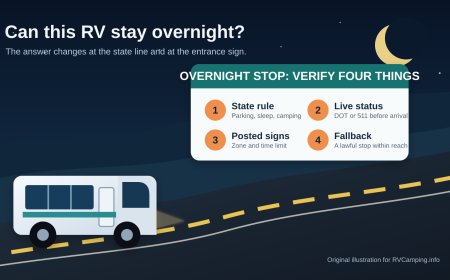
A campground confirmation does not guarantee access to the dunefield. White Sands closes nightly, and its hours change during the year. NPS tells visitors on a tight schedule to check the park closure page the day before arrival.[5]
Military tests add a second clock. NPS says Dunes Drive can close for up to three hours and that notice can arrive as little as 24 hours before a scheduled test. U.S. 70 between White Sands and Las Cruces may also close.[4] On this article's research date, October 12, 2026, the park's closure page showed a Dunes Drive closure scheduled for October 15 from 7 to 9 a.m.[4] That snapshot is useful only for understanding why a last check matters; it is not a permanent calendar.
There is also an active safety corridor from mile 3 to mile 5.5 on Dunes Drive. The current-conditions page says drivers may pass through but may not stop, park, or get out in that corridor unless directed or given written consent by a ranger.[3] Do not assume every familiar pullout or activity area is available because the entrance gate is open.
Use this verification order:
- The evening before: check the NPS operating-hours page and military-testing closure page. If the route uses U.S. 70 toward Las Cruces, check the highway status too.[4][5]
- Before leaving camp: open the NPS current-conditions page for Dunes Drive weather closures and the mile 3 to 5.5 safety corridor.[3]
- At the entrance: read posted restrictions and ask which pullouts, trails, and picnic areas are open. A green light for Dunes Drive is not permission to stop inside the safety corridor.
- Before taking the RV onto gypsum: secure exterior gear and loose interior items. NPS warns that the unpaved section can be washboarded, potholed, or drifted with sand.[6]
- Before sunset or closing time: leave enough margin to exit. Published hours can change, and the park is not an overnight fallback.[1][5]
What to verify with each campground
A useful phone call is short and specific. Give the total length of the RV or tow combination exactly as the operator requests it, then ask:
- Is my exact site available for all nights, and is it reserved or first come, first served?
- What is the site's maximum vehicle length and usable pad length?
- Are the listed electric and water connections working at that site today?
- Is potable water accessible to my rig, or must I fill containers at a shared point?
- Is the dump station open? Oliver Lee's published 2026 alert says no; Valley of Fires publishes hours for its station.[7][9]
- What are the gate hours on my arrival date, and is after-hours entry possible?
- Are there road grades, tight turns, low branches, width limits, or one-way sections before the site? Aguirre Spring's published 23-foot recommendation should be treated as a hard planning boundary unless BLM says otherwise.[8]
- Are fire restrictions, generator limits, pet rules, or water outages in effect?
- If conditions close White Sands or U.S. 70, can I keep the campsite and shift the park visit to another day?
Save the answer with the date, office, and staff name. Campground infrastructure and access rules can change faster than a trip-planning article.
The bottom line
White Sands is a day-use destination for RVers, not a campground.[1][2] Oliver Lee is the nearest of these three public options on the mileage table and has both hookup and dry-site choices, but its dump station is closed during the current construction project.[2][7] Aguirre Spring works only for a small rig that fits the BLM's 23-foot recommendation and a driver prepared for the narrow, winding, steep one-way access.[8] Valley of Fires is the farthest of the three, but it has the strongest published list of RV utilities and bathhouse services.[2][9]
Choose the base from those facts, not from a pin that looks close on a map. Then recheck the campsite, gate, Dunes Drive, safety corridor, and missile-test calendar just before the visit.
Sources
- NPS: Backcountry Camping at White Sands — accessed October 12, 2026.
- NPS: Eating & Sleeping Near White Sands — accessed October 12, 2026.
- NPS: Current Conditions at White Sands — accessed October 12, 2026.
- NPS: Military Testing Park Closures — accessed October 12, 2026.
- NPS: Operating Hours & Seasons — accessed October 12, 2026.
- NPS: Dunes Drive Road Conditions — accessed October 12, 2026.
- New Mexico State Parks: Oliver Lee Memorial State Park — accessed October 12, 2026.
- BLM: Aguirre Spring Recreation Area and Campground — accessed October 12, 2026.
- BLM: Valley of Fires Recreation Area — accessed October 12, 2026.
What's Your Reaction?