





















Keep Cabin Luggage Out of the RV: A Bed-Bug Travel Plan for Mixed Groups
A practical arrival, inspection, and luggage-containment plan that helps mixed RV, cabin, yurt, and furnished-tent groups avoid carrying possible bed bugs into the RV.

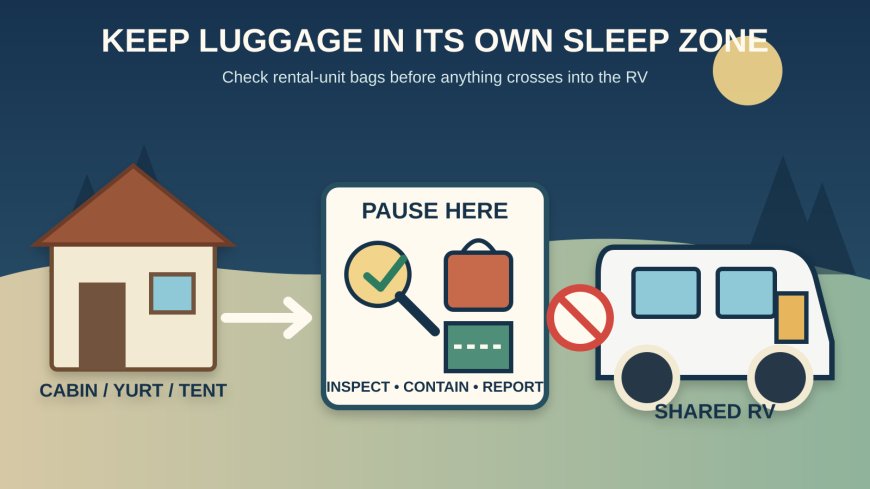
For a group split among RV sites, cabins, yurts, and furnished tents, the safest luggage plan starts before anyone treats the RV as the shared closet.
A mixed camping group often uses the RV as headquarters. Coffee lands on its counter. Chargers pile up by the dinette. Cabin guests drop a jacket or overnight bag inside while everyone decides what to do next.
That last habit deserves a rethink. Bed bugs are more likely to move with luggage and other belongings than on a person, according to University of Minnesota Extension.[2] A bag that goes from a rental bed to an RV sofa can turn separate reservations into one shared pest problem.
This is not a reason to distrust every cabin or spend the first hour in a panic. It is a reason to give luggage a route that does not run through every sleeping space.
Book the response plan, not a promise
No reservation agent can honestly guarantee that a unit will never have a pest. A more useful question is what the property does when a guest reports a possible bed bug.
Before a group books, ask:
- Who answers an after-hours pest report?
- Should guests leave belongings in place while staff inspect?
- Can the property move the party to another unit without routing bags through an occupied RV?
- Is there guest laundry on site, and what hours is it open?
- How does the property document the report and follow up after checkout?
Record the answer with the reservation. The goal is not to make the desk clerk recite a perfect policy. You need one contact and a clear first step at 10 p.m.
Give every bag a temporary landing zone
The EPA advises travelers to inspect the room, mattress, headboard, and luggage rack, then keep luggage off the bed and floor.[1] Adapt that routine to the whole campground group:
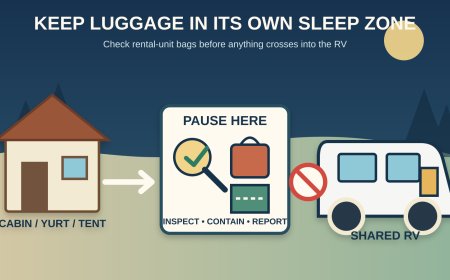
- RV sleepers take their own bags into the RV. Rental-unit bags stay with the rental-unit party.
- Cabin, yurt, and furnished-tent guests pause before unpacking. One person checks the sleeping area with a flashlight while closed bags wait in the vehicle or another low-risk place permitted by the property.
- Use an inspected rack or another hard, elevated surface. Keep bags zipped when they are not in use. Do not use the RV bed, dinette, or exterior storage bay as overflow luggage space.
- Make shared items truly shared. Put the picnic tote, games, and cooking supplies in their own clean container instead of carrying personal duffels between units.
A canvas wall does not change the basic check. Look closely at the provided mattress and its seams, the bed platform, nearby cracks, upholstered pieces, and the rack or shelf where bags will sit. The point is a short, orderly inspection, not dismantling campground furniture.
Look for evidence, not a bite pattern
University of Minnesota Extension says careful inspection is the way to confirm bed bugs and directs travelers to focus on seams, folds, cracks, and crevices.[2] Check for a live insect, cast skins, eggs, or spotting around the sleep area. A skin mark by itself is not enough to identify the cause.
If someone finds a suspicious insect or cluster of signs:
- stop unpacking;
- take clear close-up and context photos without moving the object around;
- leave bags and loose textiles where they are unless property staff direct otherwise;
- contact the campground or rental host promptly; and
- keep the RV and other occupied units out of the inspection process.
Do not carry the suspect item to the RV for better light. Bring a flashlight to the item.
Use a containment line if belongings may be exposed
Once clothing has been spread across a suspect sleeping area, the cleanest group response is containment, not a hurried transfer.
Keep potentially exposed washable items in sealed bags until they can go directly to an appropriate laundry process. Penn State Extension recommends sealed bags for traveled clothing until laundering and advises taking luggage to the laundry area rather than into a bedroom.[3] EPA guidance adds an important distinction: washing alone generally does not kill bed bugs; time in a high-temperature dryer does.[1]
Dryer temperatures, load sizes, and fabric limits vary. Follow the clothing label and the machine instructions, and use the specific treatment guidance from a pest professional if staff confirm an infestation. Do not assume a quick campground washer cycle settled the issue.
Separate the group into three lanes:
- No exposure suspected: belongings stay in their assigned unit and follow the normal trip routine.
- Possible exposure: belongings remain contained and do not enter the RV, another cabin, or a shared tow vehicle cargo pile.
- Confirmed problem: follow the property's instructions, document what moved where, and get professional advice for any RV, home, or vehicle that may need inspection.
That written movement log can be plain: "blue duffel stayed in Cabin 4; two sealed laundry bags went directly to the laundromat; no cabin bags entered the RV." It is far more useful than trying to reconstruct the trip a week later.
Skip the campsite pesticide experiment
A fogger or general bug spray is not an emergency fix for a rental unit or an RV. Penn State Extension says bed bug control is difficult and recommends a licensed, experienced pest-management professional.[3] The property needs to handle its unit, and the RV owner needs advice suited to the RV's materials, compartments, and occupied-space rules.
Do not spray mattresses, bedding, people, pets, or a campground rental with an improvised product. Do not discard someone else's mattress or furniture. Contain belongings, report the evidence, and let the responsible owner arrange identification and treatment.
The five-minute mixed-group briefing
Use this before keys and site numbers are handed out:
Personal luggage stays with the place where you sleep. Keep bags closed and off beds and floors until the sleep area and rack have been checked. If you see a suspicious insect, shed skin, or spotting, stop unpacking, take photos, and call the trip lead and property contact. Do not bring the bag to the RV.
Assign one trip lead to keep the property number, laundry information, sealable bags, and a flashlight. That person coordinates; they do not diagnose insects.
The RV can still be the group's kitchen table and rainy-day lounge. It just should not be the first stop for every suitcase.
Sources
- U.S. Environmental Protection Agency: Tips for Travel — official room-inspection, luggage-placement, and return-home guidance; retrieved October 9, 2026.
- University of Minnesota Extension: Bed bugs and traveling — official extension guidance on inspection, belongings, containment, and travel; retrieved October 9, 2026.
- Penn State Extension: Got Bed Bugs? Eliminate Bed Bugs with IPM — official extension guidance on travel precautions and professional pest management; retrieved October 9, 2026.
What's Your Reaction?