













RVLock V4 review: convenient keyless entry, unforgiving fit
Research-based RVLock V4 review covering towable fit measurements, installation, batteries, backup access, durability and security limits.

The RVLock V4 is a sensible upgrade for travel-trailer and fifth-wheel owners who want keypad entry and have a door that matches the lock's dimensions closely.[1][2] Buy it for convenience, not because a keypad turns an RV into a vault.
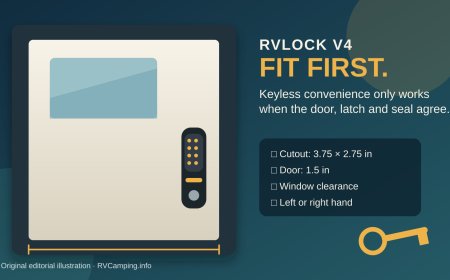
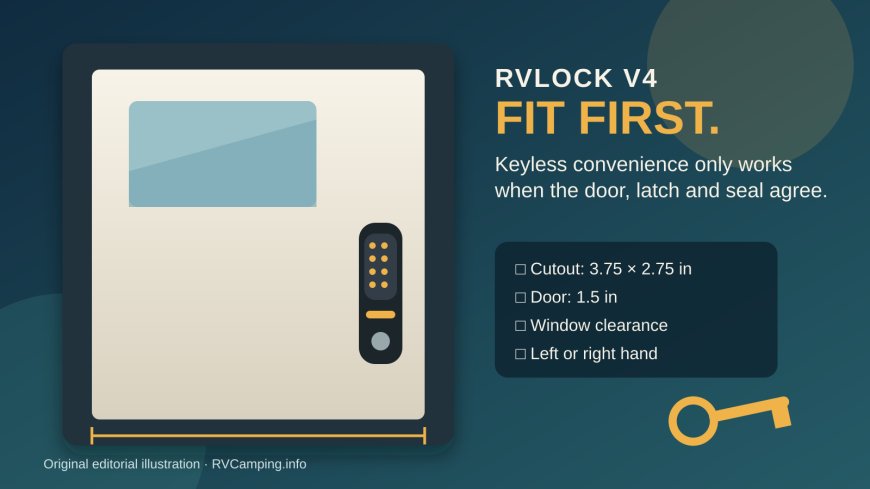
Measure before ordering. The current RVLock fit guide calls for an opening about 3.75 by 2.75 inches, a 1.5-inch-thick door, at least 1 7/8 inches between the handle and a nearby window, and the correct left- or right-hand version.[2] Skip this V4 if you have a Class A or Class C motorhome, a mismatched cutout, or a glass-door layout you cannot verify.[2]
The tradeoff is simple: leaving the key behind is genuinely handy, but the V4 adds batteries, wiring, programming, and fit details to a door latch that used to be purely mechanical.
This is a research-based review. RVCamping.info did not purchase, install, use, or physically test this lock.
Exact model and Amazon listing
This review covers the current RVLock V4 Keyless Handle for travel trailers and fifth wheels. It is the full-metal V4, not the lighter Compact and not the Atlas or Charter motorhome handle.[1]
The matched Amazon listing is ASIN B00N58KQMQ. The listing title identifies an RVLock V4 keyless RV door lock for campers, fifth wheels, and trailers.[4] Amazon copy has also described a 1.25-to-1.5-inch door-thickness range, while RVLock's current product page and fit guide specify a 1.5-inch-thick door.[1][2][4] For a fit decision, use the current RVLock guide and measurements from your actual door rather than the broader marketplace wording.
As an Amazon Associate, RVCamping.info earns from qualifying purchases. If you buy through an Amazon link in this article, we may earn a commission at no additional cost to you.
Confirm V4, B00N58KQMQ, door handing, and your measurements before ordering. Similar-looking RVLock handles serve different door types.[1][2]
Verdict: useful convenience after a strict fit check
The V4's best feature is mundane and useful: you can unlock the trailer without carrying a key. The current package includes keypad entry, two remote fobs, two mechanical keys, four AA batteries, installation hardware, and a strike plate.[1] The electronics move the deadbolt; they do not electronically operate the paddle latch.[1]
That makes the V4 a good match for families, couples, and campers who move in and out of the rig often. A mechanical key remains the fallback. RVLock explicitly says to keep those keys outside the trailer rather than locking them inside.[3]
The lock is a poor impulse buy. A nominally standard cutout does not guarantee that the teardrop body will cover old paint lines or an off-center opening. RVLock's own page includes an owner report of visible paint gaps after an otherwise straightforward installation.[1] A Grand Design owner reported a larger gap on two doors even though the openings measured 3.75 by 2.75 inches; that owner ultimately pursued a different lock footprint.[6] Those are individual reports, but they expose the decision that matters: measure the opening, surrounding footprint, edge-latch position, window clearance, and door thickness.
The five measurements to take before buying
Remove nothing until you know how your existing handle is mounted. Photograph both sides of the door and the edge latch, then record:
- Cutout height and width. RVLock specifies an opening of about 3.75 by 2.75 inches.[2]
- Door thickness. The current fit guide says 1.5 inches.[2]
- Window clearance. RVLock calls for 1 7/8 inches between the existing handle and a nearby window.[2]
- Hinge side from outside. Hinges on the right call for the common right-hand V4; hinges on the left call for the separate left-hand model.[2]
- Old handle footprint and latch position. Trace or measure the area hidden by the current escutcheon. A new lock can fit the hole yet expose paint, sealant, or an irregular cutout.[1][6]
Take the measurements twice, with the door open and supported.[2] If the old lock has shifted, the visible outline may not match the true opening.[1][6] Ask RVLock to confirm fit if the dimensions sit near a boundary or if the door contains glass.[2]
Do not assume the V4 fits a motorhome because the word "RV" appears in the product name. RVLock says this model does not fit Class A or Class C motorhomes and directs those owners to other handle families.[2]
Installation is short only when the door cooperates
RVLock markets an installation time of about 10 minutes with a screwdriver.[1] An independent fifth-wheel owner also reported a 5-to-10-minute installation, although he had to adjust an older strike plate.[5] That is useful evidence for a compatible door, not a promise for every trailer.
The official sequence is more important than the time claim. Remove the old handle, clean the mounting area, leave the new deadbolt unlocked, guide the interior portion into the opening latch-end first, and keep the wires away from pinch points.[3] Connect the interior and exterior wires, align the actuator and deadbolt components, start the four interior machine screws without fully tightening them, straighten the handle, and then tighten.[3]
Before declaring the job done, test every path with the door open.[3]
- paddle latch from inside and outside;
- mechanical deadbolt with the key;
- interior deadbolt lever;
- keypad lock and unlock;
- both fobs;
- smooth bolt travel with no scraping or wire movement.
Then close the door and repeat the tests while keeping a mechanical key outside.[3] RVLock says to adjust the jamb strike plate if the door is hard to close or will not shut tightly.[3] Do not force the deadbolt against a misaligned strike.[3] Binding wastes battery power and can leave the lock appearing secure when the bolt has not seated fully.[3]
A gap around the exterior body deserves more than cosmetic attention.[1][6] Stop if the housing does not cover the opening, if the seal is uneven, or if a spacer makes the latch bind.[6] Caulk cannot correct bad mechanical alignment.[3][6] Return or exchange the lock if a durable, weather-resistant fit requires improvised metalwork you cannot evaluate safely.[6]
Codes, fobs, batteries, and backup access
The current help page says the default code is 1-2-3-4 and instructs owners to replace it with a 4-to-6-digit code.[3] An older independent review described an up-to-eight-digit code, which appears to reflect earlier instructions or hardware.[5] Follow the instructions supplied with your exact lock and the current support page. Do not keep the factory code.
RVLock says one handle can pair with as many as 10 remotes, while each four-button fob can operate two handles.[3] The fob is convenient from a tow vehicle or campsite, but a keypad is often simpler because it adds nothing else to carry.[1][3] Treat the fob like a car remote: do not leave it where an accidental button press can unlock the trailer.
Four AA batteries power the electronics.[1][3] RVLock says most sets last about six months and that the handle gives a verbal low-battery warning.[1][3] Battery life will vary with use, temperature, battery quality, alignment, and how often the motor fights a tight bolt. Replace all four cells as a set, inspect the compartment for corrosion, and test the mechanical key after every battery change.[3]
The lock has low, medium, high, and mute volume settings, selected by holding the number 1 button.[3] That current control resolves the loud-beep complaint in the older independent review.[5]
Keep one mechanical key in the tow vehicle or another secure place outside the RV. Do not hide it in an obvious unlocked compartment. The keypad and fob are convenience layers; the key is the recovery path for depleted batteries, damaged wiring, or failed electronics.[3]
Durability evidence is mixed and generation-sensitive
The current V4 uses a backlit silicone keypad that RVLock describes as wear resistant.[1] That detail matters because an owner who installed an earlier V4 reported that its keypad began to disintegrate after about three and a half years, then replaced the membrane.[5] Current replacement keypads are listed by RVLock, but the older report cannot establish how the revised silicone part will age.[1][5]
The same review praised easy programming and common AA batteries, while criticizing the old inside handle feel and loud audio.[5] Current manufacturer copy now claims full-metal construction and adjustable volume.[1] This is a product-generation conflict, not a reason to erase either account. Inspect the exact unit you receive and rely on current instructions for controls. Treat the older report as a warning to inspect sun-exposed keypad material over time.
Add the lock to the normal exterior check. Look for cracked keypad material, loose mounting screws, water paths, corrosion, a dragging latch, pinched wiring, and a strike plate that has shifted. Test the key before a long trip. A keyless lock with an untested cylinder is not a complete backup plan.
Security limits
RVLock says the V4 uses laser-cut keys without a master cylinder and offers many key cuts.[3] That may reduce shared-key concerns compared with some common RV hardware, but it does not make the trailer intrusion-proof. The door, frame, windows, hinges, storage openings, and installation quality still set the larger security boundary.
Do not share one permanent code with every guest, technician, and campground neighbor. Change it after temporary access. Avoid obvious dates and repeated digits. If you suspect a fob is missing, clear or re-pair remotes according to the current instructions.[3]
The V4 does not provide remote internet access, an audit log, or proof that the door is physically latched.[1][3] Listen for the motor, then pull the door to confirm the deadbolt engaged.[3] A poorly aligned bolt can sound busy without delivering a sound lockup.[3]
Who should buy it
Buy the V4 if you own a compatible travel trailer or fifth wheel, your measurements match the current guide, and you value keypad access enough to maintain batteries and a backup key.[1][2][3] It is especially useful when several trusted people need entry without circulating extra keys.
The full-metal V4 is also the better RVLock option for shoppers who prefer a heavier body over the company's lighter Compact model.[1] Fit comes first, though. A lighter lock that covers the opening properly is better than a stronger-looking lock that leaves a gap.
Who should skip it
Skip this exact model if you have a Class A or C motorhome, the wrong hinge orientation, a nonstandard cutout, insufficient window clearance, or a door thickness outside the current guide.[2] Also skip it if you do not want to maintain batteries or keep a mechanical recovery key outside the rig.
Owners with glass doors, offset latch openings, old paint shadows, or irregular factory cutouts should get model-specific confirmation before ordering. Independent fit reports show that passing the basic cutout measurement does not always produce a clean exterior seal.[1][6]
Bottom line
The RVLock V4 solves a real campsite annoyance: getting into a towable without fishing for keys. Its keypad, fobs, mechanical backup, low-battery warning, and current volume control form a practical package.[1][3]
Fit is the catch. Measure the opening, door thickness, window clearance, handing, latch position, and old lock footprint before buying.[2][6] Install it without pinching wires, test all entry methods with the door open, and keep the mechanical key outside the trailer.[3]
If the door matches, the V4 is a useful convenience upgrade. If the body leaves a gap or the bolt binds, stop treating it as a ten-minute project and choose a lock that actually fits.
Sources
What's Your Reaction?