
















Sanitize an RV fresh-water tank without guessing the bleach dose
Match the exact RV manual, verify tank capacity, calculate only from its stated dose, preserve its contact time, and flush every listed endpoint.


By Romana · October 12, 2026 · Tips and Trends
The bleach bottle is not the place to choose an RV sanitizing dose. Neither is a forum post that never asks which RV you own. Start with the owner’s manual for the exact model and model year, confirm the tank capacity stated for that unit, and copy its dose and contact time onto one worksheet.
That caution is not fussy bookkeeping. Two current manufacturer manuals can give the same nominal bleach-to-capacity instruction and still specify very different contact times. The 2026 Jayco Class C manual describes a 50 ppm procedure that remains in the system for at least four hours. The 2026 Winnebago Towables manual says its solution should sit for at least 24 hours.[1][2] Swapping one manual’s wait time into another manual’s procedure is still guessing.
Bleach safety comes first: Never mix bleach with any other cleaner or disinfectant. That includes ammonia, acids, vinegar and products whose ingredients you have not checked. CDC warns that mixing bleach or disinfectants with other cleaners can release vapors that are dangerous to breathe.[3] Work with ventilation, follow the bleach label, and use any gloves or eye protection the label calls for.
This is tank maintenance, not emergency water treatment
Sanitizing an RV tank and disinfecting a gallon of questionable water are different jobs. EPA’s emergency drinking-water table is for interruptions such as floods, hurricanes and pipe breaks. It also warns that boiling or disinfection does not remove heavy metals, salts or most other chemicals.[4] Do not borrow the EPA emergency drops-per-gallon table as a shortcut for an RV plumbing procedure.
If a tank may contain fuel, sewage, antifreeze not intended for potable systems, an unknown chemical, or floodwater, stop using the system for drinking, cooking, brushing teeth and ice. A routine bleach cycle is not proof that chemical contamination is gone. Contact the RV manufacturer or a qualified RV service facility and the appropriate public-health authority.
This guide stays with the maintenance decision: finding the controlling manual, calculating only what that manual authorizes, moving its solution through the intended plumbing, holding it for the stated time, and flushing it as directed. It does not cover choosing a potable refill source or preventing campground hose cross-connections.
Build the exact-manual card before opening the bleach
Use the VIN, model, model year and floorplan to retrieve the owner’s manual from the manufacturer. A family-wide manual may cover several plumbing layouts, so compare its illustrations and valve names with the labels on your RV. If your installed utility panel differs, stop and ask the manufacturer or dealer for the correct supplement.
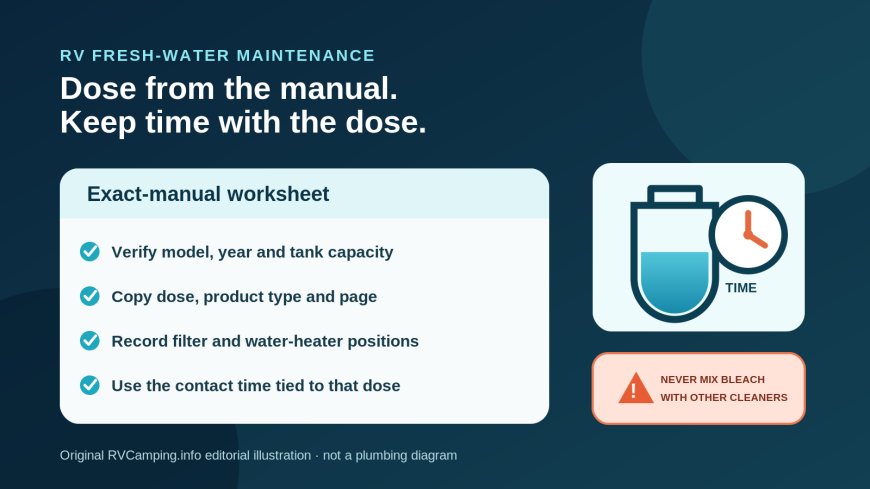
Write these items on one card:
- RV make, model, model year and floorplan.
- Manual title, revision or document number, URL and page number.
- Fresh-water tank capacity for the exact unit. Do not add gray capacity, black capacity or a marketing number called “total water.”
- Bleach description and concentration required by the manual, if the manual states one.
- Dose basis exactly as printed.
- Required contact time and any alternate concentration/contact-time path.
- Filter treatment: remove, bypass, replace or another stated action.
- Water-heater position and whether the manual includes or bypasses it.
- Every endpoint the manual says to open, including hot and cold faucets, toilet, shower, exterior shower, spray ports or ice maker if applicable.
- Drain, refill and flushing instructions.
Tank capacity deserves its own line because brochures can list capacities differently, and equipment changes can affect a unit. Jayco’s 2026 Class C manual explicitly says fresh-water tank sizes vary by model and tells owners to contact the dealer or customer service for the specific size.[1] A monitor panel reading is not a substitute for a documented capacity; it estimates level, not design volume.
The manuals show why a universal ratio fails
The following comparison is not a recommendation to use either procedure on a different RV. It is evidence that the whole instruction set matters.
| Manual | Dose language | Contact time | System details that affect the job |
|---|---|---|---|
| 2026 Jayco Class C | Prepare 1/4 cup household bleach in one gallon of water, with one gallon of that solution per 15 gallons of tank capacity, for the manual’s 50 ppm path | At least 4 hours | Turn water-heater power off, drain, close drains, remove the filter from its canister, and bypass the storage water heater; the manual also provides separate paths for units with and without a utility center.[1] |
| 2026 Winnebago Towables | 1/4 cup bleach for every 15 gallons, mixed with one gallon of water | At least 24 hours | Close drains, fill the tank, run every listed hot and cold endpoint until bleach is detected, then drain, refill and flush until the odor is gone; its water-heater section puts bypass valves in the bypass position for sanitizing.[2] |
Both rows mention 1/4 cup and 15 gallons. They do not describe interchangeable procedures. One gives a four-hour 50 ppm path and an alternate higher-concentration path; the other specifies a 24-hour hold. Their valve panels, filters and water-heater instructions also differ.[1][2]
Bleach products differ too. CDC says regular unscented household bleach commonly contains 5% to 9% sodium hypochlorite and says not to use products with an unspecified percentage, splashless bleach or inappropriate laundry bleach for disinfection.[3] EPA’s emergency-water guidance similarly rejects scented, color-safe bleach and bleach with added cleaners.[4] Those agencies supply useful product-safety boundaries; they do not replace the RV manual’s dose.
Calculation worksheet: use only the manual’s variables
Complete this worksheet only after the manual match is documented. If the manual does not provide a dose formula, do not manufacture one from this example.
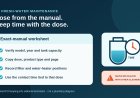
Manual-qualified worksheet
- Verified tank capacity, T: ______ gallons
- Manual’s capacity block, B: ______ gallons
- Manual’s bleach amount per block, D: ______ cup, ounce or milliliter
- Number of blocks, N = T ÷ B: ______
- Bleach amount, N × D: ______
- Dilution-water amount stated by manual: ______
- Contact time tied to this exact dose: ______
- Bleach type/concentration accepted by manual or confirmed by manufacturer: ______
- Filter position: ______
- Water-heater position and power state: ______
- Page/revision checked: ______
For a worked arithmetic example only, suppose the exact applicable manual states the same basis printed in the two manuals above and the verified tank is 30 gallons. The worksheet gives 30 ÷ 15 = 2 blocks, then 2 × 1/4 cup = 1/2 cup. That calculation does not choose a contact time, approve a bleach formulation or decide the valve positions. The controlling manual still supplies those fields.[1][2]
Do not “correct” a manual’s dose because a different bottle has a different percentage. If the manual is silent about concentration or your bottle does not match its wording, ask the RV manufacturer which currently sold product strength its procedure assumes. Do not solve the ambiguity by adding extra bleach.
A manual-first work sequence
1. Prepare the RV and the work area
Park where draining chlorinated water is allowed. Some campgrounds prohibit discharging it onto the site or into a storm drain. Keep children and pets away. Ventilate the RV. Turn off the water heater before draining or changing valve positions, and never energize a storage water heater unless it is full. Copy the exact valve names from your manual instead of relying on memory.
Read the bleach label before measuring. Use regular, unscented bleach that fits the manual and label directions. Never use scented, color-safe, splashless or added-cleaner bleach as an improvised substitute. Never mix bleach with another cleaner or disinfectant.[3][4]
2. Drain and configure exactly as directed
Follow the manual’s drain sequence. Close the drains it tells you to close before drawing or pouring solution. Set the water-heater bypass exactly as shown for your plumbing layout. Handle filters as directed. Jayco, for example, calls for removing the full-system filter and reinstalling the empty canister, while its storage water heater is bypassed during the cited procedure.[1] That is a model-family instruction, not a general rule for every RV.
Do not pour concentrated bleach straight onto a tank fitting or plumbing component unless the exact manual explicitly instructs that method. The cited manuals call for mixing the measured amount with water before introducing it.[1][2]
3. Fill and distribute the solution
Add the prepared solution by the route specified for your layout: gravity fill, sanitizing siphon, filter canister or another manufacturer-defined route. Fill as instructed without walking away from a pressurized fill.
Use the pump and open each endpoint in the sequence named by the manual. “Kitchen faucet done” does not mean the system is done. The Winnebago procedure names hot and cold faucets, the shower, exterior shower and spray ports.[2] Jayco’s procedure includes hot and cold faucets, the toilet and the outside shower where equipped.[1] Make a checklist for your installed endpoints so one branch does not stay untreated.
4. Start the clock only when distribution is complete
Record the time after the manual’s endpoint condition has been reached and the faucets are closed. Keep the pump state exactly as directed. Do not shorten a four-hour hold because another manual mentions a stronger solution, and do not turn a 24-hour instruction into an overnight guess. Dose and time travel together.
5. Drain, refill and flush
Drain to an approved location, refill with potable water, and flush every endpoint the manual names. Repeat only as the manual directs. Restore filters and water-heater valves in the required order. Confirm the water heater is full before restoring its power.
Never add vinegar, ammonia, detergent, acid, another sanitizer or a deodorizer to a system that contains bleach. “Neutralizing” by mixing chemicals can create hazardous vapors. If a manual contains a separate post-flush treatment, follow its separation, draining and rinsing steps exactly, but never combine it with bleach.[3]
Stop conditions
Stop the job and get manufacturer or qualified-service help when:
- the tank capacity cannot be verified for the exact unit;
- the manual’s plumbing diagram does not match the installed valves;
- a filter, water heater, hydronic system, ice maker or washer is not addressed;
- the bleach percentage or product type does not match the manual or label;
- concentrated bleach was accidentally added where the manual did not allow it;
- the tank may contain an unknown chemical or non-potable antifreeze;
- a strong chlorine odor remains after the prescribed flushing;
- water remains discolored, cloudy, oily or unusually odorous; or
- anyone develops coughing, breathing trouble, eye irritation, nausea or other symptoms while chemicals are in use. Move to fresh air and seek appropriate emergency or poison-control advice.
Keep a maintenance record
Record the date, odometer if useful, manual revision, verified tank capacity, bleach brand and sodium-hypochlorite percentage, measured amount, dilution volume, start and finish times, valve positions, filter action, endpoints flushed and number of potable-water refills. Keep a photo of the bleach label with the record.
That note turns the next sanitizing job into a controlled repeat, but check for a revised manual before reusing it. The useful habit is not memorizing “a quarter cup per 15 gallons.” It is preserving the exact dose, contact time and plumbing configuration as one inseparable instruction set.
Sources
- Jayco, 2026 Class C Owner’s Manual, document 26.2050807.2, sanitizing instructions on printed pages 56–57. Retrieved October 12, 2026.
- Winnebago Towables Owner’s Manual, Model Year 2026, fresh-water system sanitizing on printed page 59 and water-heater bypass discussion on page 61. Retrieved October 12, 2026.
- CDC, Cleaning and Disinfecting with Bleach, bleach product selection, ventilation and chemical-mixing warning. Reviewed April 24, 2024; retrieved October 12, 2026.
- U.S. EPA, Emergency Disinfection of Drinking Water, emergency-use scope, bleach restrictions and limits of disinfection. Modified February 24, 2026; retrieved October 12, 2026.
What's Your Reaction?