

















Before campground check-in: prepare the ID, card, vehicle details and deposit questions
A property-specific front-desk workflow for matching the named guest, payment method, licensed vehicles and authorized occupants while clarifying deposits and card authorizations.


Before campground check-in: prepare the ID, card, vehicle details and deposit questions
By Romana | October 12, 2026 | RV Camping
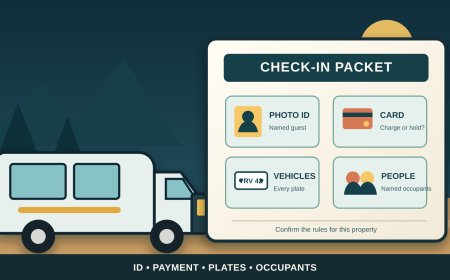
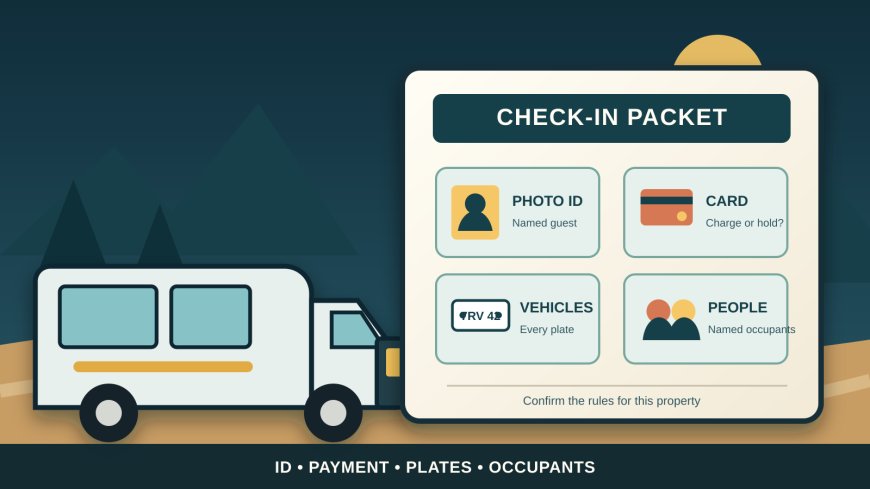
The quickest campground check-in starts before the RV reaches the office lane. Put the reservation confirmation, the right person's photo ID, payment details, license plates and occupant list in one small check-in packet. Then add a short list of money questions. That last step matters because "deposit," "card on file" and "hold" can describe different transactions.
There is no universal campground front-desk rule. California State Parks tells arriving campers to have their confirmation and photo identification ready, while a specific KOA says the named reservation holder must show photo ID and finish check-in before the rest of the party enters.[1][5]
Texas asks for all licensed vehicles during booking; an Oregon state park uses a self-registration envelope with the primary vehicle's plate.[3][8] Treat the reservation confirmation and the property's current rules as the instructions for this stay, not as boilerplate to skim once.
Build one check-in packet
Make a paper sleeve or offline phone note labeled with the campground, arrival date and site type. It should contain:
- the full reservation confirmation, not just a screenshot of the total;
- the reservation number and the name exactly as booked;
- the named guest's unexpired government-issued photo ID;
- the physical payment card requested by the property, plus a different backup payment method if available;
- membership, annual-pass, discount or accessibility documents used for the booking;
- a vehicle sheet with every motor vehicle, RV and licensed trailer; and
- the names and ages or age bands of the people who will occupy the site, if the property requests them.
California's statewide guidance specifically calls for the confirmation and photo ID. It also requires proof for an accessible overnight facility and for reservation discounts where applicable.[1] That is a useful reminder not to bury a pass or eligibility document in the RV after entering a narrow registration lane.
Do not send sensitive documents in an ordinary email unless the campground provides a secure method and explains why it needs them. The packet is for presentation at check-in. A list of plate numbers is usually enough preparation; a campground that needs registration or insurance documents should say so. Thousand Trails' Rondout Valley policy, for example, says staff may ask for valid ID plus the camper's registration and certificate of insurance, and members should carry their membership card.[7] That is a property policy, not proof that every park wants an insurance certificate.
Match the person, reservation and card
Check the reservation name first. If it uses a nickname, a former surname or the name of somebody who will not be there, contact the property before travel and ask how it handles an authorized change. Do not assume another adult can simply show the confirmation and take over.
The reason is visible in official rules. Massachusetts DCR requires the primary occupant's name and address at registration, requires acceptable government-issued ID from that person, and may request ID from other campers age 15 or older. Its rule also makes the primary occupant responsible for occupants and visitors.[4] Elizabethtown/Hershey KOA goes further for its own operation: the guest listed on the booking must show valid photo ID and finish registration before the rest of the party enters the site; cabin guests must also present the card used for the reservation deposit.[5]
For an ordinary arrival, the cleanest setup is:
- reservation, ID and front-desk card all under the same available adult's control;
- any approved name change recorded in writing;
- the cardholder present if the property says the original card must be shown; and
- the rest of the party waiting where staff directs until registration is complete.
This is not a reservation-holder handoff procedure. If the named guest cannot arrive, stop and get the property's authorization process rather than improvising at the counter.
Write a vehicle sheet that reflects the whole rig
A plate list should cover more than the tow vehicle. Record:
- tow vehicle or motorhome: year, make, model, color, state or province, plate;
- travel trailer, fifth-wheel, pop-up or other licensed camping unit: plate and jurisdiction;
- towed car: plate and jurisdiction;
- second or visitor vehicle, if permitted;
- total connected length and RV length as booked; and
- number of vehicles expected overnight.
Texas Parks and Wildlife asks travelers to enter every arriving vehicle's plate during the reservation process. Its FAQ says to enter all licensed vehicles, including RVs, trailers and pop-ups, in the reservation's Site Occupants vehicle section and to respect the selected site's vehicle limit.[2][3] At L.L. Stub Stewart State Park in Oregon, a reserved camper writes the site, name and primary vehicle plate on a self-registration envelope; one vehicle is included, while additional vehicles register and pay separately.[8]
Those systems illustrate why "our plate" is not specific enough. A towable can have its own plate. A towed car can count as another vehicle. The nightly price may include only one vehicle even when the physical pad can hold more. California State Parks says its camping fee covers a single motor vehicle plus a trailer or vehicle being towed legally; other vehicles cost extra per night. It also warns that space for two vehicles does not mean both are included in the fee.[1]
Before arrival, compare your sheet with three different limits: vehicles permitted on the site, vehicles included in the rate and vehicles that may be parked elsewhere for an extra fee. They are not the same question.
Count the people who are actually staying
List every overnight occupant under the correct site or cabin. Include children in the count even when they camp free, and mark any day visitors separately. Ask whether the property wants legal names, age bands, vehicle assignments or wristband information.
Do not infer an occupancy rule from another campground in the same brand. At Elizabethtown/Hershey KOA, a site or cabin reservation includes two adults and two children, with extra-person and extra-vehicle fees described separately.[5] Rondout Valley describes four people as the usual capacity for its RV sites and lodging, then applies a daily guest fee above that number.[7] Massachusetts DCR requires the names of all occupants at registration.[4] These policies do not create a national four-person rule. They show what must be checked: maximum occupancy, guests included in the quoted price and which people must be named.
If friends have their own reservation, keep each party's occupants and vehicles attached to the correct booking. A group label does not turn several bookings into one registration.
Separate the three money questions
Campground confirmations often use similar words for different things. Ask staff to identify each transaction plainly.
1. What has already been charged? A booking deposit is money captured when the reservation is made. KOA's general FAQ says a standard reservation deposit is usually one night's stay, while some holiday or special-event reservations may be charged in full; it directs campers to the individual campground for specifics.[6] Texas State Parks uses a different model and collects the reservation's total cost, including entrance fees, when the booking is completed.[3]
2. What balance will be charged, and when? The answer may be at check-in, before arrival or on another schedule. Rondout Valley says the card may be charged before arrival up to a one-night rack-rate deposit and that the remaining balance is due before arrival.[7] Your confirmation should show what this reservation actually received and what remains.
3. Is there a separate authorization hold or damage authorization? A pending authorization can reduce available credit without being a completed charge. A card-on-file agreement may instead authorize later charges for unpaid amounts, damages or expenses. Rondout Valley's published terms authorize expenses from the stay to be charged to the card or applied against deposited funds.[7] Elizabethtown/Hershey KOA says lodge and cabin guests need a card on file for damages.[5] Neither statement establishes the amount or release timing of a temporary hold.
Ask these exact questions:
- Is this a completed charge, a refundable deposit or a temporary authorization?
- What amount will appear today?
- If it is an authorization, when does the campground release it after checkout?
- Can my bank take longer to restore available funds?
- What damage, cleaning, key, gate-card, pet or extra-vehicle charges can be added?
- Must the card be credit rather than debit?
- Must the cardholder and physical card be present?
- Which payment method receives any refund?
- Can I get the answer and receipt in writing?
Do not tell readers that a hold always disappears in a fixed number of days. The property controls when it releases an authorization; the card issuer's posting time is a separate variable. If available credit is tight, ask before entering the arrival lane and use a payment method that can absorb the stated amount.
Add a one-minute property-rules record
The front desk is the place to close the gaps left by a generic checklist. Record the staff answer, date and where the rule appears for:
- site number and registered vehicles;
- names or count of authorized occupants;
- amount paid, balance due and receipt number;
- any deposit or authorization amount and stated release process;
- vehicle passes, gate cards, keys or wristbands issued;
- extra-person, visitor and extra-vehicle fees;
- pet registration or documentation;
- quiet hours, generator hours and checkout time; and
- where overflow vehicles, trailers and visitors may park.
California tells campers to use the individual park page for the applicable headcount, animal and other important rules.[1] KOA's general deposit answer likewise sends guests to the individual campground for reservation charges.[6] The practical rule is simple: brand-level or statewide pages establish a baseline, but the confirmation and local property page decide the details you need to write down.
Save the final receipt and photograph any issued parking tags before putting them on the windshield. If staff changes a vehicle, occupant or payment detail, ask for the updated reservation or receipt. That creates a short record both the traveler and campground can use later without turning check-in into a contract negotiation.
The five-minute pre-arrival check
Before pulling into the registration lane, one adult reads this list aloud:
- Correct named guest is present with photo ID.
- Confirmation opens without cell service.
- Requested physical card and backup payment method are reachable.
- Discount, membership and accessibility proof are reachable.
- Every licensed vehicle and trailer is on the vehicle sheet.
- Occupant list matches who is staying tonight.
- The three money questions are ready: charged, due and held.
- Local rules page or confirmation has been reviewed.
- Pen or phone note is ready for the answers and receipt number.
That packet will not make every campground policy identical. It does something more useful: it exposes the mismatch before the front desk has an RV idling outside. The goal is a documented check-in for this property, with the right person, the right credentials, a complete rig record and no mystery about what the card is being asked to cover.
Source note: This is a research-based editorial workflow. It does not claim firsthand check-in experience. Policies were reviewed on October 12, 2026 and can change; confirm the current reservation notice and property rules before arrival.
Sources
- Camping Information & Reservations Policies | California State Parks — Statewide check-in documents, vehicle-fee scope and direction to review park-specific rules; captured October 12, 2026.
- Park Reservations | Texas Parks and Wildlife Department — Reservation inputs, payment cards and request for all vehicle plates; captured October 12, 2026.
- Reservations FAQs | Texas Parks and Wildlife Department — Licensed-vehicle entry, site limits, full payment and confirmation contents; captured October 12, 2026.
- 302 CMR 12.00: Parks and Recreation Rules | Massachusetts DCR — Primary-occupant identification, occupant names and responsibility under section 12.08; browser/indexed evidence captured October 12, 2026.
- General Campground Information | Elizabethtown / Hershey KOA — Property-specific named-guest, ID, payment-card, party-access and occupancy terms; captured October 12, 2026.
- Why am I being charged before arrival? | KOA FAQ — General deposit explanation and direction to check the specific campground; captured October 12, 2026.
- Rondout Valley RV Campground Policies | Thousand Trails — Property-specific ID, camper documents, deposit schedule, card authorization and guest count; captured October 12, 2026.
- L.L. Stub Stewart State Park | Oregon State Parks — Self-registration, primary plate and additional-vehicle procedure; captured October 12, 2026.
What's Your Reaction?