



















RV carbon monoxide alarm: test, replace or troubleshoot?
Identify an RV carbon monoxide alarm pattern, respond to a sounding alarm, test by the exact manual, separate power trouble from end of life, and know when replacement or qualified inspection is required.

RV carbon monoxide alarm: test, replace or troubleshoot?
By Romana | October 12, 2026
A carbon monoxide alarm that starts beeping at 2 a.m. creates a bad decision point. Is it warning about CO, asking for a battery, reporting a fault, or announcing that its sensor has aged out? The safe answer does not come from the volume, your nose, or a generic chart. It comes from the exact sound-and-light pattern in the manual for that alarm.
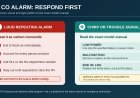
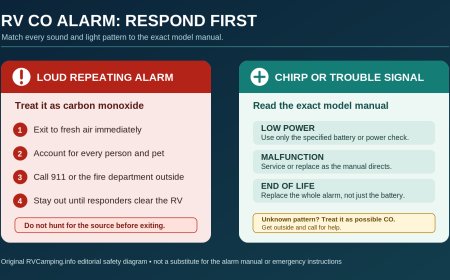
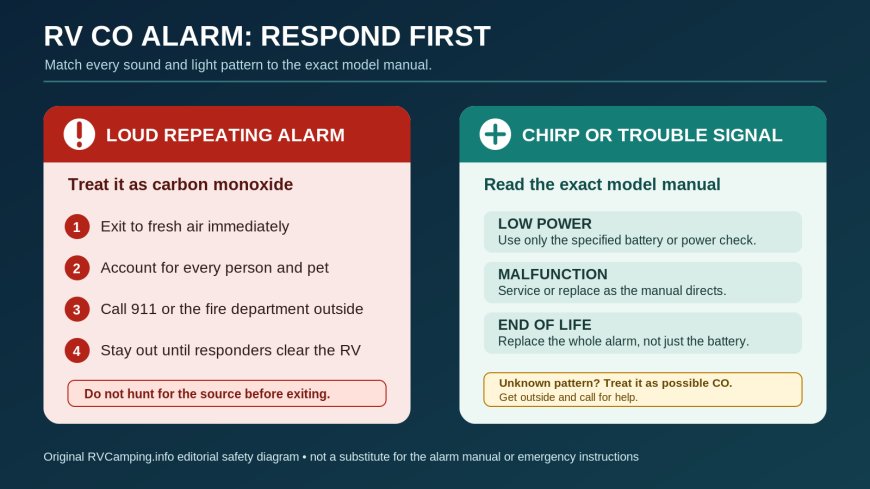
Treat a repeating CO alarm pattern as an emergency, not a maintenance puzzle. Get everyone into fresh air, account for every person and pet, call 911 or the local fire department from outside, and stay out until responders say it is safe to return. CPSC's current advice is blunt: never ignore an alarm; get outside immediately and then call 911.[1] Do not spend those first minutes pulling batteries, opening access panels, hunting for an appliance, or pressing buttons until the cabin goes quiet.
This guide helps after immediate safety is handled. It separates a routine test, a low-power warning, a malfunction signal, and an end-of-life notice. It also explains when the alarm itself needs replacement and when the RV's fuel-burning equipment needs qualified inspection.
First, identify the sound before touching anything
CO alarms do not share one universal chirp code. Even alarms from the same maker can use different patterns. A four-beep sequence may be a CO alarm on one unit, while the number and timing of chirps for low battery, malfunction, and end of life vary by model.
Stand outside the RV if an alarm has sounded. From a safe location, use a photo of the alarm face or your RV records to find the brand, model number, manufacture date, installation date, power type, and user manual. If you cannot confidently match the signal to the manual, treat it as a possible CO event and call the fire department. NFPA advises checking a trouble signal for low batteries, but says to call the fire department if the signal continues.[2]
A useful record for each RV alarm includes:
- a clear photo of the front and label;
- the exact model and approval markings;
- the installation and replace-by dates;
- whether it uses a replaceable battery, sealed battery, or RV 12-volt supply;
- the manual's patterns for CO, low power, malfunction, and end of life; and
- the test interval and cleaning directions.
Keep that record where it can be reached without entering the RV. A phone photo and a copy in the tow vehicle are more useful during an alarm than a manual stored in an overhead cabinet.
If the CO alarm pattern sounds
Leave. Bring people and pets only if they are within reach on the way out. Do not delay evacuation to shut down a furnace, generator, water heater, stove, engine, or battery system. Once outside, count everyone and call emergency services. Stay in fresh air and do not re-enter because the horn stopped, because a window is open, or because nobody feels ill. NFPA says to remain outside until emergency personnel declare it safe to return.[2]
The alarm's silence button is not a repair. First Alert says its silence feature does not correct a CO problem and warns against removing the battery to quiet the horn.[4] Some manuals include a test/mute step in their response sequence, but muting never replaces evacuation or the emergency call. If a button must be pressed to help identify the signal, do that only if it does not delay getting out and the exact manual calls for it.
Do not reset the alarm repeatedly to see whether it comes back. Do not carry it outside as a way to make the sound stop. The sensor reports the air where it is installed, and moving or disabling it removes information responders may need.
If anyone has headache, dizziness, nausea, confusion, unusual fatigue, vomiting, chest pain, or loss of consciousness, tell the dispatcher that CO exposure is possible. Follow the dispatcher's medical instructions. Do not drive an impaired person yourself unless emergency services direct you to do so.
Test: use the button and the model's schedule
Testing checks whether the alarm can power up and produce its intended electrical, visual, and audible response. It does not prove that every part of the RV is free of CO, and on some models it does not expose the sensor to test gas.
NFPA recommends testing CO alarms at least monthly and replacing them according to the maker's instructions.[2] RV-specific manuals may call for more frequent checks. The SAFE-T-ALERT 65 Series manual says to test after storage, before each trip, and at least weekly during use. It also states that the test button checks the alarm circuit rather than the sensor.[3] First Alert's CO250RVA manual calls for weekly button testing.[4]
Use the stricter schedule in the exact alarm and RV manuals. For a button test:
- Read the model's test section before pressing anything.
- Warn occupants, protect anyone sensitive to loud noise, and stand back as directed.
- Confirm normal power indication first.
- Press and hold the test button exactly as instructed.
- Compare both the horn pattern and indicator lights with the manual.
- If it fails, follow only the manual's basic power and cleanliness checks. Replace the alarm if the manual directs replacement.
- Record the date and result.
Never test a CO alarm with vehicle exhaust, a camp stove, a candle, a grill, a generator, or another improvised combustion source. The SAFE-T-ALERT manual explicitly says not to generate CO to test the alarm.[3] First Alert warns that vehicle exhaust can permanently damage its unit.[4] If the maker specifies a calibrated aerosol test product and procedure, leave sensor verification to a qualified RV service provider or follow the manufacturer's directions without improvisation.
Replace: age, end-of-life signal, failed test, or fault
The sensor does not last forever. Replace the complete alarm by the deadline printed on the unit or stated in its manual, even if the test button still produces noise. The button test and sensor service life answer different questions.
Model-specific examples show why the label matters. The SAFE-T-ALERT 65 Series manual gives its sensor a five-year service life and describes an end-of-life pattern of red-red-green-green flashes with a beep every 25 to 30 seconds.[3] The First Alert CO250RVA manual gives its alarm a seven-year replacement interval and describes five chirps per minute as end of life.[4] Those examples are not interchangeable codes for other alarms.
Replace the alarm when any of these applies:
- its replace-by date has arrived or its age cannot be established;
- the manual's end-of-life signal occurs;
- it fails the prescribed test after the manual's permitted battery or cleaning checks;
- its manual identifies the pattern as malfunction or service required;
- the case, sensor openings, wiring, connector, battery contacts, or mounting are damaged; or
- contamination, water intrusion, paint, cleaning spray, or physical impact may have compromised it.
An end-of-life hush is only a short replacement window. It is not added service life. SAFE-T-ALERT allows its named EOL signal to be reset for 72 hours at a time, for up to 30 days, while the First Alert model allows its EOL chirp to be silenced for about two days.[3][4] Arrange replacement immediately and do not occupy the RV without working CO protection.
Choose a replacement approved for RV use and compatible with the original installation, supply voltage, mounting location, wiring, and any interconnect or control functions. Do not assume a household alarm is a direct substitute for a hardwired RV alarm. If the old unit controls a relay, generator shutdown, solenoid, or other system, have the RV maker, alarm maker, dealer, or qualified RV technician specify and install the correct replacement. Do not splice unfamiliar wires or bypass a relay to stop a trouble signal.
Troubleshoot only power, dates, and permitted cleaning
Troubleshooting should be narrow. The goal is to decide whether normal power can be restored as the manual allows or whether the alarm must be replaced. It is not an invitation to open the case, alter a sensor, bridge wiring, defeat a buzzer, or change a fuse rating.
For a replaceable-battery alarm, verify the exact battery type and polarity named in the manual. Install a fresh listed battery, close the cover fully, and run the prescribed test. First Alert distinguishes one chirp per minute for low battery, three chirps per minute for malfunction, and five chirps per minute for end of life on the CO250RVA.[4] A new battery addresses only the low-battery condition. It does not cure a malfunction or reset sensor age.
For a 12-volt hardwired RV alarm, loss of the green normal indicator may point to coach power, a fuse, wiring, polarity, or a depleted battery on the circuit. The SAFE-T-ALERT 65 Series troubleshooting chart lists those possibilities, but its manual also says not to attempt internal repair.[3] Check only owner-accessible items that the RV and alarm manuals explicitly permit, such as the battery disconnect position or the identified fuse. If power is present and the alarm still shows a fault, arrange service or replacement.
Clean only as directed. A soft brush vacuum attachment may be allowed for dust. Sprays, solvents, wax, paint, compressed air, and water can damage or contaminate some sensors.[3][4] Never cover the openings to stop a nuisance signal.
Check fuel-burning sources after responders clear the RV
Replacing an old or faulty alarm does not explain a genuine CO event. After emergency personnel clear the RV, keep suspect equipment off until a qualified technician has inspected it. Give the technician the alarm model, pattern, time, weather, nearby equipment, symptoms, and any peak-memory reading. Do not erase stored readings until responders or the technician have seen them.
Potential RV sources include the furnace, water heater, range or oven, built-in or portable generator, vehicle engine, and damaged exhaust or venting. CO can also enter from a neighboring generator, an idling vehicle, a grill, or another RV. The SAFE-T-ALERT manual specifically lists engine and generator exhaust, furnaces, stoves, ovens, portable heaters, grills, nearby RVs, and venting problems among possible sources.[3]
Look from outside for information, not for a do-it-yourself repair: a generator placed near an opening, exhaust aimed toward the site, a blocked appliance vent, storm debris, snow, or a neighboring engine running nearby. CPSC specifies at least 20 feet of separation between a portable generator and a home or building; its exhaust should point away from doors, windows, and vents.[1] At a campground, wind and close spacing can still carry another source's exhaust toward an RV.
A technician should evaluate the fuel-burning equipment, exhaust route, combustion air, venting, seals, and operating conditions. Do not restart a suspected appliance merely to reproduce the alarm. A transient event may have cleared before help arrived; that does not prove the original alarm was false.
Make the next alarm easier to handle
Before the next trip, write the four relevant signal patterns on a card: CO alarm, low battery or low power, malfunction, and end of life. Add the alarm's replacement date, emergency number, campground address, and site number. Store spare batteries only if the model uses replaceable batteries, and use the exact type listed in its manual.
Test on the maker's schedule, after storage, and before travel when the RV manual requires it. Inspect dates at the start of each season. Most of all, agree on the response before anyone is sleepy or disoriented: a CO alarm means everyone exits, gathers in fresh air, calls for help, and waits for clearance. Silence comes after safety, not before it.
Sources
- U.S. Consumer Product Safety Commission, "CPSC Warns of Generator, Carbon Monoxide and Fire Hazards Ahead of Hurricane Season" — Alarm response and portable-generator placement guidance; consulted October 12, 2026.
- National Fire Protection Association, "Keeping Your Community Safe with Carbon Monoxide Alarms" — Testing, replacement, trouble-signal, evacuation, and re-entry guidance; consulted October 12, 2026.
- MTI Industries, SAFE-T-ALERT 65 Series RV Carbon Monoxide Alarm User's Manual — RV-specific test, power, malfunction, end-of-life, care, alarm-response, and source guidance; consulted October 12, 2026.
- First Alert, CO250RVA Battery Powered Carbon Monoxide Alarm User's Manual — Battery, signal-pattern, test, silence, replacement, and troubleshooting instructions; consulted October 12, 2026.
What's Your Reaction?