




















Mopeka Pro Check Universal review: useful propane level data, not a leak detector
Research-based Mopeka Pro Check Universal review covering steel-tank fit, setup sensitivity, model-number conflicts and propane safety limits.

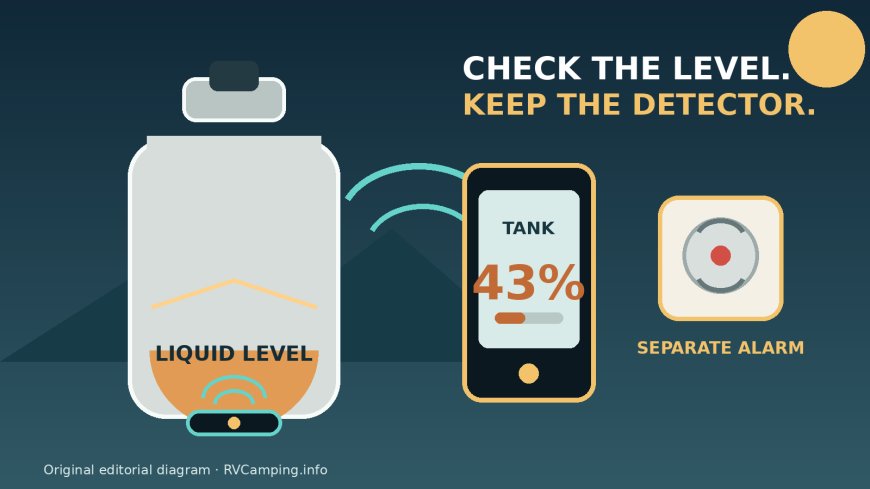
The Mopeka Pro Check Universal is worth considering if you use enough propane that an unexpected empty cylinder would disrupt a trip, especially in cold weather or while boondocking.[4][5] The reviewed steel-tank sensor sits under a compatible cylinder, measures liquid height with ultrasound, and sends the reading to a phone over Bluetooth.[1][7]
Buy it if your RV has an accessible steel propane cylinder or tank, enough clearance under the foot ring, and a flat bottom-center spot where the sensor can make clean contact.[1][2] Skip it if the tank is composite, the bottom is inaccessible, you want a no-phone gauge without buying the optional display, or you expect the sensor to warn of a propane leak.[1][6] It measures liquid level.[1][7] It is not a gas detector.[1][6]
The central tradeoff is convenience versus installation sensitivity. Mopeka claims 99.5% accuracy for the Universal generation, but that number comes from the manufacturer and assumes the right tank profile, location, contact, and setup.[1][2] Owner reports are mixed: some describe dependable readings, while others trace erratic readings to placement, battery condition, grease, or a sensor that needed replacement.[4][5]
This is a research-based review. RVCamping.info did not purchase, install, use, or physically test this sensor.
Exact model, Amazon ASIN, and a part-number mismatch
This review covers the North American Mopeka Pro Check Universal for steel tanks, which Mopeka currently identifies as part M1017023.[1] The matched Amazon listing is ASIN B0C7HJ9J14 and presents the steel propane-tank variant in the Universal family.[3]
There is one identity problem worth seeing before checkout.[1][3] The Amazon product data exposed during research lists item model M1017020, while Mopeka's current steel-tank page says M1017023.[1][3] Those numbers should not be silently treated as interchangeable.[1][3] Confirm that the seller is shipping the current North American Pro Check Universal steel-tank package, with the magnetic sensor, grease packet, and spacers, rather than an older Pro Check or the collar-mounted aluminum/plastic version.[1][3]
As an Amazon Associate, RVCamping.info earns from qualifying purchases. If you buy through an Amazon link in this article, we may earn a commission at no additional cost to you.
Check the Mopeka Pro Check Universal steel-tank sensor on Amazon
If the listing still shows M1017020, ask the seller to confirm the manufacturer part on the box before ordering.[1][3] The ASIN identifies the reviewed listing, but the current manufacturer part number remains M1017023.[1][3]
Verdict: good information when the installation is good
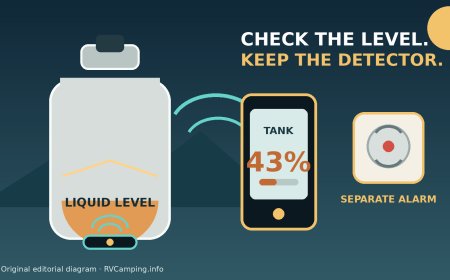
A propane cylinder's pressure does not tell you its remaining liquid volume in a simple, useful way.[6] The Mopeka sensor instead sends an ultrasonic pulse through the tank bottom and estimates the liquid height from the return signal.[2][7] Nordic Semiconductor described that architecture for the older Pro Check generation, including its Bluetooth Low Energy connection to the app.[7] The Universal model keeps the bottom-mounted sonar idea but adds a bubble-level tool, temperature sensing, configurable sampling, firmware updates, and more supported liquids.[1]
For an RV with two 20-, 30-, or 40-pound steel cylinders, the practical benefit is obvious.[2] You can label each sensor in the app and check which cylinder is low without lifting it or pouring warm water down the side.[1] Mopeka also lists horizontal and vertical tanks, which can make the sensor useful on an accessible motorhome ASME tank.[1][2]
The catch is that ultrasound needs a clean path.[2][7] A sensor that is off center, tilted, separated from the tank by rust or debris, short of coupling grease, or configured for the wrong tank can still produce a confident-looking percentage.[1][2] Owner discussions repeatedly mention readings improving after correcting those details, while a few owners report replacements or continuing inconsistency.[4][5]
Treat the display as a planning instrument rather than an unquestionable fuel meter.[4][5] A stable trend over several readings is more useful than one percentage captured immediately after towing, refilling, or moving a cylinder.[4][5]
Compatibility starts with the tank, not the app
The exact sensor in this review uses magnets and is intended for steel tanks.[1][2] Do not buy it simply because the product family says "Universal."[1] Mopeka sells a different collar-mounted package for aluminum, plastic, and poly tanks.[1][2] The manufacturer's current table does not support fiberglass tanks for this steel package.[1]
Check these boundaries before ordering:
- Tank material. A magnet should attach firmly to the intended bottom location. If the tank is aluminum or another nonmagnetic material, use the correct Mopeka sensor and collar package instead of improvising adhesive around the steel-tank version.[1][2]
- Bottom access. The sensor must sit at the bottom of the tank.[1][2] A permanently enclosed ASME tank may have no safe working room, even though its material and capacity otherwise look compatible.
- Foot-ring clearance. Portable cylinders can sit too close to the tray or ground for the sensor. The reviewed package includes spacers, but you still need to check that the cylinder remains stable and properly restrained.[2][3]
- Tank shape. The manufacturer lists vertical and horizontal tanks, but the sensor still needs a bottom-center position and the correct profile in the app.[1][2]
- Travel retention. Magnets are convenient, not a reason to ignore rough roads.[1] Confirm that the sensor cannot strike the tray, wiring, regulator, or adjacent cylinder.[1] Recheck it after the first trip and whenever a cylinder is exchanged.[1]
- Region and app. Mopeka identifies the reviewed package as a North American and non-European/UK model. The regional versions are not presented as interchangeable.[1]
Mopeka's current product page says the steel sensor fits tanks up to 250 gallons.[1] A downloadable specification sheet still says less than 1,000 gallons and up to 48 inches in diameter.[2] That is a live documentation conflict.[1][2] For an ordinary RV cylinder the difference is academic, but owners of larger ASME tanks should use the current 250-gallon page limit and confirm the exact installation with Mopeka rather than relying on the older, broader PDF figure.[1][2]
Install it like a sensor, not a refrigerator magnet
The first setup deserves more care than the marketing photos suggest.[1][2]
- Close the propane service valve and follow the RV and cylinder maker's handling instructions before moving a portable cylinder.[6]
- Inspect the cylinder. Do not install an accessory over severe rust, a damaged foot ring, a bulge, a gouge, or any area that needs a propane professional's attention.[6]
- Clean the bottom-center contact area.[2][4] Remove loose dirt and debris without grinding, drilling, or altering the pressure vessel.[6]
- Install a fresh CR2032 battery if the supplied battery condition is uncertain, then pair the sensor before putting the cylinder back into a tight tray.[2]
- Apply the supplied dielectric or sonic coupling grease to the sensor pad as directed. The grease is part of the ultrasonic path, not optional cosmetic paste.[1][2]
- Center the sensor and use the app's level indicator. A horizontal tank also needs the sensor aligned at the lowest center point.[1]
- Select the correct tank profile and size in the app.[1] Name dual cylinders "curb" and "road" or another label that remains obvious after they are swapped.
- Return the cylinder to its proper upright, restrained position.[6] Check that the spacer arrangement leaves room for the sensor without making the cylinder unstable.[2][3]
- Wait for the liquid to settle, then compare several readings.[4] A reading taken seconds after moving or filling the cylinder can be less useful than one taken later.[4]
- Inspect the installation after travel.[1][4] Look for a shifted sensor, lost grease contact, damaged spacers, trapped debris, or a weakened Bluetooth connection.[1][4]
If the reading is implausible, do not start by changing the displayed percentage to what you expected. Check contact quality, center position, level, battery, tank profile, and app freshness. Owner reports suggest those details explain some failures, but not all of them.[4][5]
What 99.5% accuracy does and does not promise
Mopeka markets the Universal model at 99.5% accuracy, and its specification sheet expresses the claim as within plus or minus 1% of actual tank level.[1][2] Those are manufacturer claims, not results from our own bench test.
A percentage can also be more precise than the underlying situation deserves.[4][5] Propane moves in a cylinder.[4] Temperature changes the liquid volume.[1] The bottom shape may not convert liquid height into remaining pounds with perfect linearity.[4][5] The app's selected geometry matters.[1] A sensor can therefore repeat a liquid-height measurement well while the displayed "percent full" still needs interpretation.[4][5]
Independent owner evidence is useful because it exposes failure modes, but it is not a controlled validation. In an Airstream discussion, some owners describe false or changing readings, battery sensitivity, and improvement after correcting grease or placement; others report years of useful service.[4] A 2026 Jayco discussion likewise includes both an accurate installation and a warranty replacement.[5] Those reports support a cautious verdict: good setup can produce useful information, but the purchase does not guarantee laboratory-grade accuracy on every RV tank.
A simple field check is more persuasive than the app alone.[4][5] Record the reading before refill, note how much propane the dispenser adds, and compare the new reading after the cylinder settles.[4][5] Repeat over several fills.[4][5] Portable cylinders can also be weighed on a suitable scale using the stamped tare weight, provided you can handle them safely.[6] You are looking for consistent trends and an honest low-fuel warning, not a perfect single decimal.[4][5]
Bluetooth, displays, and remote checking
The sensor broadcasts locally over Bluetooth.[1][7] That is enough when you are near the RV with a compatible phone or tablet.[1][7] A steel compartment, distance, and the RV body can shorten practical range, so test from the seat or bed where you expect to check it.[4][5]
Mopeka also supports separate displays and a Wi-Fi bridge in the broader ecosystem.[1] Those accessories solve different problems.[1] The display is useful if you do not want to open a phone app.[1] A bridge can provide readings away from the RV, but it adds power and network dependencies.[1] The single ASIN reviewed here should not be assumed to include either one.[3]
The manufacturer rates battery life at three to five years and identifies a replaceable CR2032 cell.[2] Sampling settings, temperature, radio conditions, and battery quality can affect real life.[1][2] Check battery status before a cold trip and carry a reputable spare rather than treating the upper estimate as a replacement schedule.
This is not a propane leak detector
A falling level may prompt an investigation, but the sensor is not designed to identify propane vapor, locate a leak, close a valve, or prove the system is safe.[1][6] A slow appliance load and a leak can both reduce tank contents.[6] A small leak may be dangerous before a tank-level trend becomes obvious.[6]
The Propane Education & Research Council says a dedicated propane alarm can catch leaks that occupants do not smell and recommends following the detector manufacturer's installation and care instructions.[6] It also calls for connection leak checks when a cylinder is connected.[6] Keep the RV's approved propane alarm operational, replace it on schedule, and treat a gas odor or alarm as an emergency.[6] Do not wait for the Mopeka percentage to change.[6]
The same boundary applies to refilling.[6] The sensor does not replace cylinder inspection, requalification rules, overfill protection, a qualified fill operator, or the fixed maximum-liquid-level equipment on an ASME tank.[6]
Generation and documentation traps
Search results mix at least three identities: the older Pro Check, the current Pro Check Universal, and separate material-specific Universal packages. Older reviews remain useful for understanding bottom contact, grease, Bluetooth, and battery issues, but their range, battery life, firmware, and app behavior may not describe the current model.[4][7]
The current documentation also disagrees on maximum tank size. The live product page says 250 gallons, while the PDF says less than 1,000 gallons.[1][2] Use the narrower current limit unless Mopeka confirms otherwise for your exact tank.
Finally, the Amazon listing's model field does not match the current M1017023 manufacturer page.[1][3] That does not prove the listing is wrong, but it does mean the buyer should verify the package label.[1][3] A photo and title saying "Universal" are not enough when the steel and collar-mounted variants have different hardware.[1][3]
Who should buy it
The strongest use case is an RV that burns meaningful propane for heat, refrigeration, hot water, or cooking and has one or two accessible steel cylinders.[1][4] Winter campers can spot a declining cylinder before a cold night.[4] Boondockers can plan a refill before leaving a service town.[1] Owners with a single ASME tank may gain more value than someone whose automatic changeover regulator already gives ample warning between two easily exchanged cylinders.[1][4]
It also suits people who will spend ten careful minutes on installation and verify the result over a few fill cycles. The sensor rewards attention to contact and geometry.
Who should skip it
Skip it if you use little propane and already manage dual cylinders by refilling the empty side after changeover. The app may add more maintenance than value. Skip it for composite cylinders, inaccessible tank bottoms, or installations where spacers would compromise how the cylinder sits and is restrained.[1][2]
Choose another approach if you need certified leak detection, automatic shutoff, or a permanently installed gauge integrated with the RV's panel.[1][6] This product provides level information.[1][7] It does not take control of the propane system.[1][6]
Bottom line
The Mopeka Pro Check Universal can answer a useful RV question: "How much liquid propane is left without removing the tank?" The current steel-tank version, part M1017023, combines a magnetic bottom mount, ultrasound, Bluetooth, and a replaceable coin cell.[1][2]
Its value depends on the tank and the installation. Confirm steel construction, bottom access, clearance, retention, profile selection, and stable readings. Treat Mopeka's 99.5% figure as a manufacturer claim, not a promise that every curved or weathered tank will read perfectly. Most of all, keep level monitoring separate from propane safety. The sensor may help prevent an inconvenient runout, but only a proper propane detector and sound inspection practices address leaks.[6]
Sources
- Mopeka Pro Check Universal steel tanks, part M1017023
- Mopeka Pro Check Universal specification sheet
- Amazon listing: Mopeka Pro Check Universal steel-tank sensor, ASIN B0C7HJ9J14
- Airstream Forums: Mopeka sensor troubleshooting experiences
- Jayco Owners: Mopeka Pro Check LP tank sensor accuracy
- PERC safety guide for propane users
- Nordic Semiconductor: Mopeka Pro Check ultrasound and Bluetooth architecture
What's Your Reaction?