






Before You Book a Glamping Unit for Kids: The Exact-Unit Worksheet for Mixed RV Groups
A child-by-child booking worksheet for mixed RV and glamping groups to verify beds, raised-sleep limits, heat, alarms, exits, bathroom routes, occupancy, and supervision before payment.

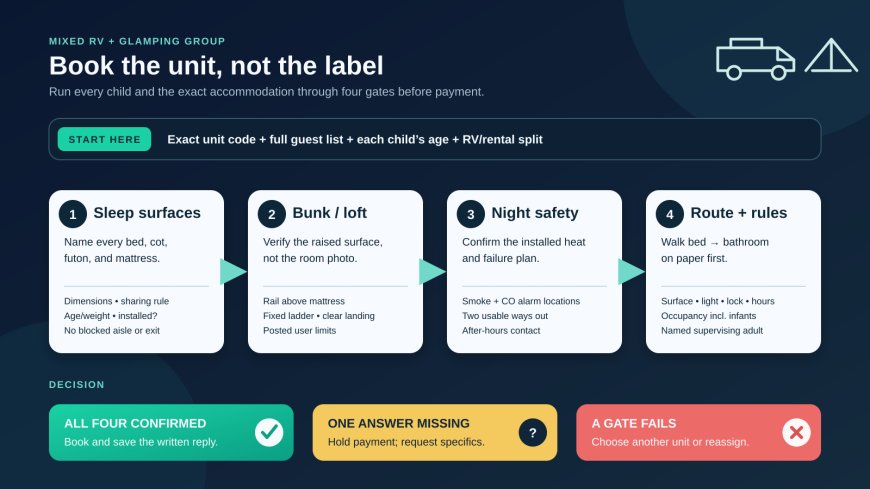
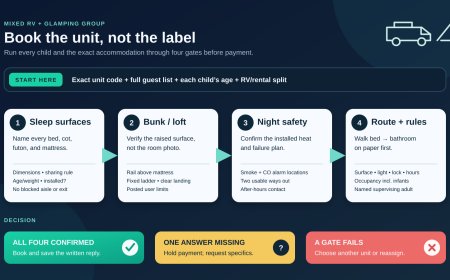
A listing that “sleeps six” does not tell you whether your six people can safely and legally use the beds, loft, heater, exits, and bathroom route. Settle those questions for the assigned unit before the RV group pays.
A mixed group can look easy on a reservation screen: four people in the motorhome, two adults and three children in a glamping cabin. Then the details arrive. One “bed” is an upper bunk the youngest child cannot use. The loft has a ladder but no stated weight limit. The tent’s toilet is down a dark path. The property counts an infant toward occupancy, or requires an adult to accompany children in the bathhouse.
Do not solve those problems by assuming the cabin side works like the RV. The RV and the rental are separate sleeping units with separate limits. Use the worksheet below for the exact rentable unit or unit number, not merely a category photo.
Start with a named-unit sleep map
Write every overnight guest in one row before assigning beds:
| Guest | Age | Sleeping unit | Confirmed sleep surface | Night bathroom plan | Supervising adult |
|---|---|---|---|---|---|
| Adult 1 | RV / rental | ||||
| Child 1 | RV / rental | ||||
| Child 2 | RV / rental |
For each rental surface, record the type, usable mattress dimensions, stated occupancy, and any age or weight limit. “Twin” and “queen” are not enough when a platform has a short mattress, a futon is intended for one adult or two children, or a cot is available only by advance request. Ask whether linens, pillows, and a waterproof mattress cover are provided. If a crib or pack-and-play matters, ask whether it is permitted in that unit and where it fits without narrowing an exit.
One official property example shows why the guest count belongs at the beginning of the search. Wildhaven Yosemite tells guests to enter children during booking, describes different tent choices for one, two, or three to four children, and distinguishes bunks, cots, futons, and loft mattresses.[5] That is useful policy information, but it is not a substitute for confirming the particular option shown in your checkout screen.
Mark a surface unassigned until the operator answers all of these:
- What is the surface: fixed bed, upper bunk, lower bunk, loft mattress, futon, sofa bed, cot, or floor mattress?
- What are the mattress width, length, and maximum permitted thickness?
- Is it already installed in this exact unit, or must it be requested?
- What age and weight limits does the property or bed manufacturer post?
- May an adult use it? May two people share it?
- Does opening the sofa bed or adding a cot block the door, heater clearance, ladder, aisle, or another bed?
A maximum occupancy number is not a bed assignment. If five people are permitted but only four suitable surfaces are confirmed, the unit is not solved.
Put bunks and lofts through a separate gate
A loft marketed as “perfect for kids” still needs a rail, ladder, and user-limit answer. Ask for current photos that show the entire open side, the ladder attachment, the mattress in place, and the route from the ladder to the door. Do not ask a reservation agent to declare the arrangement “safe.” Ask for observable facts and the property’s written restrictions.
CPSC’s bunk-bed compliance manual summarizes federal requirements for covered bunk beds, including guardrails on both sides, rail height measured above the manufacturer’s maximum mattress, and warnings against upper-bunk use by children under six. The instructions also call for one person on the upper bunk and use of the ladder to enter and leave.[1] Those rules are a useful screening baseline, but they do not prove that every built-in loft, platform, or custom glamping structure is a compliant bunk bed.
Use this exact-unit checklist:
- Is this called a bunk bed, sleeping loft, or raised platform by the operator?
- Is there a guard or rail on every open edge? Where are the openings?
- How high is the rail above the supplied mattress, not above the bed frame?
- Is the mattress the specified size and thickness for that structure?
- Is the ladder fixed, and does it have intact rungs and a clear landing?
- What are the minimum age, maximum user weight, and one-person/two-person rules?
- Can the assigned child climb down without passing a heater, stove, glass door, or another sleeper?
- Is there a light or reachable switch for a nighttime descent?
If the operator has no stated age or weight limit, do not invent one from a photograph. Reassign that guest to a verified lower surface or choose another unit. A removable travel rail is not permission to alter rental furniture, and adding a thicker mattress can reduce the effective rail height.
Verify heat, alarms, and two usable ways out
Ask what heat is permanently installed in the exact unit: electric resistance heater, mini-split, vented furnace, wood stove, heated mattress pad, or no heat. Record the operating instructions, overnight-use rule, required clearance, guest-adjustment limit, and who responds after hours. “Heated” should not be the end of the conversation.
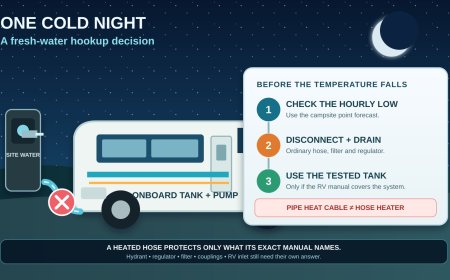
For fuel-burning portable camping equipment, the CPSC warns against using heaters or lanterns while people sleep in enclosed tents, campers, or vehicles because of the carbon monoxide hazard.[3] Do not bring an unapproved heater from the RV to fix an under-specified rental. Confirm the forecast plan and the property’s approved backup: extra bedding, another unit, or cancellation/change terms.
The U.S. Fire Administration’s short-term-rental checklist calls for working smoke alarms in sleeping rooms, CO alarms on every level, two ways out of every room, operable doors and windows that lead outside, and an outside meeting place.[2] Turn that into booking questions rather than assuming a canvas wall is an exit:
- Where are the smoke and CO alarms for this unit, and does each installed fuel-burning appliance affect the alarm plan?
- When were the alarms last tested, and may staff demonstrate the test at check-in?
- What are the primary and alternate exits from each sleeping area?
- Do both exits open without a key, special tool, furniture move, or adult lifting a child from a loft?
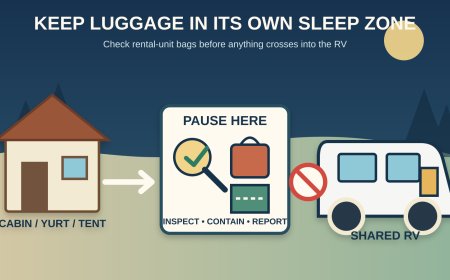
- Does the sofa bed, cot, or luggage placement narrow either route?
- Where is the group meeting point, away from both the rental and the RV?
- What number reaches the night host, and what should guests do if an alarm sounds or heat fails?
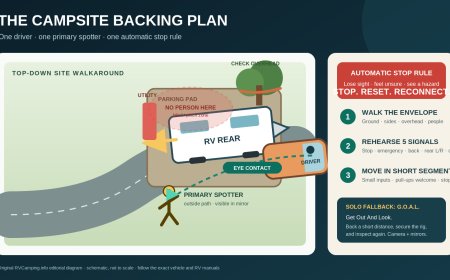
Keep the RV’s escape plan separate. The rental alarm does not warn the RV, and the RV door does not count as an exit for the cabin. Park vehicles, chairs, strollers, and coolers so neither unit’s route is obstructed.
Trace the bathroom trip from pillow to fixture
“Bathroom nearby” is not a route description. Wildhaven Yosemite, for example, says its tent bathhouse is a 30- to 60-second walk while its cabins have private bathrooms.[5] A minute on a level, lit deck is different from a minute across roots, gravel, steps, or a road.
Ask the property to describe or photograph the nighttime path from the exact unit’s door:
- private bathroom, shared bathhouse, vault toilet, or portable toilet;
- distance and realistic walking time;
- steps, thresholds, slopes, boardwalk gaps, loose gravel, roots, mud, and road crossings;
- lighting from the bed to the fixture and whether a flashlight is still needed;
- door width, turning room, grab bars, shower entry, toilet height, and space for a caregiver, if relevant;
- lock, code, key, opening hours, cleaning closures, and an after-hours alternative;
- whether children must be accompanied, and by whom.
For an accessible room, get the reserved unit’s accessibility features in writing. The U.S. Access Board standard for transient lodging illustrates the level of specificity involved: an accessible sleeping area includes clear floor space by the bed, and a covered in-room bathroom includes compliant fixtures and route details.[4] Do not translate “ADA” into a promise about a child’s stroller, a particular mobility device, or the outdoor path without dimensions and current conditions.
The National Park Service’s Yosemite accessibility guide makes the same point in a real lodging setting. It tells guests to describe their specific needs, notes that paths can be uneven or poorly lit, and identifies Curry Village’s accessible heated tent cabins, shared accessible shower/restroom facilities, and a mix of dirt and paved routes.[6] Ask about the whole chain: parking to unit, bed to bathroom, and unit to the group’s RV site.
Reconcile occupancy with supervision rules
Count people the way the property counts them. Send the number of adults, children by age, and infants; ask whether day visitors count; and state which people sleep in the RV versus the rental. Do not move a child from the rental to the RV after booking unless both reservations still comply with their stated occupancy and site rules.
Property rules can be narrower than the number of mattresses suggests. Seward/Lincoln West KOA’s published information, for example, lists a two-person glamping-pod limit and a six-person family-cabin limit, requires an adult with children under 14, and includes additional bathhouse and quiet-hours supervision rules.[7] That example is not a universal KOA policy. It shows why the group must read the rules for its selected property and accommodation.
Get written answers to these questions:
- What is the maximum overnight occupancy of the exact unit, and do infants count?
- Must the reservation holder be a certain age and sleep in the unit?
- May children occupy a separate adjacent tent, loft, or room without an adult? If yes, what ages and conditions apply?
- Do children need an adult on the bathroom route, in the bathhouse, or during quiet hours?
- Are visitors from the RV allowed inside the rental or on its deck, and do they count toward a limit?
- May the group gather at the RV site, or does that site have its own guest cap?
- If two units must each have a supervising adult, which named adults fill those roles all night?
“Adjacent” needs a map or measured description. Two units can share a marketing label and still be separated by a path, vegetation, traffic lane, or other occupied sites.
Copy-and-send booking worksheet
Send this while the reservation can still be changed without a costly penalty:
Our party will place [number] people in an RV and [number] people in the glamping rental, including children ages [ages] and [number] infants. Please confirm these details for accommodation [exact name/unit code]:
1. Maximum overnight occupancy, whether infants count, and the required age/location of the supervising or reservation-holding adult. 2. Every sleep surface, mattress dimensions, sharing rule, and any age or weight limit. For each bunk or loft: rail arrangement, rail height above the supplied mattress, ladder type, and posted restrictions. 3. Installed heater type and model, permitted overnight operation, required clearances, and the approved response if heat fails. Please identify smoke and CO alarm locations and the last test or inspection process. 4. Primary and alternate exits from each sleeping area, whether both can be opened from inside, and whether a deployed cot or sofa bed affects either route. 5. Bathroom type and the door-to-door route: distance, surface, steps/slope, lighting, road crossings, lock/code, hours, and child-supervision rules. Please list the reserved unit’s accessibility features if applicable. 6. Whether RV-site guests may visit or gather at the rental, whether rental guests may gather at the RV, and how day visitors affect each occupancy limit.
Please reply in writing and attach current photos or a floor plan for this exact accommodation if available.
Save the reply, listing, floor plan, cancellation terms, and screenshot of the unit selected at checkout. Label each worksheet line confirmed, not offered, or unanswered. “Probably” is unanswered.
Make the go/no-go decision
Book only when every child has a permitted sleep surface, every raised surface has stated limits your assignment meets, installed heat has an approved operating plan, alarms and exits are identified, the bathroom route works at night, and named adults can satisfy the unit and campground supervision rules.
A different unit is the correct answer when one of those gates fails. The RV should not become overflow sleeping space, an emergency bathroom shuttle, or a source of borrowed heaters after everyone arrives. Reconfirm any seasonal detail shortly before the trip, then compare the unit at check-in with the written record. If the assigned accommodation differs, pause before unpacking and ask staff for a compliant alternative rather than improvising around a missing rail, blocked exit, unsuitable route, or occupancy conflict.
Sources
- CPSC: Test Manual for Bunk Bed Entrapment Hazards — retrieved October 10, 2026.
- U.S. Fire Administration: Hotel and Vacation Rental Fire Safety — retrieved October 10, 2026.
- CPSC Safety Alert: Carbon Monoxide Hazard with Camping Equipment — retrieved October 10, 2026.
- U.S. Access Board: ADA Accessibility Standards, Chapter 8 — retrieved October 10, 2026.
- Wildhaven Yosemite: Glamping FAQ and Policies — retrieved October 10, 2026.
- National Park Service: Yosemite Accessibility Guide 2022 — retrieved October 10, 2026.
- Seward / Lincoln West KOA Holiday: General Information — retrieved October 10, 2026.
What's Your Reaction?